Departament of Biochemistry and Immunology, Ribeirão Preto School of Medicine, University of São Paulo, Ribeirão Preto, SP 14049-900, Brazil.
Exp Parasitol. 2010 Apr;124(4):428-35. doi: 10.1016/j.exppara.2009.12.013. Epub 2010 Jan 4.
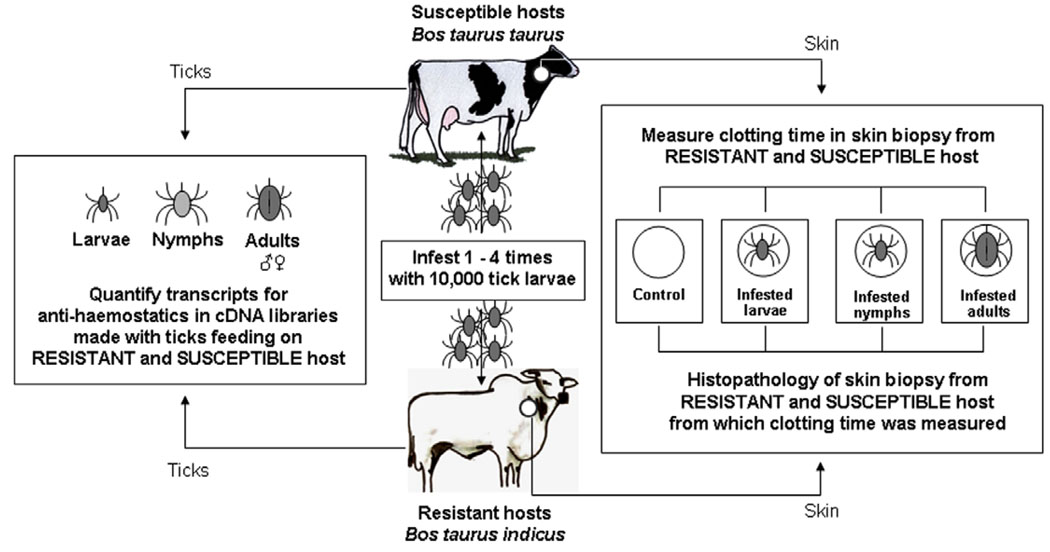
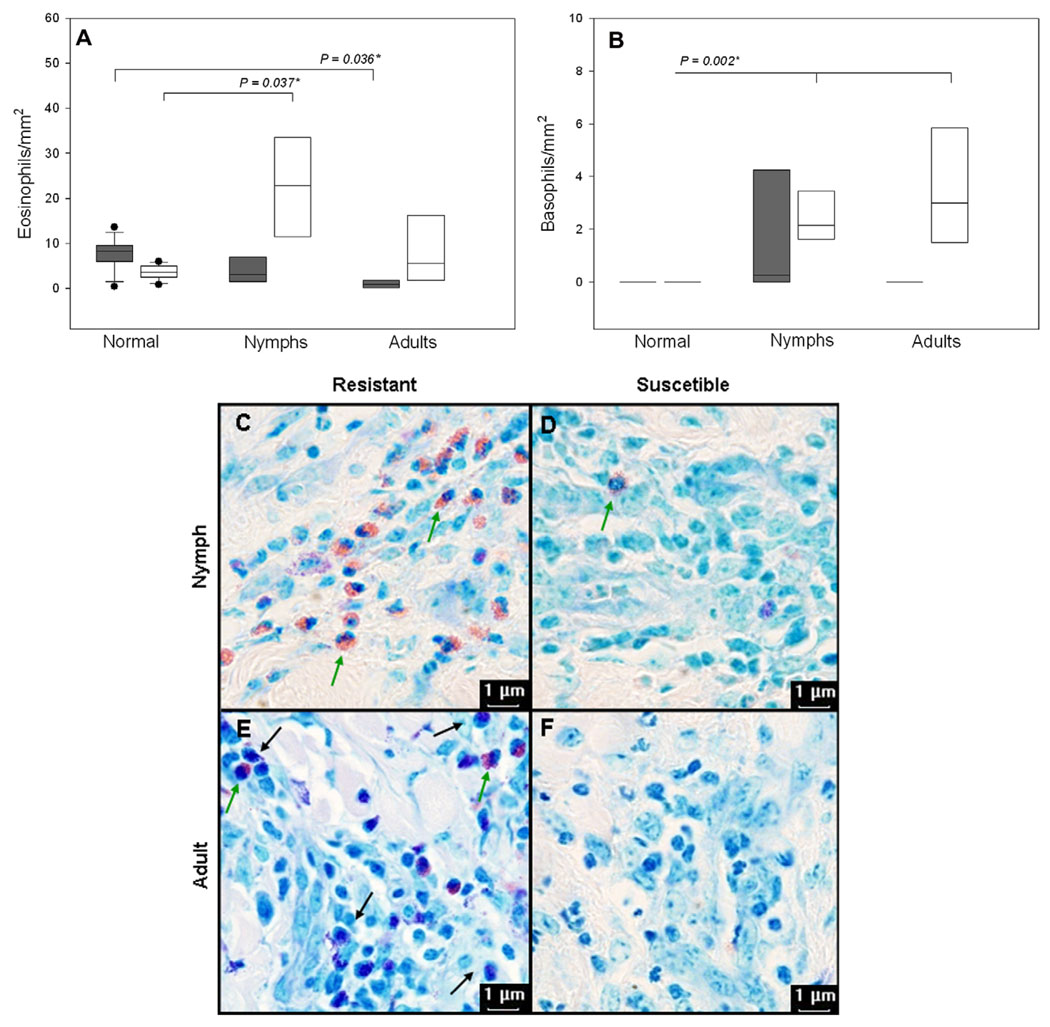
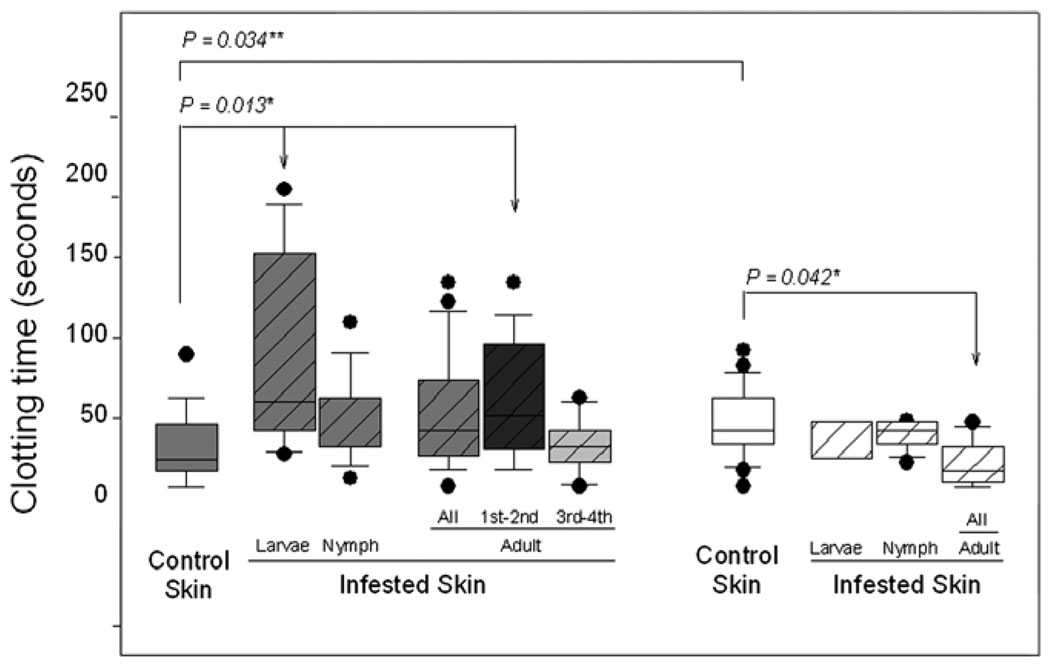
Ticks deposit saliva at the site of their attachment to a host in order to inhibit haemostasis, inflammation and innate and adaptive immune responses. The anti-haemostatic properties of tick saliva have been described by many studies, but few show that tick infestations or its anti-haemostatic components exert systemic effects in vivo. In the present study, we extended these observations and show that, compared with normal skin, bovine hosts that are genetically susceptible to tick infestations present an increase in the clotting time of blood collected from the immediate vicinity of haemorrhagic feeding pools in skin infested with different developmental stages of Rhipicepahlus microplus; conversely, we determined that clotting time of tick-infested skin from genetically resistant bovines was shorter than that of normal skin. Coagulation and inflammation have many components in common and we determined that in resistant bovines, eosinophils and basophils, which are known to contain tissue factor, are recruited in greater numbers to the inflammatory site of tick bites than in susceptible hosts. Finally, we correlated the observed differences in clotting times with the expression profiles of transcripts for putative anti-haemostatic proteins in different developmental stages of R. microplus fed on genetically susceptible and resistant hosts: we determined that transcripts coding for proteins similar to these molecules are overrepresented in salivary glands from nymphs and males fed on susceptible bovines. Our data indicate that ticks are able to modulate their host's local haemostatic reactions. In the resistant phenotype, larger amounts of inflammatory cells are recruited and expression of anti-coagulant molecules is decreased tick salivary glands, features that can hamper the tick's blood meal.
蜱在附着于宿主的部位分泌唾液,以抑制止血、炎症和先天及适应性免疫反应。许多研究描述了蜱唾液的抗止血特性,但很少有研究表明蜱感染或其抗止血成分在体内产生系统性效应。在本研究中,我们扩展了这些观察结果,并表明与正常皮肤相比,对蜱感染具有遗传易感性的牛宿主在受不同发育阶段 Rhipicephalus microplus 感染的皮肤出血性采食池附近采集的血液的凝血时间增加;相反,我们确定来自遗传抗性牛的感染蜱的皮肤的凝血时间短于正常皮肤。凝血和炎症有许多共同的成分,我们确定在抗性牛中,已知含有组织因子的嗜酸性粒细胞和嗜碱性粒细胞被募集到蜱叮咬的炎症部位的数量多于易感宿主。最后,我们将观察到的凝血时间差异与在易感和抗性宿主上不同发育阶段的 R. microplus 进食时推测的抗止血蛋白的转录物表达谱相关联:我们确定编码与这些分子相似的蛋白质的转录物在从易感牛进食的若虫和雄性的唾液腺中过度表达。我们的数据表明,蜱能够调节宿主的局部止血反应。在抗性表型中,募集了更多数量的炎症细胞,并且抗凝血分子的表达减少了蜱的唾液腺,这些特征可能会妨碍蜱的吸血。