Centre for Animal Science, Queensland Alliance for Agriculture and Food Innovation, The University of Queensland, St. Lucia, QLD, Australia.
Centre for Comparative Genomics, Murdoch University, Perth, WA, Australia.
Front Cell Infect Microbiol. 2017 Dec 11;7:506. doi: 10.3389/fcimb.2017.00506. eCollection 2017.
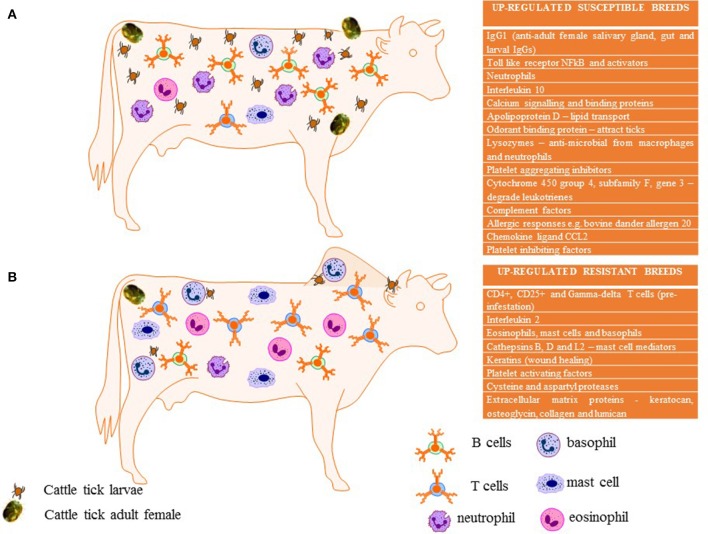
Ticks are able to transmit tick-borne infectious agents to vertebrate hosts which cause major constraints to public and livestock health. The costs associated with mortality, relapse, treatments, and decreased production yields are economically significant. Ticks adapted to a hematophagous existence after the vertebrate hemostatic system evolved into a multi-layered defense system against foreign invasion (pathogens and ectoparasites), blood loss, and immune responses. Subsequently, ticks evolved by developing an ability to suppress the vertebrate host immune system with a devastating impact particularly for exotic and crossbred cattle. Host genetics defines the immune responsiveness against ticks and tick-borne pathogens. To gain an insight into the naturally acquired resistant and susceptible cattle breed against ticks, studies have been conducted comparing the incidence of tick infestation on bovine hosts from divergent genetic backgrounds. It is well-documented that purebred and crossbred cattle are more resistant to ticks and tick-borne pathogens compared to purebred European cattle. Genetic studies identifying Quantitative Trait Loci markers using microsatellites and SNPs have been inconsistent with very low percentages relating phenotypic variation with tick infestation. Several skin gene expression and immunological studies have been undertaken using different breeds, different samples (peripheral blood, skin with tick feeding), infestation protocols and geographic environments. Susceptible breeds were commonly found to be associated with the increased expression of toll like receptors, MHC Class II, calcium binding proteins, and complement factors with an increased presence of neutrophils in the skin following tick feeding. Resistant breeds had higher levels of T cells present in the skin prior to tick infestation and thus seem to respond to ticks more efficiently. The skin of resistant breeds also contained higher numbers of eosinophils, mast cells and basophils with up-regulated proteases, cathepsins, keratins, collagens and extracellular matrix proteins in response to feeding ticks. Here we review immunological and molecular determinants that explore the cattle tick -host resistance phenomenon as well as contemplating new insights and future directions to study tick resistance and susceptibility, in order to facilitate interventions for tick control.
蜱能够将蜱传传染病病原体传播给脊椎动物宿主,这对公共卫生和畜牧业健康造成了重大限制。与死亡率、复发、治疗和产量下降相关的成本在经济上是巨大的。蜱在脊椎动物止血系统演变成针对外来入侵(病原体和外寄生虫)、失血和免疫反应的多层次防御系统后,适应了吸血生活。随后,蜱通过发展抑制脊椎动物宿主免疫系统的能力而进化,这对外国和杂交牛尤其具有破坏性。宿主遗传学决定了对蜱和蜱传病原体的免疫反应。为了深入了解对蜱具有天然抗性和敏感性的牛品种,已经进行了研究,比较了来自不同遗传背景的牛宿主的蜱感染发生率。有充分的文献记载,与纯种欧洲牛相比,纯种和杂交牛对蜱和蜱传病原体的抵抗力更强。使用微卫星和 SNP 鉴定数量性状基因座标记的遗传研究与与蜱感染相关的表型变异的百分比非常低不一致。已经进行了几项皮肤基因表达和免疫学研究,使用不同品种、不同样本(外周血、带蜱喂食的皮肤)、感染方案和地理环境。易感品种通常与 Toll 样受体、MHC Ⅱ类、钙结合蛋白和补体因子的表达增加有关,在蜱喂食后皮肤中的中性粒细胞增加。在感染蜱之前,抗性品种的皮肤中存在更多的 T 细胞,因此似乎对蜱的反应更有效。抗性品种的皮肤还含有更多的嗜酸性粒细胞、肥大细胞和嗜碱性粒细胞,以及上调的蛋白酶、组织蛋白酶、角蛋白、胶原蛋白和细胞外基质蛋白,以响应喂食的蜱。在这里,我们综述了探索牛蜱-宿主抗性现象的免疫学和分子决定因素,并思考了研究蜱抗性和敏感性的新见解和未来方向,以促进蜱控制干预。