Department of Neuropsychiatry, Seoul National University Hospital, Seoul, Korea.
Psychiatry Investig. 2008 Sep;5(3):155-62. doi: 10.4306/pi.2008.5.3.155. Epub 2008 Sep 30.
We investigated the influence of social support on health, quality of life (QOL), and the risk of depression in elderly Korean people.
This study was conducted as a part of the Korean Longitudinal Study on Health and Aging (KLoSHA). A total of 787 nondemented community-dwelling elderly aged 65 years or older were recruited and underwent clinical evaluations for dementia and psychiatric disorders conformed to Korean version of the Consortium to Establish a Registry for Alzheimer's Disease Clinical Assessment Battery (CERAD-K) and the Korean version of the Mini-International Neuropsychiatric Interview (MINI), respectively. Social support was assessed using the Medical Outcome Study Social Support Survey (MOS-SSS). Poor social support (PSS) was defined as having a MOS-SSS score below the 25(th) percentile of the entire sample. General health status was comprehensively evaluated using the modified Cumulative Illness Rating Scale (CIRS), the Korean version of the Geriatric Depression Scale (GDS-K), Mini-Mental Status Examination (MMSE-KC), Korean Activities of Daily Living (KADL), and Korean Instrumental Activities of Daily Living (KIADL). Health-related QOL was evaluated using the Short Form 36 (SF-36).
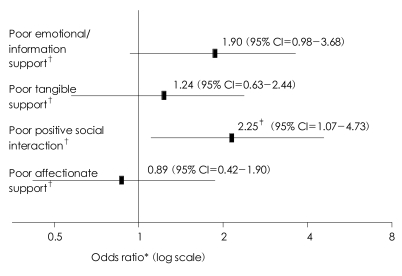
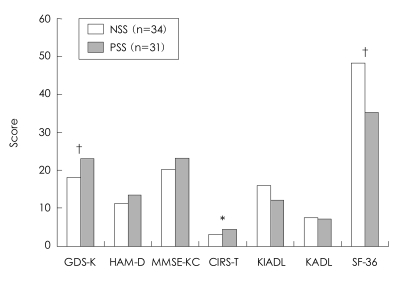
Low educational attainment and living alone were associated with PSS. Geriatric depression was more prevalent in the PSS group (OR=3.05, 95% CI=1.77-5.27) than in the normal social support (NSS) group. Among the various forms of social support, positive social interaction was significantly associated with risk of geriatric depression (OR=2.25, 95% CI=1.07-4.73). Although health-related QOL was lower in the PSS group than in the NSS group, the ADL and IADL scores of the subjects in the PSS group were better than those of the subjects in the NSS group. In the subjects with geriatric depression, PSS was associated with more severe depression, higher medical morbidity, and poor QOL.
PSS had a negative influence on the general health status and QOL among community-dwelling elderly and was an independent risk factor of geriatric depression.
本研究旨在探讨社会支持对韩国老年人健康、生活质量(QOL)和抑郁风险的影响。
本研究是韩国健康老龄化纵向研究(KLoSHA)的一部分。共纳入 787 名无痴呆的社区居住的 65 岁及以上老年人,并对其进行了痴呆和精神障碍的临床评估,分别符合韩国版认知障碍联盟临床评估成套测验(CERAD-K)和韩国版简易国际神经精神访谈(MINI)。社会支持采用医学结局研究社会支持量表(MOS-SSS)进行评估。较差的社会支持(PSS)定义为 MOS-SSS 评分低于全样本第 25 百分位数。使用改良累积疾病评分量表(CIRS)、韩国老年抑郁量表(GDS-K)、简易精神状态检查(MMSE-KC)、韩国日常生活活动量表(KADL)和韩国工具性日常生活活动量表(KIADL)对一般健康状况进行综合评估。采用健康调查简表 36 项(SF-36)评估健康相关生活质量。
低教育程度和独居与 PSS 相关。PSS 组老年抑郁的患病率高于正常社会支持(NSS)组(OR=3.05,95%CI=1.77-5.27)。在各种形式的社会支持中,积极的社会互动与老年抑郁的风险显著相关(OR=2.25,95%CI=1.07-4.73)。虽然 PSS 组的健康相关生活质量低于 NSS 组,但 PSS 组的日常生活活动和工具性日常生活活动评分均优于 NSS 组。在患有老年抑郁的患者中,PSS 与更严重的抑郁、更高的医疗发病率和较差的生活质量相关。
PSS 对社区居住的老年人的一般健康状况和生活质量有负面影响,是老年抑郁的独立危险因素。