Ann Gen Psychiatry. 2010 Jan 5;9(1):1. doi: 10.1186/1744-859X-9-1.
The aim of the current study was to assess the reliability and validity of the Greek translation of the Short Anxiety Screening Test (SAST), for use in primary care settings. The scale consists of 10 items and is a brief clinician rating scale for the detection of anxiety disorder in older people, particularly, in the presence of depression.
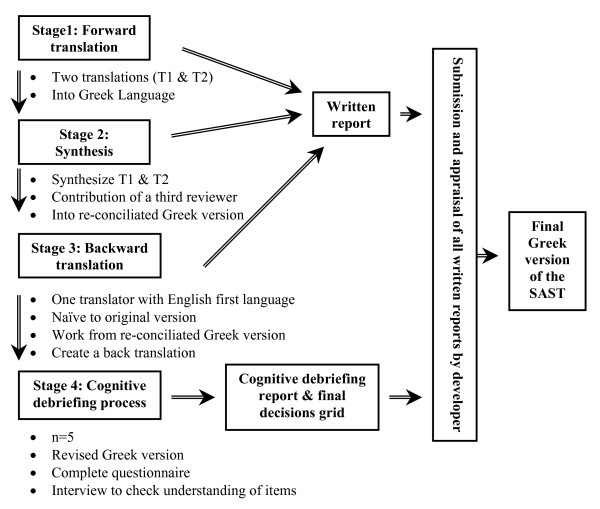
The study was performed in two rural primary care settings in Crete. The sample consisted of 99 older (76 +/- 6.3 years old) people, who fulfilled the participating criteria. The translation and cultural adaptation of the questionnaire was performed according to international standards. Internal consistency using the Cronbach alpha coefficient and test-retest reliability using the intraclass correlation coefficient (ICC) was used to assess the reliability of the tool. An exploratory factor analysis using Varimax with Kaiser normalisation (rotation method) was used to examine the structure of the instrument, and for the correlation of the items interitem correlation matrix was applied and assessed with Cronbach alpha.
Translation and backtranslation did not reveal any specific problems. The psychometric properties of the Greek version of the SAST scale in primary care were good. Internal consistency of the instrument was good, the Cronbach alpha was found to be 0.763 (P <0.001) and ICC (95% CI) for reproducibility was found to be 0.763 (0.686 to 0.827). Factor analysis revealed three factors with eigenvalues >1.0 accounting for 60% of variance, while the Cronbach alpha was >0.7 for every item.
The Greek translation of the SAST questionnaire is comparable with that of the original version in terms of reliability, and can be used in primary healthcare research. Its use in clinical practice should be primarily as a screening tool only at this stage, with a follow-up consisting of a detailed interview with the patient, in order to confirm the diagnosis.
本研究旨在评估希腊语版短焦虑筛查测试(SAST)的信度和效度,以供初级保健环境使用。该量表由 10 个项目组成,是一种用于检测老年人焦虑障碍的简短临床医生评定量表,尤其是在存在抑郁的情况下。
该研究在克里特岛的两个农村初级保健环境中进行。样本由 99 名老年人(76 ± 6.3 岁)组成,他们符合参与标准。根据国际标准进行了问卷的翻译和文化适应性调整。使用 Cronbach alpha 系数评估内部一致性,使用组内相关系数(ICC)评估测试-再测试可靠性,以评估工具的可靠性。使用 Varimax 与 Kaiser 标准化(旋转方法)进行探索性因子分析,以检查仪器的结构,以及应用和评估项目间相关性的项目间相关矩阵的 Cronbach alpha。
翻译和回译没有发现任何特定问题。初级保健中 SAST 量表的希腊语版本的心理测量特性良好。仪器的内部一致性良好,Cronbach alpha 为 0.763(P <0.001),可重复性的 ICC(95%CI)为 0.763(0.686 至 0.827)。因子分析显示,三个特征值>1.0 的因子占方差的 60%,而每个项目的 Cronbach alpha 均>0.7。
SAST 问卷的希腊语翻译在可靠性方面与原始版本相当,可用于初级保健研究。在现阶段,其在临床实践中的应用主要应作为一种筛查工具,后续应与患者进行详细访谈,以确认诊断。