Duke University Medical Center, Department of Psychiatry and Behavioral Sciences, DUMC Box 3527, Durham, NC 27710, USA.
The Johns Hopkins Hospital, Division of Child and Adolescent Psychiatry, 600 North Wolfe Street, Baltimore, MD 21287, USA.
Child Adolesc Psychiatry Ment Health. 2010 Jan 5;4:1. doi: 10.1186/1753-2000-4-1.
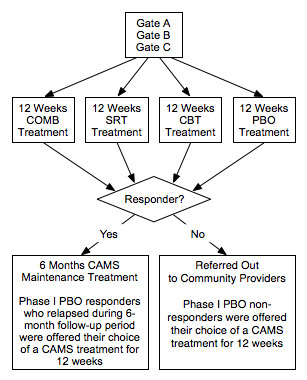
To present the design, methods, and rationale of the Child/Adolescent Anxiety Multimodal Study (CAMS), a recently completed federally-funded, multi-site, randomized placebo-controlled trial that examined the relative efficacy of cognitive-behavior therapy (CBT), sertraline (SRT), and their combination (COMB) against pill placebo (PBO) for the treatment of separation anxiety disorder (SAD), generalized anxiety disorder (GAD) and social phobia (SoP) in children and adolescents.
Following a brief review of the acute outcomes of the CAMS trial, as well as the psychosocial and pharmacologic treatment literature for pediatric anxiety disorders, the design and methods of the CAMS trial are described.
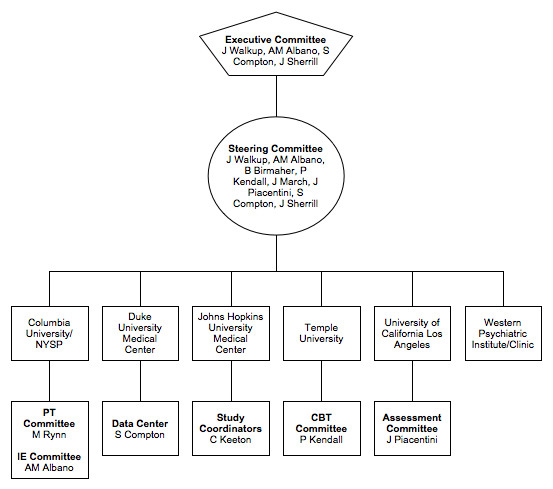
CAMS was a six-year, six-site, randomized controlled trial. Four hundred eighty-eight (N = 488) children and adolescents (ages 7-17 years) with DSM-IV-TR diagnoses of SAD, GAD, or SoP were randomly assigned to one of four treatment conditions: CBT, SRT, COMB, or PBO. Assessments of anxiety symptoms, safety, and functional outcomes, as well as putative mediators and moderators of treatment response were completed in a multi-measure, multi-informant fashion. Manual-based therapies, trained clinicians and independent evaluators were used to ensure treatment and assessment fidelity. A multi-layered administrative structure with representation from all sites facilitated cross-site coordination of the entire trial, study protocols and quality assurance.
CAMS offers a model for clinical trials methods applicable to psychosocial and psychopharmacological comparative treatment trials by using state-of-the-art methods and rigorous cross-site quality controls. CAMS also provided a large-scale examination of the relative and combined efficacy and safety of the best evidenced-based psychosocial (CBT) and pharmacologic (SSRI) treatments to date for the most commonly occurring pediatric anxiety disorders. Primary and secondary results of CAMS will hold important implications for informing practice-relevant decisions regarding the initial treatment of youth with anxiety disorders.
ClinicalTrials.gov NCT00052078.
介绍儿童/青少年焦虑多模态研究(CAMS)的设计、方法和原理,这是一项最近完成的联邦资助的多中心、随机安慰剂对照试验,旨在研究认知行为疗法(CBT)、舍曲林(SRT)及其组合(COMB)与安慰剂(PBO)治疗儿童和青少年分离焦虑症(SAD)、广泛性焦虑症(GAD)和社交恐惧症(SoP)的相对疗效。
在简要回顾 CAMS 试验的急性结果以及儿科焦虑障碍的心理社会和药物治疗文献后,描述了 CAMS 试验的设计和方法。
CAMS 是一项为期六年、六个地点、随机对照试验。488 名(N=488)符合 DSM-IV-TR 诊断标准的 SAD、GAD 或 SoP 儿童和青少年(年龄 7-17 岁)被随机分配到以下四种治疗条件之一:CBT、SRT、COMB 或 PBO。以多测量、多信息的方式评估焦虑症状、安全性和功能结果,以及治疗反应的潜在中介和调节因素。使用基于手册的疗法、经过培训的临床医生和独立评估者确保了治疗和评估的一致性。具有各地点代表的多层次管理结构促进了整个试验、研究方案和质量保证的跨地点协调。
CAMS 提供了一种适用于心理社会和心理药理学比较治疗试验的临床试验方法模型,采用了最先进的方法和严格的跨地点质量控制。CAMS 还对迄今为止最常见的儿科焦虑障碍的最佳证据心理社会(CBT)和药物(SSRIs)治疗的相对和联合疗效和安全性进行了大规模检查。CAMS 的主要和次要结果将对为焦虑障碍青年的初始治疗提供实践相关决策具有重要意义。
ClinicalTrials.gov NCT00052078。