Faculty of Health Sciences, University of Sydney, New South Wales, Australia.
Eur J Clin Nutr. 2010 Mar;64(3):280-8. doi: 10.1038/ejcn.2009.137. Epub 2010 Jan 6.
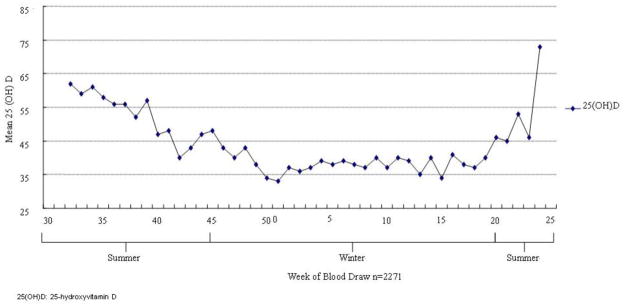
BACKGROUND/OBJECTIVES: As vitamin D deficiency is considered to be more common in regions with little solar ultraviolet (UV) light in winter, the aim of this study was to analyze predictors of vitamin D status by season within a large sample of male smokers from Finland, a country where there is negligible solar UV light in winter.
SUBJECTS/METHODS: Vitamin D (measured by 25-hydroxyvitamin D (25(OH)D) nmol/l) and other serum constituents were assayed. Measured anthropometry, and self-reported dietary intake and physical activity (PA) were obtained and analyzed using stepwise multiple linear and logistic regression in 2271 middle-aged Finnish male smokers.
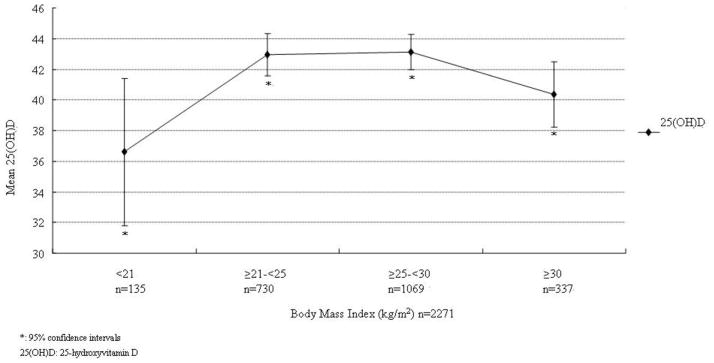
In all, 27% of the population in winter and 17% in summer had serum 25(OH)D levels of <25 nmol/l, respectively. In summer, in multiple logistic regression analyses with adjustment for confounding and other predictors, high vitamin D intake (odds ratios (OR) 3.6; 95% confidence interval (CI) 1.5-8.5), some leisure time PA (OR 2.0; 95% CI 1.3-3.1) and having a body mass index (BMI) of >or=21 kg/m(2) compared with <21 kg/m(2) (OR 2.6; 95% CI 1.3-5.0), were associated with 25(OH)D >or=25 nmol/l. In winter, additional modifiable factors were occupational PA (OR 1.6; 95% CI 1.1-2.5) and high fish (OR 3.1; 95% CI 1.7-6.2) or poultry consumption (OR 1.7; 95% CI 1.2-2.5). Predictors from linear regression analyses of continuous levels of 25(OH)D were similar to the logistic regression analyses of 25(OH)D >or=25 nmol/l.
In this Finnish sample more vitamin D intake, PA and having a BMI of >or=21 may have important modifiable roles in maintaining an adequate vitamin D status.
背景/目的:由于维生素 D 缺乏被认为在冬季阳光紫外线(UV)较少的地区更为常见,因此本研究旨在分析芬兰大量男性吸烟者中维生素 D 状态的季节预测因素,芬兰在冬季几乎没有太阳紫外线。
受试者/方法:测定了维生素 D(通过 25-羟基维生素 D(25(OH)D)nmol/L 测定)和其他血清成分。使用逐步多元线性和逻辑回归分析了 2271 名中年芬兰男性吸烟者的测量人体测量学、自我报告的饮食摄入和体力活动(PA)。
在冬季,人群中 27%,夏季 17%的血清 25(OH)D 水平<25nmol/L。在夏季,在调整混杂因素和其他预测因素的多元逻辑回归分析中,高维生素 D 摄入(比值比(OR)3.6;95%置信区间(CI)1.5-8.5)、一些休闲时间 PA(OR 2.0;95%CI 1.3-3.1)和 BMI 为>或=21kg/m(2)与<21kg/m(2)(OR 2.6;95%CI 1.3-5.0)相比,与 25(OH)D>或=25nmol/L 相关。在冬季,其他可改变的因素是职业 PA(OR 1.6;95%CI 1.1-2.5)和高鱼类(OR 3.1;95%CI 1.7-6.2)或家禽摄入(OR 1.7;95%CI 1.2-2.5)。25(OH)D 连续水平线性回归分析的预测因素与 25(OH)D>或=25nmol/L 的逻辑回归分析相似。
在这个芬兰样本中,更多的维生素 D 摄入、PA 和 BMI 为>或=21 可能在维持足够的维生素 D 状态方面具有重要的可改变作用。