Program on Work and Health in Central America (SALTRA), Central American Institute for Studies in Toxic Substances (IRET), Universidad Nacional, Heredia, Costa Rica.
Glob Health Action. 2009 Nov 11;2. doi: 10.3402/gha.v2i0.2062.
Climate change is producing major impacts including increasing temperatures in tropical countries, like Costa Rica, where the sugarcane industry employs thousands of workers who are exposed to extreme heat.
This article outlines a pilot qualitative evaluation of working conditions and heat in the sugarcane industry.
A literature review, direct observations and exploratory interviews with workers were conducted to reach a preliminary understanding of the dimensions of heat-related health issues in the sugarcane industry, as a basis for the design of future studies.
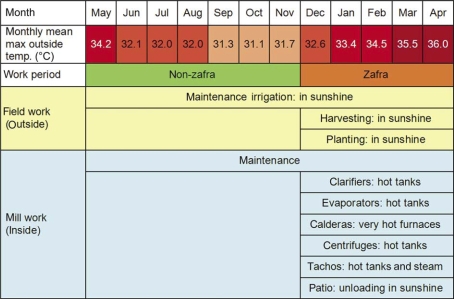
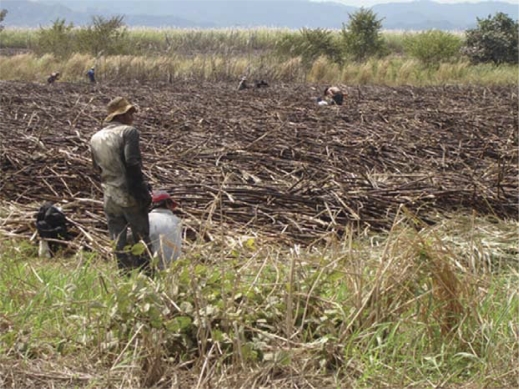
The industry employs temporary workers from Nicaragua and Costa Rica as well as year-round employees. Temporary employees work 12-hour shifts during the harvest and processing ('zafra') season. In many cases, sugarcane field workers are required to carry their own water and often have no access to shade. Sugar mill workers are exposed to different levels of heat stress depending upon their job tasks, with the most intense heat and workload experienced by the oven ('caldera') cleaners.
Research is needed to achieve better understanding of the multiple factors driving and interacting with heat exposures in the sugarcane industry in order to improve the health and safety of workers while maintaining worker productivity.
气候变化正在产生重大影响,包括提高温度在热带国家,如哥斯达黎加,那里的甘蔗业雇用了成千上万的工人,他们暴露在极端高温下。
本文概述了对甘蔗业工作条件和高温的初步定性评估。
进行了文献回顾、直接观察和对工人的探索性访谈,初步了解了甘蔗业与热有关的健康问题的各个方面,作为未来研究设计的基础。
该行业雇用了来自尼加拉瓜和哥斯达黎加的临时工以及常年雇员。临时工在收获和加工(“zafra”)季节期间轮班工作 12 小时。在许多情况下,甘蔗田工人需要携带自己的水,而且往往没有遮荫处。糖厂工人根据工作任务暴露在不同程度的热应激下,烤箱(“caldera”)清洁工经历的热和工作量最大。
需要进行研究,以更好地了解驱动和相互作用的多种因素,以便在保持工人生产力的同时,改善工人的健康和安全。