Gage Occupational and Environmental Health Unit, University of Toronto, Ontario, Canada.
Environ Health Perspect. 2010 Jan;118(1):120-4. doi: 10.1289/ehp.0900550.
Systemic inflammation may be one of the mechanisms mediating the association between ambient air pollution and cardiovascular morbidity and mortality. Interleukin-6 (IL-6) and fibrinogen are biomarkers of systemic inflammation that are independent risk factors for cardio-vascular disease.
We investigated the association between ambient air pollution and systemic inflammation using baseline measurements of IL-6 and fibrinogen from controlled human exposure studies.
In this retrospective analysis we used repeated-measures data in 45 nonsmoking subjects. Hourly and daily moving averages were calculated for ozone, nitrogen dioxide, sulfur dioxide, and particulate matter <or= 2.5 microm in aerodynamic diameter (PM2.5). Linear mixed-model regression determined the effects of the pollutants on systemic IL-6 and fibrinogen. Effect modification by season was considered.
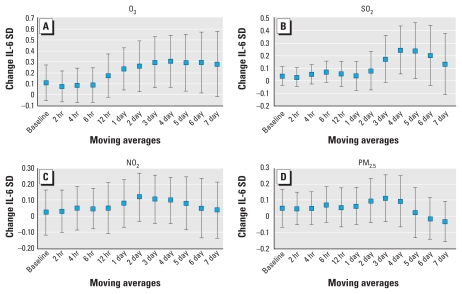
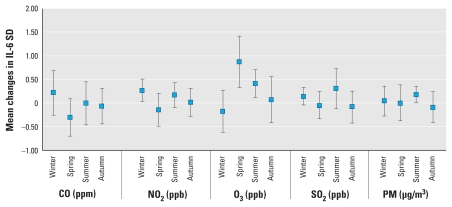
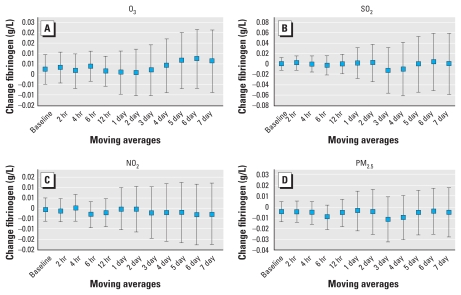
We observed a positive association between IL-6 and O3 [0.31 SD per O3 interquartile range (IQR); 95% confidence interval (CI), 0.080.54] and between IL-6 and SO2 (0.25 SD per SO2 IQR; 95% CI, 0.060.43). We observed the strongest effects using 4-day moving averages. Responses to pollutants varied by season and tended to be higher in the summer, particularly for O3 and PM2.5. Fibrinogen was not associated with pollution.
This study demonstrates a significant association between ambient pollutant levels and baseline levels of systemic IL-6. These findings have potential implications for controlled human exposure studies. Future research should consider whether ambient pollution exposure before chamber exposure modifies IL-6 response.
全身炎症可能是环境空气污染与心血管发病率和死亡率之间关联的机制之一。白细胞介素-6(IL-6)和纤维蛋白原是全身炎症的生物标志物,也是心血管疾病的独立危险因素。
我们通过对照人体暴露研究中的 IL-6 和纤维蛋白原的基线测量,研究了环境空气污染与全身炎症之间的关系。
在这项回顾性分析中,我们使用了 45 名不吸烟的受试者的重复测量数据。计算了臭氧、二氧化氮、二氧化硫和空气动力学直径<2.5 微米的颗粒物(PM2.5)的每小时和每日移动平均值。线性混合模型回归确定了污染物对全身 IL-6 和纤维蛋白原的影响。考虑了季节的效应修饰。
我们观察到 IL-6 与 O3 之间存在正相关[每 O3 四分位距(IQR)增加 0.31 SD;95%置信区间(CI),0.080.54],以及 IL-6 与 SO2 之间存在正相关[每 SO2 IQR 增加 0.25 SD;95% CI,0.060.43]。我们使用 4 天移动平均值观察到最强的效应。对污染物的反应因季节而异,夏季的反应往往更高,特别是对于 O3 和 PM2.5。纤维蛋白原与污染无关。
这项研究表明,环境污染物水平与全身 IL-6 的基线水平之间存在显著关联。这些发现对对照人体暴露研究具有潜在影响。未来的研究应考虑在进入舱室暴露之前暴露于环境污染物是否会改变 IL-6 的反应。