Yoshizawa Katsuhiko, Kuwata Maki, Kawanaka Ayako, Uehara Norihisa, Yuri Takashi, Tsubura Airo
Second Department of Pathology, Kansai Medical University, Moriguchi, Osaka, Japan.
Mol Vis. 2009 Dec 30;15:2919-25.
A single systemic administration of N-methyl-N-nitrosourea (MNU) causes retinal degeneration involving photoreceptor cell loss within 7 days. MNU-induced photoreceptor cell loss is due to apoptosis and is a reliable animal model for human retinitis pigmentosa. The purpose of this study was to determine if p53 contributes to the development of MNU-induced retinal degeneration in mice.
Eight-week-old p53(-/-), p53(+/-), and p53(+/+) mice received an intraperitoneal injection of 60 mg/kg bodyweight of MNU. Age-matched p53(+/+) mice received the vehicle only (physiologic saline containing 0.05% acetic acid). Mice were sacrificed and necropsied 7 days after the treatment. Both eyes were examined histologically and morphometrically to determine retinal thickness, photoreceptor cell ratio, and retinal damage ratio.
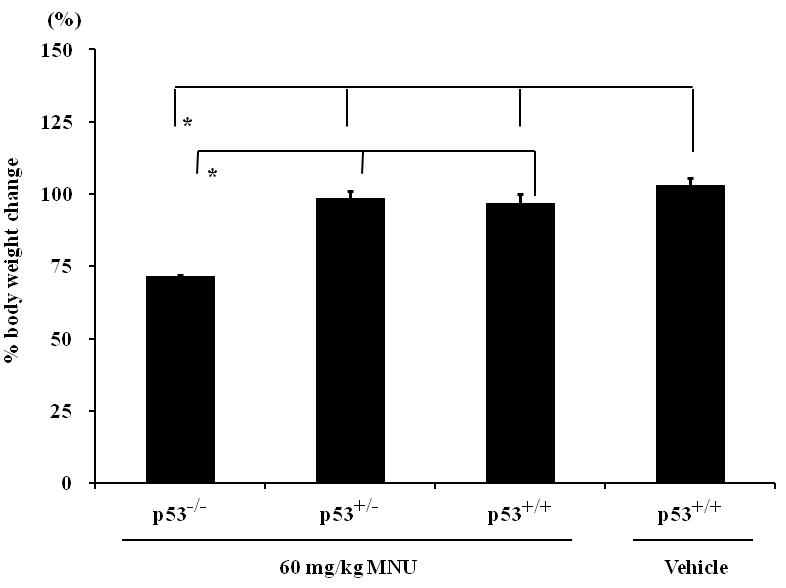
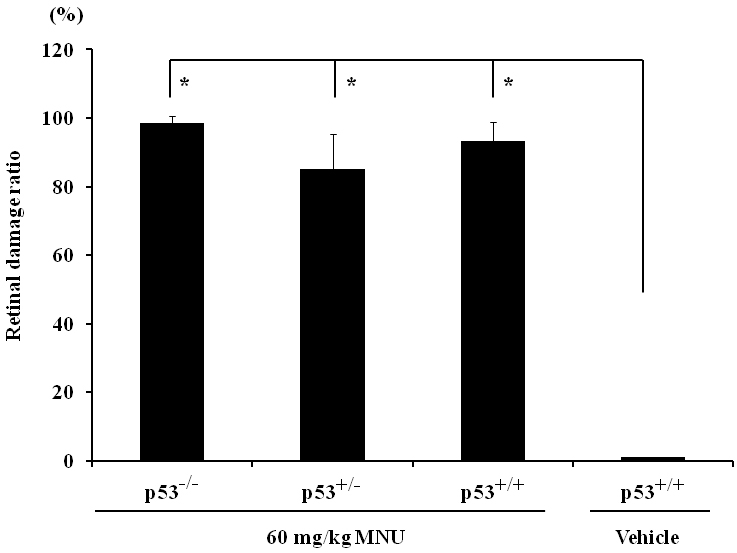
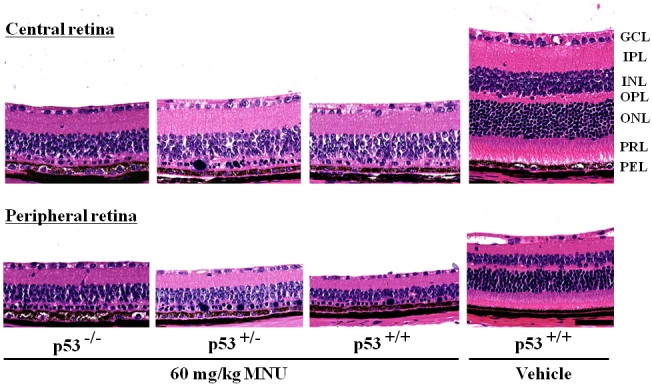
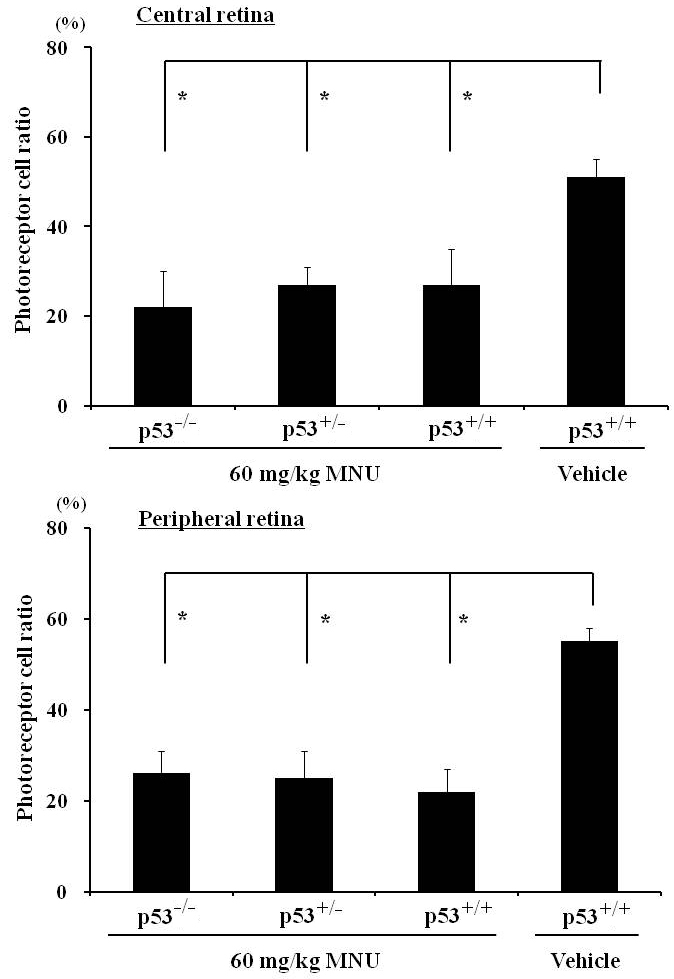
No mice died during the experiment, but the p53 null mice treated with MNU had a statistically significant weight loss compared to the other groups. Histologically, all MNU-treated mice, regardless of p53 gene status, experienced retinal degeneration characterized by photoreceptor cell loss (the disappearance of the outer nuclear layer and photoreceptor layer) in both the central and peripheral retina. All MNU-treated mice had significantly decreased retinal thickness and photoreceptor cell ratios at the central and peripheral retina and an increased retinal damage ratio compared to the vehicle-treated control. The retinal changes caused by MNU in p53(+/+), p53(+/-), and p53(-/-) mice were not significantly different and hence were related to a p53-independent apoptotic mechanism.
Because the absence of p53 did not prevent photoreceptor cell loss, we conclude that p53 is not essential for MNU-mediated photoreceptor cell degeneration.
单次全身给予N-甲基-N-亚硝基脲(MNU)可导致视网膜变性,在7天内出现光感受器细胞丢失。MNU诱导的光感受器细胞丢失是由凋亡引起的,是人类视网膜色素变性的可靠动物模型。本研究的目的是确定p53是否参与小鼠MNU诱导的视网膜变性的发生。
8周龄的p53(-/-)、p53(+/-)和p53(+/+)小鼠腹腔注射60mg/kg体重的MNU。年龄匹配的p53(+/+)小鼠仅接受溶剂(含0.05%乙酸的生理盐水)。治疗7天后处死小鼠并进行尸检。对双眼进行组织学和形态计量学检查,以确定视网膜厚度、光感受器细胞比例和视网膜损伤比例。
实验期间无小鼠死亡,但与其他组相比,用MNU处理的p53基因缺失小鼠体重有统计学意义的下降。组织学上,所有接受MNU处理的小鼠,无论p53基因状态如何,均出现视网膜变性,其特征是中央和周边视网膜的光感受器细胞丢失(外核层和光感受器层消失)。与溶剂处理的对照组相比,所有接受MNU处理的小鼠中央和周边视网膜的厚度和光感受器细胞比例均显著降低,视网膜损伤比例增加。MNU在p53(+/+)、p53(+/-)和p53(-/-)小鼠中引起的视网膜变化无显著差异,因此与p53非依赖性凋亡机制有关。
由于p53的缺失并未阻止光感受器细胞丢失,我们得出结论,p53对MNU介导的光感受器细胞变性并非必不可少。