Leibniz-Institute of Plant Genetics and Crop Plant Research (IPK), Corrensstr, 3, 06466 Gatersleben, Germany.
BMC Plant Biol. 2010 Jan 8;10:5. doi: 10.1186/1471-2229-10-5.
Association mapping is receiving considerable attention in plant genetics for its potential to fine map quantitative trait loci (QTL), validate candidate genes, and identify alleles of interest. In the present study association mapping in barley (Hordeum vulgare L.) is investigated by associating DNA polymorphisms with variation in grain quality traits, plant height, and flowering time to gain further understanding of gene functions involved in the control of these traits. We focused on the four loci BLZ1, BLZ2, BPBF and HvGAMYB that play a role in the regulation of B-hordein expression, the major fraction of the barley storage protein. The association was tested in a collection of 224 spring barley accessions using a two-stage mixed model approach.
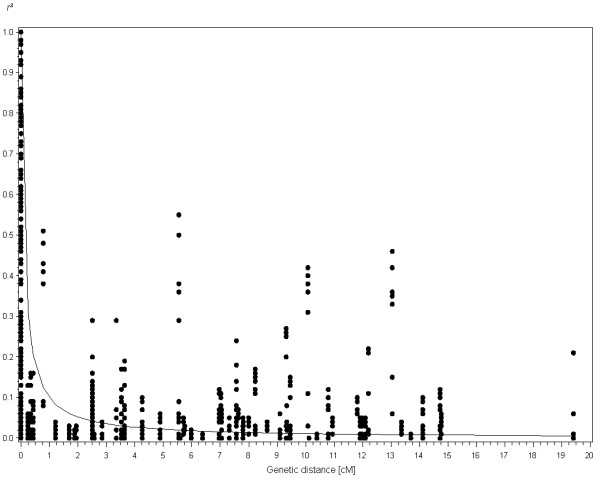
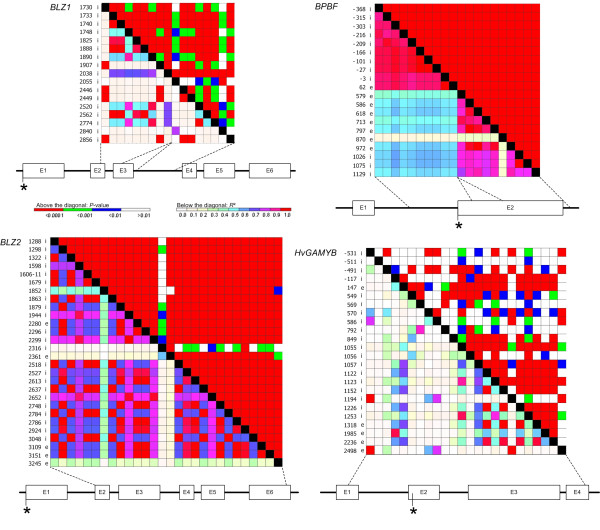
Within the sequenced fragments of four candidate genes we observed different levels of nucleotide diversity. The effect of selection on the candidate genes was tested by Tajima's D which revealed significant values for BLZ1, BLZ2, and BPBF in the subset of two-rowed barleys. Pair-wise LD estimates between the detected SNPs within each candidate gene revealed different intra-genic linkage patterns. On the basis of a more extensive examination of genomic regions surrounding the four candidate genes we found a sharp decrease of LD (r2<0.2 within 1 cM) in all but one flanking regions.Significant marker-trait associations between SNP sites within BLZ1 and flowering time, BPBF and crude protein content and BPBF and starch content were detected. Most haplotypes occurred at frequencies <0.05 and therefore were rejected from the association analysis. Based on haplotype information, BPBF was associated to crude protein content and starch content, BLZ2 showed association to thousand-grain weight and BLZ1 was found to be associated with flowering time and plant height.
Differences in nucleotide diversity and LD pattern within the candidate genes BLZ1, BLZ2, BPBF, and HvGAMYB reflect the impact of selection on the nucleotide sequence of the four candidate loci.Despite significant associations, the analysed candidate genes only explained a minor part of the total genetic variation although they are known to be important factors influencing the expression of seed quality traits. Therefore, we assume that grain quality as well as plant height and flowering time are influenced by many factors each contributing a small part to the expression of the phenotype. A genome-wide association analysis could provide a more comprehensive picture of loci involved in the regulation of grain quality, thousand grain weight and the other agronomic traits that were analyzed in this study. However, despite available high-throughput genotyping arrays the marker density along the barely genome is still insufficient to cover all associations in a whole genome scan. Therefore, the candidate gene-based approach will further play an important role in barley association studies.
关联作图在植物遗传学中受到了广泛关注,因为它有可能对数量性状位点(QTL)进行精细作图、验证候选基因,并鉴定感兴趣的等位基因。本研究通过关联 DNA 多态性与粒质量性状、株高和开花时间的变异,来研究大麦中的关联作图,以进一步了解控制这些性状的基因功能。我们专注于 BLZ1、BLZ2、BPBF 和 HvGAMYB 这四个位点,它们在 B-麦醇溶蛋白表达的调控中发挥作用,B-麦醇溶蛋白是大麦贮藏蛋白的主要成分。我们使用两阶段混合模型方法,在 224 个春大麦品系中测试了关联。
在四个候选基因的测序片段中,我们观察到不同水平的核苷酸多样性。通过 Tajima 的 D 检验候选基因的选择效应,发现 BLZ1、BLZ2 和 BPBF 在二棱大麦亚群中具有显著值。在每个候选基因内检测到的 SNP 之间的成对 LD 估计显示出不同的基因内连锁模式。基于对四个候选基因周围基因组区域的更广泛研究,我们发现除一个侧翼区域外,所有区域的 LD 都急剧下降(1cM 内 r2<0.2)。在 SNP 位点内 BLZ1 与开花时间、BPBF 与粗蛋白含量和 BPBF 与淀粉含量之间检测到显著的标记-性状关联。大多数单倍型的频率<0.05,因此被排除在关联分析之外。基于单倍型信息,BPBF 与粗蛋白含量和淀粉含量相关,BLZ2 与千粒重相关,BLZ1 与开花时间和株高相关。
候选基因 BLZ1、BLZ2、BPBF 和 HvGAMYB 内核苷酸多样性和 LD 模式的差异反映了选择对四个候选位点核苷酸序列的影响。尽管存在显著关联,但分析的候选基因仅解释了总遗传变异的一小部分,尽管它们是影响种子质量性状表达的重要因素。因此,我们假设谷物质量以及株高和开花时间受许多因素影响,每个因素对表型的表达贡献一小部分。全基因组关联分析可以提供一个更全面的图像,参与调节谷物质量、千粒重和其他在本研究中分析的农艺性状的基因。然而,尽管有可用的高通量基因分型芯片,但大麦基因组中的标记密度仍然不足以覆盖整个全基因组扫描中的所有关联。因此,候选基因方法将在大麦关联研究中进一步发挥重要作用。