Maurer Andreas, Draba Vera, Pillen Klaus
Institute of Agricultural and Nutritional Sciences, Martin Luther University Halle-Wittenberg, Betty-Heimann-Str. 3, 06120 Halle, Germany.
Institute of Agricultural and Nutritional Sciences, Martin Luther University Halle-Wittenberg, Betty-Heimann-Str. 3, 06120 Halle, Germany. Interdisciplinary Center for Crop Plant Research (IZN), Betty-Heimann-Str. 3, 06120 Halle, Germany.
J Exp Bot. 2016 Apr;67(8):2507-18. doi: 10.1093/jxb/erw070. Epub 2016 Mar 1.
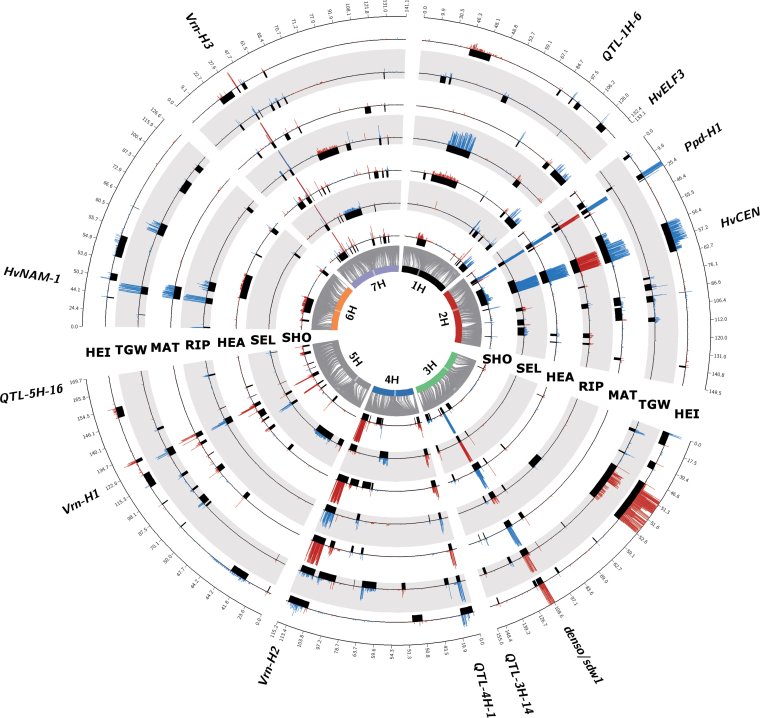
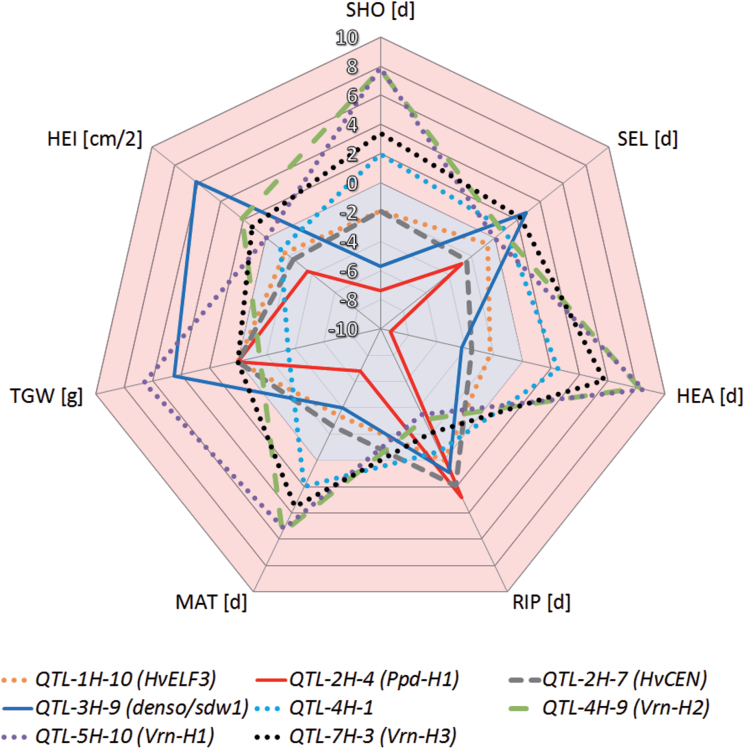
Flowering time is a key agronomic trait that plays an important role in crop yield. There is growing interest in dissecting the developmental subphases of flowering to better understand and fine-tune plant development and maximize yield. To do this, we used the wild barley nested association mapping (NAM) population HEB-25, comprising 1420 BC1S3 lines, to map quantitative trait loci (QTLs) controlling five developmental traits, plant height, and thousand grain weight. Genome-wide association studies (GWAS) enabled us to locate a total of 89 QTLs that genetically regulate the seven investigated traits. Several exotic QTL alleles proved to be highly effective and potentially useful in barley breeding. For instance, thousand grain weight was increased by 4.5 g and flowering time was reduced by 9.3 days by substituting Barke elite QTL alleles for exotic QTL alleles at the denso/sdw1 and the Ppd-H1 loci, respectively. We showed that the exotic allele at the semi-dwarf locus denso/sdw1 can be used to increase grain weight since it uncouples the negative correlation between shoot elongation and the ripening phase. Our study demonstrates that nested association mapping of HEB-25 can help unravel the genetic regulation of plant development and yield formation in barley. Moreover, since we detected numerous useful exotic QTL alleles in HEB-25, we conclude that the introgression of these wild barley alleles into the elite barley gene pool may enable developmental phases to be specifically fine-tuned in order to maximize thousand grain weight and, potentially, yield in the long term.
开花时间是一个关键的农艺性状,对作物产量起着重要作用。人们越来越有兴趣剖析开花的发育亚阶段,以更好地理解和微调植物发育并实现产量最大化。为此,我们使用了由1420个BC1S3株系组成的野生大麦巢式关联作图(NAM)群体HEB - 25,来定位控制五个发育性状、株高和千粒重的数量性状基因座(QTL)。全基因组关联研究(GWAS)使我们能够定位总共89个从基因上调控所研究的七个性状的QTL。几个外来QTL等位基因被证明在大麦育种中非常有效且可能有用。例如,通过分别在denso/sdw1和Ppd - H1基因座用外来QTL等位基因替代Barke优良QTL等位基因,千粒重增加了4.5克,开花时间缩短了9.3天。我们表明,半矮秆基因座denso/sdw1处的外来等位基因可用于增加粒重,因为它消除了茎伸长与成熟阶段之间的负相关。我们的研究表明,HEB - 25的巢式关联作图有助于揭示大麦中植物发育和产量形成的遗传调控。此外,由于我们在HEB - 25中检测到许多有用的外来QTL等位基因,我们得出结论,将这些野生大麦等位基因渗入优良大麦基因库可能使发育阶段得到特异性微调,以便从长远来看使千粒重最大化,并有可能提高产量。