Department Surgery, University of Florida College of Medicine, Gainesville, FL 32610, USA.
J Exp Med. 2010 Feb 15;207(2):319-26. doi: 10.1084/jem.20091959. Epub 2010 Jan 13.
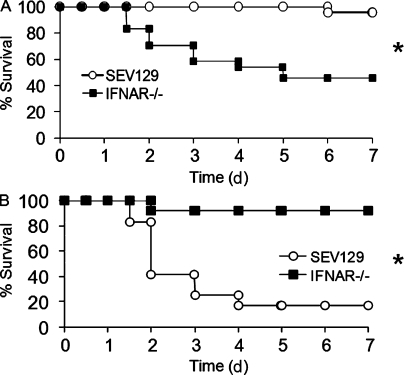
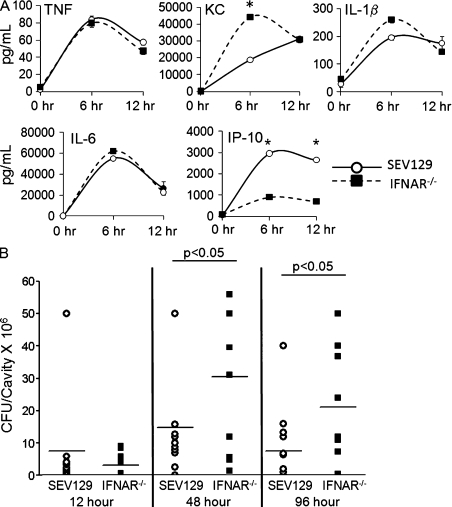
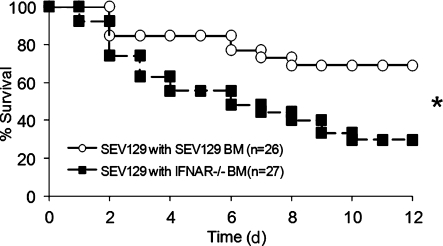
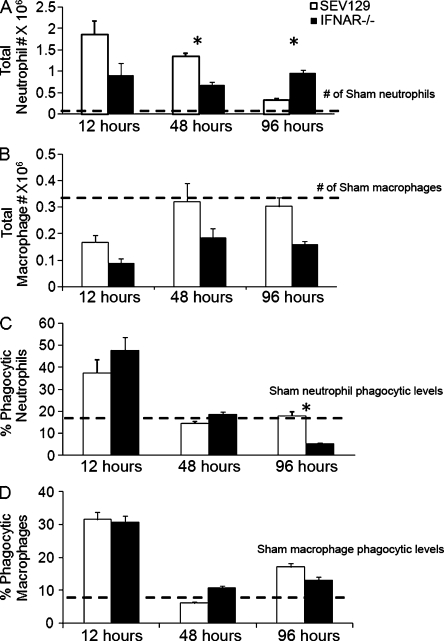
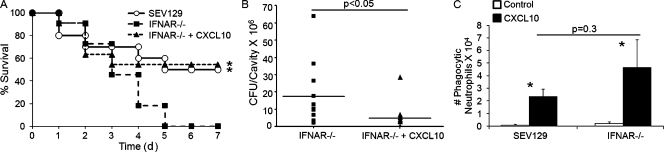
Type I interferon (IFN) alpha/beta is critical for host defense. During endotoxicosis or highly lethal bacterial infections where systemic inflammation predominates, mice deficient in IFN-alpha/beta receptor (IFNAR) display decreased systemic inflammation and improved outcome. However, human sepsis mortality often occurs during a prolonged period of immunosuppression and not from exaggerated inflammation. We used a low lethality cecal ligation and puncture (CLP) model of sepsis to determine the role of type I IFNs in host defense during sepsis. Despite increased endotoxin resistance, IFNAR(-/-) and chimeric mice lacking IFNAR in hematopoietic cells display increased mortality to CLP. This was not associated with an altered early systemic inflammatory response, except for decreased CXCL10 production. IFNAR(-/-) mice display persistently elevated peritoneal bacterial counts compared with wild-type mice, reduced peritoneal neutrophil recruitment, and recruitment of neutrophils with poor phagocytic function despite normal to enhanced adaptive immune function during sepsis. Importantly, CXCL10 treatment of IFNAR(-/-) mice improves survival and decreases peritoneal bacterial loads, and CXCL10 increases mouse and human neutrophil phagocytosis. Using a low lethality sepsis model, we identify a critical role of type I IFN-dependent CXCL10 in host defense during polymicrobial sepsis by increasing neutrophil recruitment and function.
I 型干扰素 (IFN)α/β 对于宿主防御至关重要。在全身性炎症占主导地位的内毒素血症或高致死性细菌感染期间,缺乏 IFN-α/β 受体 (IFNAR) 的小鼠表现出全身炎症减少和预后改善。然而,人类败血症的死亡率通常发生在长时间的免疫抑制期,而不是由于炎症过度。我们使用低致死性盲肠结扎和穿刺 (CLP) 败血症模型来确定 I 型 IFNs 在败血症期间宿主防御中的作用。尽管对内毒素的抵抗力增加,但缺乏造血细胞 IFNAR 的 IFNAR(-/-) 和嵌合小鼠对 CLP 的死亡率更高。这与早期全身性炎症反应的改变无关,除了 CXCL10 产生减少。与野生型小鼠相比,IFNAR(-/-) 小鼠的腹膜细菌计数持续升高,腹膜中性粒细胞募集减少,吞噬功能差的中性粒细胞募集,尽管在败血症期间适应性免疫功能正常至增强。重要的是,CXCL10 治疗 IFNAR(-/-) 小鼠可提高存活率并降低腹膜细菌负荷,并且 CXCL10 增加了小鼠和人中性粒细胞的吞噬作用。使用低致死性败血症模型,我们确定了 I 型 IFN 依赖性 CXCL10 在多微生物败血症期间通过增加中性粒细胞募集和功能来发挥宿主防御的关键作用。