Rheumatology Research Unit, Instituto de Medicina Molecular, Faculdade de Medicina da Universidade de Lisboa, 1649-028 Lisbon, Portugal.
Arthritis Res Ther. 2010;12(1):R9. doi: 10.1186/ar2908. Epub 2010 Jan 15.
In this study we used a mice model of chronic arthritis to evaluate if bone fragility induced by chronic inflammation is associated with an imbalance in bone turnover and also a disorganization of the bone type I collagen network.
Serum, vertebrae and femur bones were collected from eight-month-old polyarthritis SKG mice and controls. Strength of the femoral bones was evaluated using three-point bending tests and density was assessed with a pycnometer. Bone turnover markers carboxy-terminal collagen cross-linking telopeptides (CTX-I) and amino-terminal propeptide of type I procollagen (PINP) were measured in serum. The organization and density of bone collagen were analyzed in vertebrae using second-harmonic generation (SHG) imaging with a two-photon microscope and trabecular bone microstructure was assessed by scanning electron microscope (SEM).
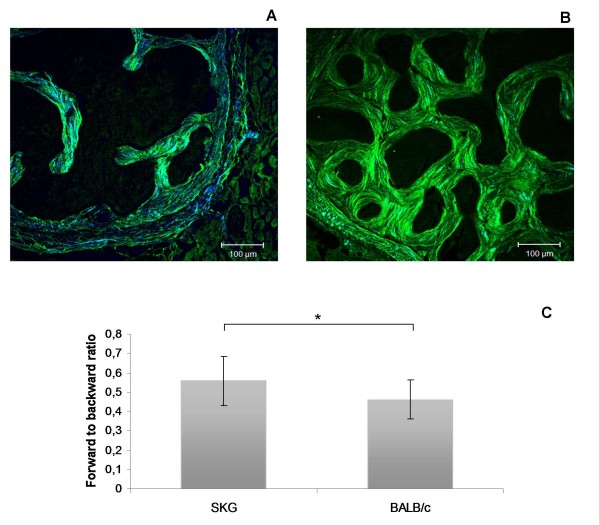
Femoral bones of SKG mice revealed increased fragility expressed by deterioration of mechanical properties, namely altered stiffness (P = 0.007) and reduced strength (P = 0.006), when compared to controls. Accordingly, inter-trabecular distance and trabecular thickness as observed by SEM were reduced in SKG mice. PINP was significantly higher in arthritic mice (9.18 +/- 3.21 ng/ml) when compared to controls (1.71 +/- 0.53 ng/ml, P < 0.001). Bone resorption marker CTX-I was 9.67 +/- 3.18 ng/ml in arthritic SKG mice compared to 6.23 +/- 4.11 ng/ml in controls (P = 0.176). The forward-to-backward signal ratio measured by SHG was higher in SKG animals, reflecting disorganized matrix and loose collagen structure, compared to controls.
We have shown for the first time that chronic arthritis by itself impairs bone matrix architecture, probably due to disturbed bone remodeling and increased collagen turnover. This effect might predispose patients to bone fragility fractures.
在这项研究中,我们使用慢性关节炎的小鼠模型来评估慢性炎症引起的骨脆弱是否与骨转换失衡以及 I 型胶原网络紊乱有关。
从 8 个月大的多关节炎 SKG 小鼠和对照小鼠中收集血清、椎骨和股骨。使用三点弯曲试验评估股骨的强度,使用比重瓶评估密度。在血清中测量骨转换标志物羧基末端胶原交联肽(CTX-I)和 I 型前胶原氨基末端肽(PINP)。使用双光子显微镜的二次谐波产生(SHG)成像分析椎骨中骨胶原的组织和密度,并通过扫描电子显微镜(SEM)评估小梁骨微观结构。
与对照组相比,SKG 小鼠的股骨表现出机械性能恶化,即刚度降低(P = 0.007)和强度降低(P = 0.006),表明脆性增加。因此,SKG 小鼠的骨小梁间距离和骨小梁厚度减小。关节炎小鼠的 PINP 明显高于对照组(9.18 +/- 3.21 ng/ml 对 1.71 +/- 0.53 ng/ml,P < 0.001)。关节炎 SKG 小鼠的骨吸收标志物 CTX-I 为 9.67 +/- 3.18 ng/ml,而对照组为 6.23 +/- 4.11 ng/ml(P = 0.176)。与对照组相比,SHG 测量的前向后信号比更高,反映了基质紊乱和胶原结构疏松。
我们首次表明,慢性关节炎本身会损害骨基质结构,可能是由于骨重塑紊乱和胶原周转增加所致。这种影响可能使患者易患脆性骨折。