Tianjin Economic-Technological Development Area School of Biological Sciences and Biotechnology, Nankai University, Tianjin, China.
PLoS One. 2010 Jan 14;5(1):e8700. doi: 10.1371/journal.pone.0008700.
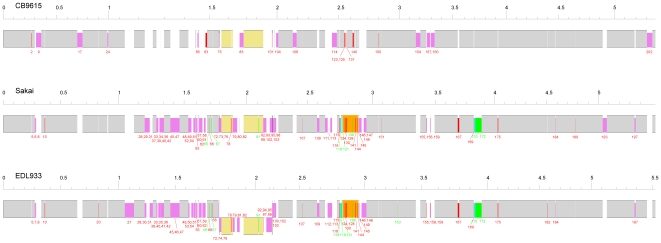
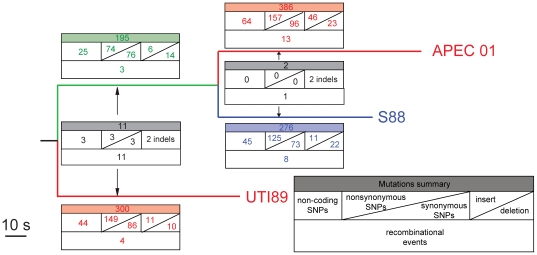
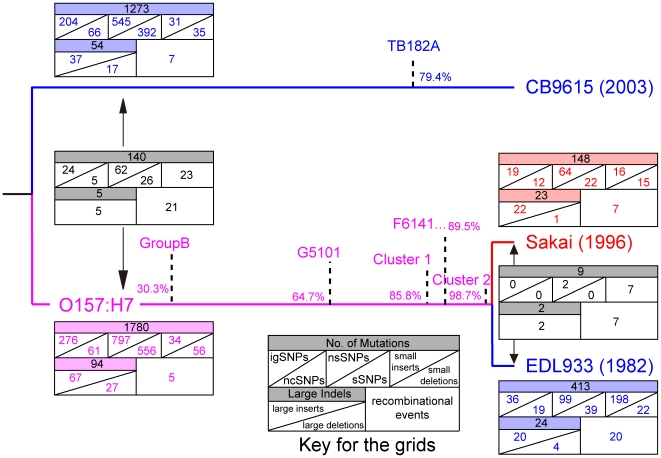
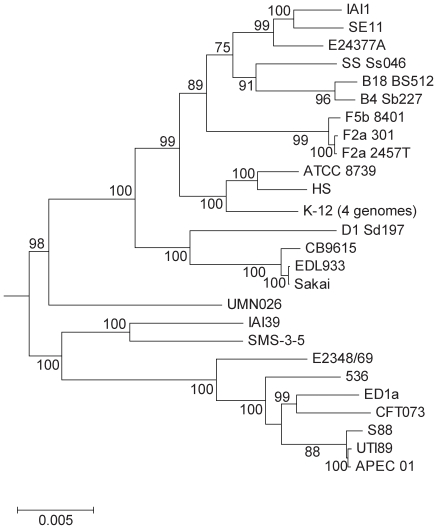
There are 29 E. coli genome sequences available, mostly related to studies of species diversity or mode of pathogenicity, including two genomes of the well-known O157:H7 clone. However, there have been no genome studies of closely related clones aimed at exposing the details of evolutionary change. Here we sequenced the genome of an O55:H7 strain, closely related to the major pathogenic O157:H7 clone, with published genome sequences, and undertook comparative genomic and proteomic analysis. We were able to allocate most differences between the genomes to individual mutations, recombination events, or lateral gene transfer events, in specific lineages. Major differences include a type II secretion system present only in the O55:H7 chromosome, fewer type III secretion system effectors in O55:H7, and 19 phage genomes or phagelike elements in O55:H7 compared to 23 in O157:H7, with only three common to both. Many other changes were found in both O55:H7 and O157:H7 lineages, but in general there has been more change in the O157:H7 lineages. For example, we found 50% more synonymous mutational substitutions in O157:H7 compared to O55:H7. The two strains also diverged at the proteomic level. Mutational synonymous SNPs were used to estimate a divergence time of 400 years using a new clock rate, in contrast to 14,000 to 70,000 years using the traditional clock rates. The same approaches were applied to three closely related extraintestinal pathogenic E. coli genomes, and similar levels of mutation and recombination were found. This study revealed for the first time the full range of events involved in the evolution of the O157:H7 clone from its O55:H7 ancestor, and suggested that O157:H7 arose quite recently. Our findings also suggest that E. coli has a much lower frequency of recombination relative to mutation than was observed in a comparable study of a Vibrio cholerae lineage.
有 29 个大肠杆菌基因组序列可供使用,这些序列主要与物种多样性或致病性模式相关,包括两个著名的 O157:H7 克隆的基因组。然而,对于密切相关的克隆,还没有进行旨在揭示进化变化细节的基因组研究。在这里,我们对 O55:H7 菌株进行了测序,该菌株与主要致病性 O157:H7 克隆的基因组序列密切相关,并进行了比较基因组和蛋白质组分析。我们能够将基因组之间的大多数差异分配给特定谱系中的单个突变、重组事件或水平基因转移事件。主要差异包括仅存在于 O55:H7 染色体中的 II 型分泌系统、O55:H7 中较少的 III 型分泌系统效应物以及与 O157:H7 相比在 O55:H7 中发现的 19 个噬菌体基因组或类似噬菌体的元件,而两者共有 3 个。在 O55:H7 和 O157:H7 谱系中都发现了许多其他变化,但总体而言,O157:H7 谱系中的变化更多。例如,我们发现 O157:H7 中的同义突变替换比 O55:H7 多 50%。这两个菌株在蛋白质组水平上也存在差异。使用新的时钟率,通过突变同义 SNP 估计了 400 年的分歧时间,而使用传统时钟率则估计为 14000 至 70000 年。相同的方法应用于三个密切相关的肠外致病性大肠杆菌基因组,发现了类似水平的突变和重组。这项研究首次揭示了 O157:H7 克隆从其 O55:H7 祖先进化过程中涉及的全部事件,并表明 O157:H7 是最近才出现的。我们的研究结果还表明,与霍乱弧菌谱系的一项类似研究相比,大肠杆菌的重组频率相对突变频率要低得多。