Centre of Excellence in Genomics (CEG), International Crops Research Institute for the Semi-Arid Tropics (ICRISAT), Patancheru, 502324, Andhra Pradesh, India.
Theor Appl Genet. 2010 May;120(7):1415-41. doi: 10.1007/s00122-010-1265-1. Epub 2010 Jan 23.
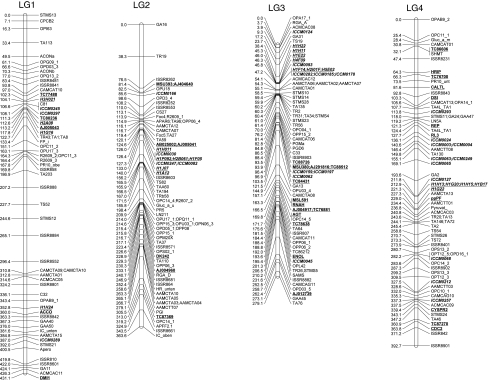
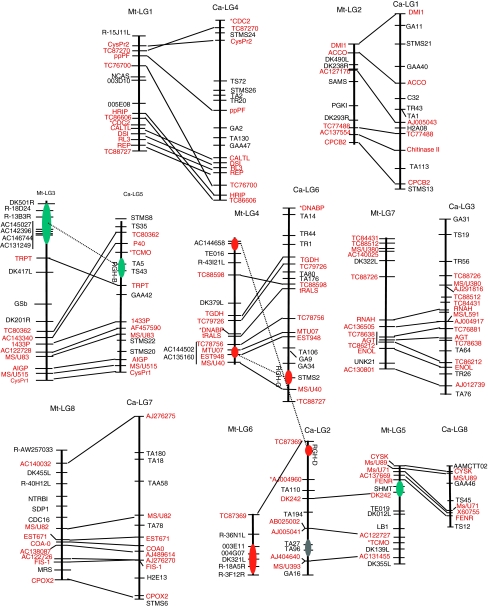
This study presents the development and mapping of simple sequence repeat (SSR) and single nucleotide polymorphism (SNP) markers in chickpea. The mapping population is based on an inter-specific cross between domesticated and non-domesticated genotypes of chickpea (Cicer arietinum ICC 4958 x C. reticulatum PI 489777). This same population has been the focus of previous studies, permitting integration of new and legacy genetic markers into a single genetic map. We report a set of 311 novel SSR markers (designated ICCM-ICRISAT chickpea microsatellite), obtained from an SSR-enriched genomic library of ICC 4958. Screening of these SSR markers on a diverse panel of 48 chickpea accessions provided 147 polymorphic markers with 2-21 alleles and polymorphic information content value 0.04-0.92. Fifty-two of these markers were polymorphic between parental genotypes of the inter-specific population. We also analyzed 233 previously published (H-series) SSR markers that provided another set of 52 polymorphic markers. An additional 71 gene-based SNP markers were developed from transcript sequences that are highly conserved between chickpea and its near relative Medicago truncatula. By using these three approaches, 175 new marker loci along with 407 previously reported marker loci were integrated to yield an improved genetic map of chickpea. The integrated map contains 521 loci organized into eight linkage groups that span 2,602 cM, with an average inter-marker distance of 4.99 cM. Gene-based markers provide anchor points for comparing the genomes of Medicago and chickpea, and reveal extended synteny between these two species. The combined set of genetic markers and their integration into an improved genetic map should facilitate chickpea genetics and breeding, as well as translational studies between chickpea and Medicago.
本研究旨在开发和定位菜豆简单重复序列(SSR)和单核苷酸多态性(SNP)标记。该作图群体基于菜豆驯化和非驯化基因型(Cicer arietinum ICC 4958 x C. reticulatum PI 489777)的种间杂交。该群体已成为先前研究的重点,使新的和传统的遗传标记能够整合到单个遗传图谱中。我们报告了一组 311 个新的 SSR 标记(命名为 ICCM-ICRISAT 菜豆微卫星),这些标记来自 ICC 4958 的 SSR 富集基因组文库。在一个多样化的 48 个菜豆品系的群体中筛选这些 SSR 标记,提供了 147 个多态性标记,每个标记有 2-21 个等位基因,多态信息含量值为 0.04-0.92。这些标记中有 52 个在种间群体的亲本基因型之间是多态的。我们还分析了 233 个先前发表的(H 系列)SSR 标记,这些标记提供了另一组 52 个多态性标记。从高度保守的菜豆和近缘植物蒺藜苜蓿的转录序列中开发了另外 71 个基于基因的 SNP 标记。通过使用这三种方法,共整合了 175 个新的标记位点和 407 个先前报道的标记位点,以获得菜豆的改良遗传图谱。该整合图谱包含 521 个位点,分为 8 个连锁群,跨度为 2602cM,平均标记间距离为 4.99cM。基于基因的标记为比较蒺藜苜蓿和菜豆的基因组提供了锚点,并揭示了这两个物种之间的扩展同线性。综合遗传标记集及其整合到改良遗传图谱中,应有助于菜豆遗传学和育种,以及菜豆和蒺藜苜蓿之间的转化研究。