Department of Psychiatry, University of Minnesota, MMC 392, Minneapolis, MN 55455, USA.
Psychopharmacology (Berl). 2010 Mar;209(1):113-25. doi: 10.1007/s00213-010-1776-0. Epub 2010 Jan 30.
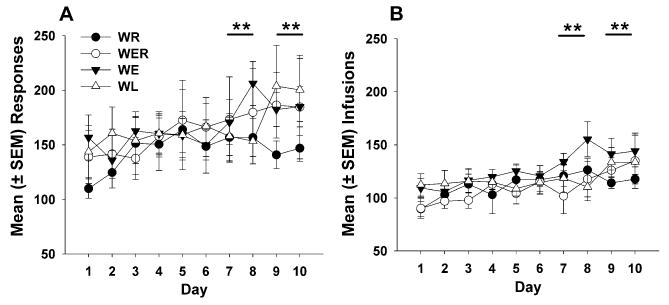
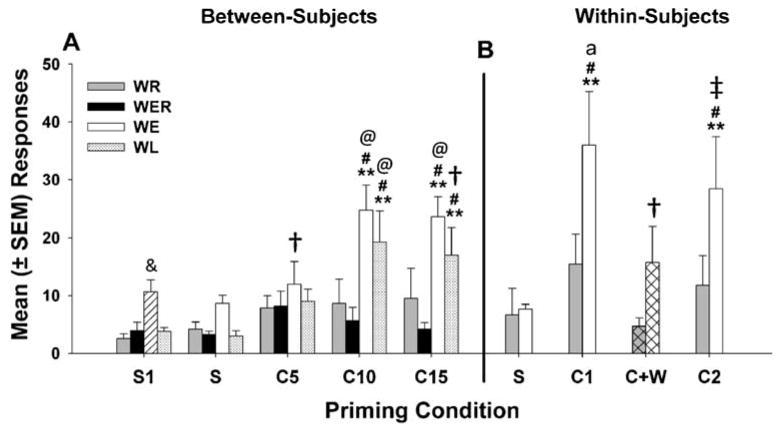
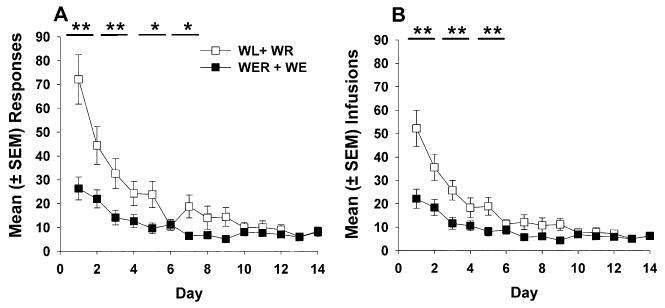
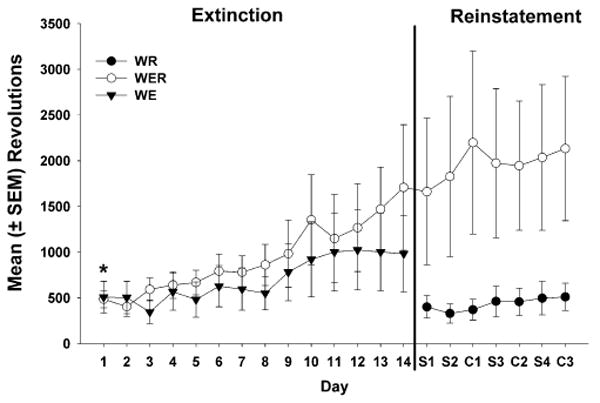
Previous work has shown that wheel running reduced the maintenance of cocaine self-administration in rats. In the present study, the effect of wheel running on extinction and reinstatement of cocaine seeking was examined. Female rats were trained to run in a wheel during 6-h sessions, and they were then catheterized and placed in an operant conditioning chamber where they did not have access to the wheel but were allowed to self-administer iv cocaine. Subsequently, rats were divided into four groups and were tested on the extinction and reinstatement of cocaine seeking while they had varying access to a wheel in an adjoining compartment. The four groups were assigned to the following wheel access conditions: (1) wheel running during extinction and reinstatement (WER), (2) wheel running during extinction and a locked wheel during reinstatement (WE), (3) locked wheel during extinction and wheel running during reinstatement (WR), and (4) locked wheel during extinction and reinstatement (WL). WE and WR were retested later to examine the effect of one session of wheel access on cocaine-primed reinstatement.
There were no group differences in wheel revolutions, in rate of acquisition of cocaine self-administration, or in responding during maintenance when there was no wheel access. However, during extinction, WE and WER responded less than WR and WL. WR and WER had lower cocaine-primed reinstatement than WE and WL. One session of wheel exposure in WE also suppressed cocaine-primed reinstatement.
Wheel running immediately and effectively reduced cocaine-seeking behavior, but concurrent access to running was necessary. Thus, exercise is a useful and self-sustaining intervention to reduce cocaine-seeking behavior.
既往研究表明,转轮运动可减少大鼠可卡因自我给药的维持。本研究旨在探讨转轮运动对可卡因觅药行为消退和复吸的影响。雌性大鼠在 6 小时的训练期内进行转轮运动,随后进行导管插入术,并置于操作条件反射室中,在此环境中大鼠无法接触转轮,但可进行 iv 可卡因自我给药。随后,大鼠被分为四组,在毗邻的隔间中,通过改变转轮的可使用条件,对其进行可卡因觅药消退和复吸的测试。四组被分配到以下转轮使用条件:(1)消退和复吸期间使用转轮(WER),(2)消退期间使用转轮,复吸期间转轮锁定(WE),(3)消退期间转轮锁定,复吸期间使用转轮(WR),以及(4)消退和复吸期间转轮锁定(WL)。随后对 WE 和 WR 进行了复测,以考察单次转轮使用对可卡因激发复吸的影响。
当无转轮时,各组间转轮旋转次数、可卡因自我给药获得率或维持期间的反应无差异。然而,在消退期间,WE 和 WER 的反应少于 WR 和 WL。WR 和 WER 的可卡因激发复吸低于 WE 和 WL。WE 单次转轮暴露也抑制了可卡因激发复吸。
转轮运动即刻且有效地减少了可卡因觅药行为,但需要同时允许转轮运动。因此,运动是减少可卡因觅药行为的一种有用且可持续的干预措施。