Baylor College of Medicine, Houston, Texas, USA.
Clin Infect Dis. 2010 Mar 1;50(5):664-71. doi: 10.1086/650454.
Infection is a common complication of ventricular-assist devices (VADs) and is associated with rehospitalization, thromboembolic events, VAD malfunction, delay in heart transplantation, and a high mortality rate. The objectives of this study were to investigate the frequency of fungal VAD infections and assess various risk factors and their effects on mortality as compared with bacterial VAD infections.
We conducted a retrospective chart review of patients with infected VADs at a single tertiary care center. The frequency, risk factors, and outcomes of fungal versus bacterial VAD infections were compared.
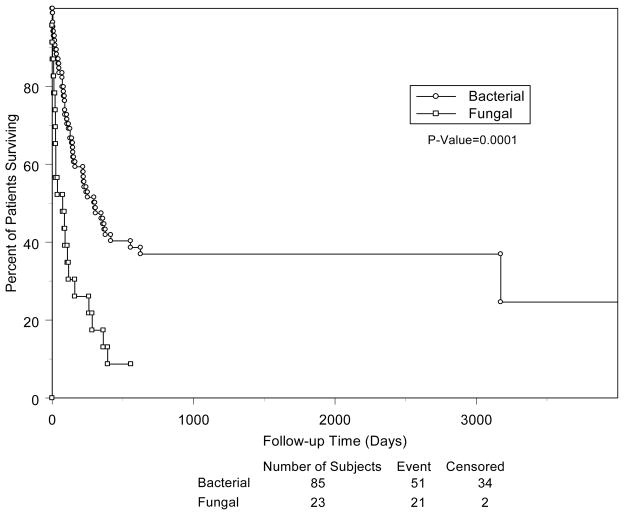
Of the 300 patients who received a VAD, 108 (36%) developed VAD infection, including 85 bacterial and 23 fungal infections. Most common bacterial causes of infection were Staphylococcus aureus, coagulase-negative staphylococci, enterococci, and Pseudomonas aeuruginosa. The most common fungal etiologic agent was Candida albicans. Only the use of total parenteral nutrition was associated with the development of a fungal VAD infection in multivariate analysis (odds ratio, 6.95; 95% confidence interval, 1.71-28.16; P=.007). Patients who experienced fungal VAD infection were less likely to be cured (17.4% vs 56.3%; P=.001) and had greater mortality (91% vs 61%; P=.006), compared with those who experienced bacterial VAD infection.
Fungi were responsible for approximately one-fifth of VAD infections and were associated with a mortality rate of 91%. Restriction of total parenteral nutrition use is essential in decreasing the rate of fungal VAD infection. Trials are needed for investigating the use of echinocandins or lipid formulations of amphotericin B for prevention and/or treatment of fungal VAD infection.
感染是心室辅助装置(VAD)的常见并发症,与再住院、血栓栓塞事件、VAD 故障、心脏移植延迟和高死亡率有关。本研究的目的是调查真菌感染 VAD 的频率,并评估各种风险因素及其对死亡率的影响,与细菌 VAD 感染相比。
我们对一家三级保健中心感染 VAD 的患者进行了回顾性图表审查。比较了真菌与细菌 VAD 感染的频率、风险因素和结果。
在接受 VAD 的 300 名患者中,有 108 名(36%)发生了 VAD 感染,包括 85 例细菌感染和 23 例真菌感染。感染最常见的细菌病原体是金黄色葡萄球菌、凝固酶阴性葡萄球菌、肠球菌和铜绿假单胞菌。最常见的真菌病原体是白色念珠菌。只有全胃肠外营养的使用与多变量分析中真菌 VAD 感染的发展相关(比值比,6.95;95%置信区间,1.71-28.16;P=.007)。与经历细菌 VAD 感染的患者相比,经历真菌 VAD 感染的患者不太可能治愈(17.4%对 56.3%;P=.001),死亡率更高(91%对 61%;P=.006)。
真菌约占 VAD 感染的五分之一,死亡率为 91%。限制全胃肠外营养的使用对于降低真菌 VAD 感染率至关重要。需要进行试验以研究使用棘白菌素或两性霉素 B 脂质制剂预防和/或治疗真菌 VAD 感染。