Robert Wood Johnson Health and Society Scholars Program, University of California at San Francisco, San Francisco, CA 94118, USA.
Psychooncology. 2010 Oct;19(10):1102-11. doi: 10.1002/pon.1667.
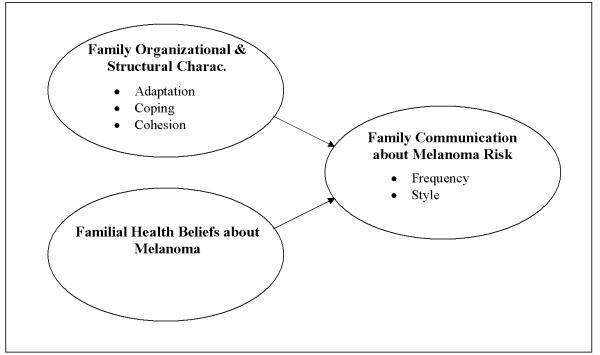
The family provides an important communication nexus for information and support exchange about family cancer history, and adoption of family-wide cancer risk reduction strategies. The goals of this study were to (1) use the family systems theory to identify characteristics of this sample of families at increased risk of developing melanoma and (2) to relate familial characteristics to the frequency and style of familial risk communication.
Participants were first-degree relatives (n=313) of melanoma patients, recruited into a family web-based intervention study. We used multivariable logistic regression models to analyze the association between family functioning and family communication.
Most participants were female (60%), with an average age of 51 years. Fifty percent of participants reported that they spoke to their relatives about melanoma risk and people were more likely to speak to their female family members. Familial adaptation, cohesion, coping, and health beliefs were strongly associated with an open style of risk communication within families. None were associated with a blocked style of risk communication. Only cohesion and adaptation were associated with the amount of risk communication that occurred within families.
Overall, individuals who came from families that were more highly cohesive, adaptable, and shared strong beliefs about melanoma risk were more likely to communicate openly about melanoma. The fact that this association was not consistent across blocked communication and communication frequency highlights the multifaceted nature of this process. Future research should focus on the interplay between different facets of communication.
家庭为交流家族癌症史信息和提供支持提供了重要的沟通枢纽,并有助于采用全家族癌症风险降低策略。本研究的目的是:(1) 使用家庭系统理论来确定这组具有较高黑色素瘤发病风险的家族的特征;(2) 将家族特征与家族内风险沟通的频率和方式联系起来。
参与者为黑色素瘤患者的一级亲属(n=313),招募进入一项基于家庭的网络干预研究。我们使用多变量逻辑回归模型分析家庭功能与家庭沟通之间的关系。
大多数参与者为女性(60%),平均年龄为 51 岁。50%的参与者表示他们曾与亲属谈论过黑色素瘤风险,且更倾向于与女性亲属谈论。家庭适应性、凝聚力、应对方式和健康信念与家庭内风险沟通的开放风格密切相关。与封闭的风险沟通风格无关。只有凝聚力和适应性与家庭内风险沟通的数量有关。
总体而言,来自凝聚力高、适应性强且对黑色素瘤风险有强烈共同信念的家庭的个体更有可能就黑色素瘤问题进行公开沟通。这种关联在阻断式沟通和沟通频率方面并不一致,这突出了这一过程的多面性。未来的研究应侧重于不同沟通方面之间的相互作用。