Department of Biochemistry, University of Missouri-Columbia, Columbia, MO 65211, USA.
Curr Opin Microbiol. 2010 Apr;13(2):124-32. doi: 10.1016/j.mib.2009.12.014. Epub 2010 Feb 1.
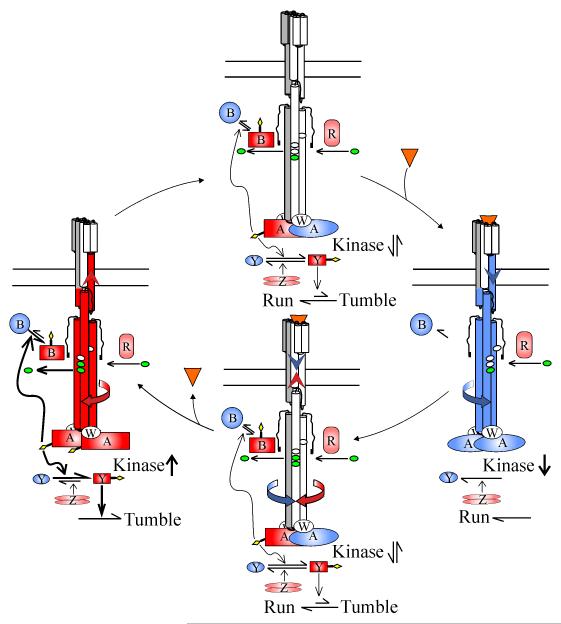
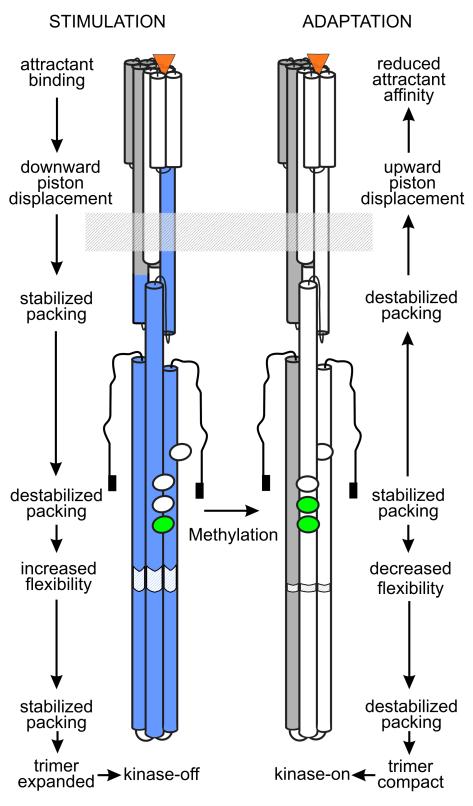
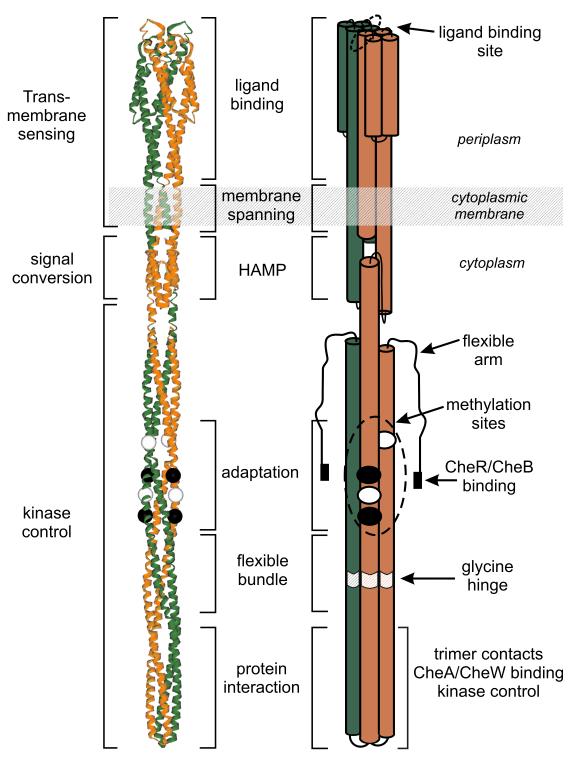
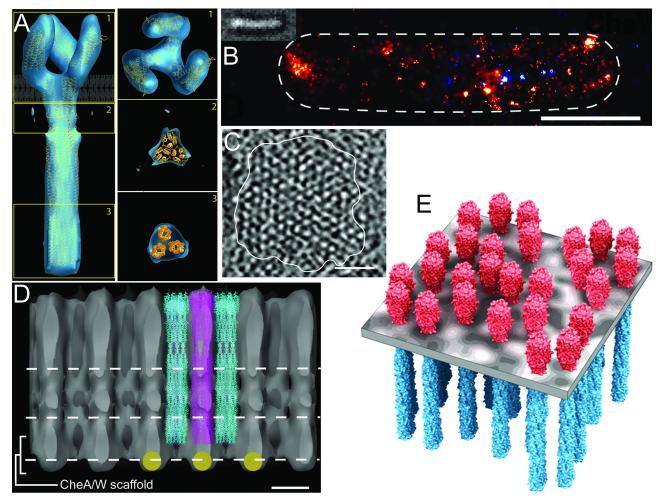
Bacteria perform chemotaxis utilizing core two-component signaling systems to which have been added enhanced features of signal amplification, sensory adaptation, molecular memory and high sensitivity over a wide dynamic range. Chemoreceptors are central to the enhancements. These transmembrane homodimers associate in trimers and in clusters of signaling complexes containing from a few to thousands of receptors. Receptor homodimers couple ligand occupancy and adaptational modification to transmembrane signaling. Trimers activate and control the histidine kinase. Clusters enable signal amplification, high sensitivity and adaptational assistance. Homodimer signaling initiates with helical piston sliding that is converted to modulation of competing packing modes of adjacent segments of an extended helical coiled coil. In trimers, signaling and coupling may involve switching between compact and expanded forms.
细菌利用核心的双组分信号系统进行趋化作用,在此基础上增加了信号放大、感觉适应、分子记忆和高灵敏度等增强功能,其动态范围很宽。化学感受器是增强功能的核心。这些跨膜同源二聚体以三聚体的形式结合,并形成包含几个到数千个受体的信号复合物簇。受体同源二聚体将配体占据和适应性修饰与跨膜信号转导偶联。三聚体激活并控制组氨酸激酶。簇使信号放大、高灵敏度和适应性辅助成为可能。同源二聚体信号起始于螺旋活塞滑动,其转换为对扩展螺旋卷曲螺旋相邻片段的竞争包装模式的调节。在三聚体中,信号转导和偶联可能涉及在紧凑和扩展形式之间的切换。