Department of Environmental Health, Boston University School of Public Health, Boston, Massachusetts 02118, USA.
Environ Health Perspect. 2010 Feb;118(2):197-202. doi: 10.1289/ehp.0901165.
Polyfluoroalkyl chemicals (PFCs) are used commonly in commercial applications and are detected in humans and the environment worldwide. Concern has been raised that they may disrupt lipid and weight regulation.
We investigated the relationship between PFC serum concentrations and lipid and weight outcomes in a large publicly available data set.
We analyzed data from the 20032004 National Health and Nutrition Examination Survey (NHANES) for participants 1280 years of age. Using linear regression to control for covariates, we studied the association between serum concentrations of perfluorooctanoic acid (PFOA), perfluorononanoic acid (PFNA), perfluorooctane sulfonic acid (PFOS), and perfluorohexane sulfonic acid (PFHxS) and measures of cholesterol, body size, and insulin resistance.
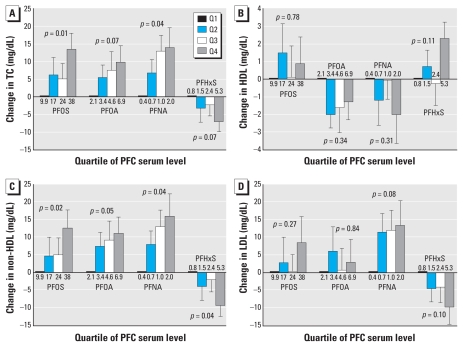
We observed a positive association between concentrations of PFOS, PFOA, and PFNA and total and non-high-density cholesterol. We found the opposite for PFHxS. Those in the highest quartile of PFOS exposure had total cholesterol levels 13.4 mg/dL [95% confidence interval (CI), 3.823.0] higher than those in the lowest quartile. For PFOA, PFNA, and PFHxS, effect estimates were 9.8 (95% CI, 0.2 to 19.7), 13.9 (95% CI, 1.925.9), and 7.0 (95% CI, 13.2 to 0.8), respectively. A similar pattern emerged when exposures were modeled continuously. We saw little evidence of a consistent association with body size or insulin resistance.
This exploratory cross-sectional study is consistent with other epidemiologic studies in finding a positive association between PFOS and PFOA and cholesterol, despite much lower exposures in NHANES. Results for PFNA and PFHxS are novel, emphasizing the need to study PFCs other than PFOS and PFOA.
多氟烷基化学品(PFCs)广泛应用于商业领域,在全球范围内的人类和环境中均有检出。人们担忧这些物质可能会扰乱脂质和体重调节。
我们在一个大型公开可用的数据集内研究了 PFC 血清浓度与脂质和体重结果之间的关系。
我们分析了 2003-2004 年全国健康与营养调查(NHANES)中 12-80 岁参与者的数据。通过线性回归控制协变量,我们研究了全氟辛酸(PFOA)、全氟壬酸(PFNA)、全氟辛烷磺酸(PFOS)和全氟己烷磺酸(PFHxS)血清浓度与胆固醇、体型和胰岛素抵抗指标之间的关联。
我们发现 PFOS、PFOA 和 PFNA 浓度与总胆固醇和非高密度脂蛋白胆固醇呈正相关。而 PFHxS 则相反。PFOS 暴露量最高四分位数的总胆固醇水平比最低四分位数高 13.4mg/dL[95%置信区间(CI):3.82-3.0]。对于 PFOA、PFNA 和 PFHxS,效应估计值分别为 9.8(95%CI:0.2-19.7)、13.9(95%CI:1.9-25.9)和 7.0(95%CI:13.2-0.8)。当连续暴露时,出现了类似的模式。我们几乎没有发现与体型或胰岛素抵抗有一致的关联。
这项探索性的横断面研究与其他流行病学研究一致,发现 PFOS 和 PFOA 与胆固醇之间存在正相关,尽管 NHANES 中的暴露水平要低得多。PFNA 和 PFHxS 的结果是新颖的,强调了需要研究除 PFOS 和 PFOA 以外的 PFCs。