University of North Carolina, Department of Epidemiology, Chapel Hill, North Carolina 27599, USA.
Nat Rev Microbiol. 2010 Mar;8(3):231-41. doi: 10.1038/nrmicro2296. Epub 2010 Feb 2.
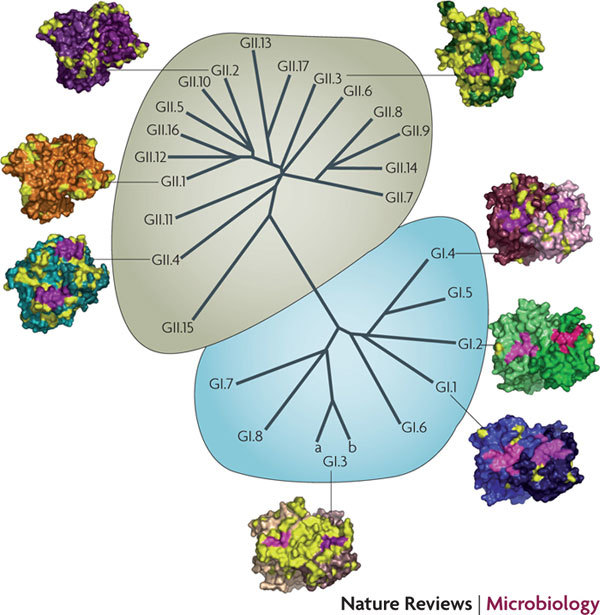
Noroviruses are the most common cause of food-borne gastroenteritis worldwide, and explosive outbreaks frequently occur in community settings, where the virus can immobilize large numbers of infected individuals for 24-48 hours, making the development of effective vaccines and antiviral therapies a priority. However, several challenges have hampered therapeutic design, including: the limitations of cell culture and small-animal model systems; the complex effects of host pre-exposure histories; differential host susceptibility, which is correlated with blood group and secretor status; and the evolution of novel immune escape variants. In this Review, we discuss the molecular and structural mechanisms that facilitate the persistence of noroviruses in human populations.
诺如病毒是全世界食源性胃肠炎的最常见病因,并且这种病毒经常在社区环境中爆发,使大量感染者在 24-48 小时内无法行动,这使得开发有效的疫苗和抗病毒疗法成为当务之急。然而,有几个挑战阻碍了治疗方法的设计,包括:细胞培养和小动物模型系统的局限性;宿主预先暴露史的复杂影响;与血型和分泌状态相关的宿主易感性差异;以及新型免疫逃逸变异的进化。在这篇综述中,我们讨论了促进诺如病毒在人群中持续存在的分子和结构机制。