Service of Diabetes, Endocrinology and Nutrition, Institut d'Investigació Biomédica de Girona, CIBEROBN (CB06/03/0010), Girona, Spain.
PLoS One. 2010 Feb 2;5(2):e9022. doi: 10.1371/journal.pone.0009022.
Potential regulators of adipogenesis include microRNAs (miRNAs), small non-coding RNAs that have been recently shown related to adiposity and differentially expressed in fat depots. However, to date no study is available, to our knowledge, regarding miRNAs expression profile during human adipogenesis. Thereby, the aim of this study was to investigate whether miRNA pattern in human fat cells and subcutaneous adipose tissue is associated to obesity and co-morbidities and whether miRNA expression profile in adipocytes is linked to adipogenesis.
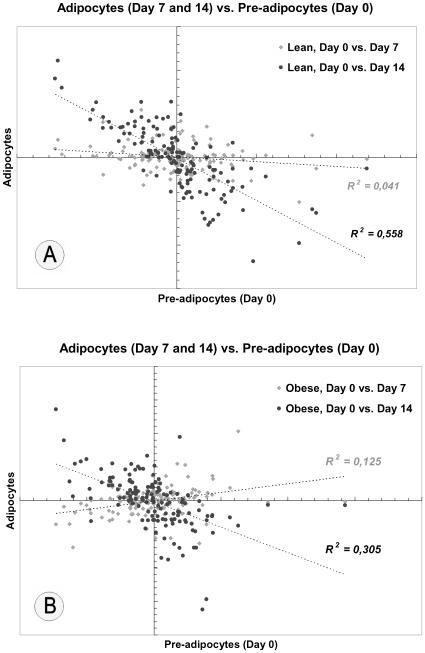
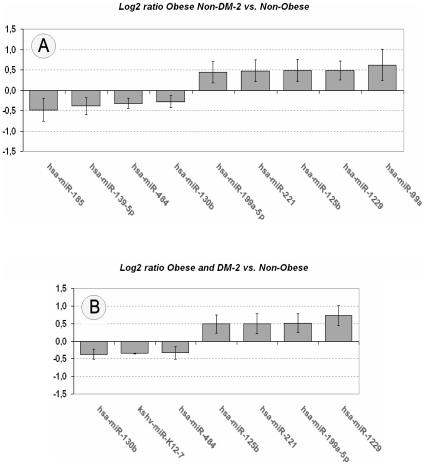
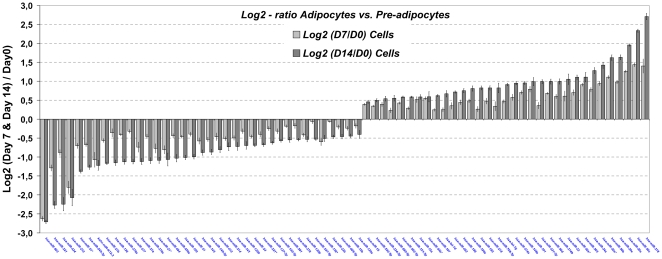
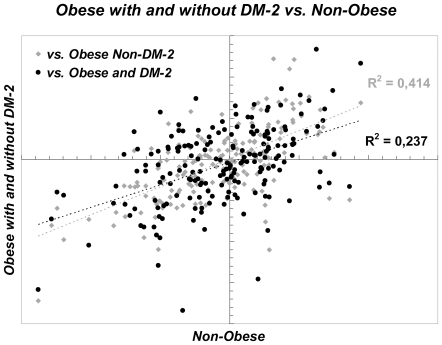
METHODOLOGY/PRINCIPAL FINDINGS: We performed a global miRNA expression microarray of 723 human and 76 viral mature miRNAs in human adipocytes during differentiation and in subcutaneous fat samples from non-obese (n = 6) and obese with (n = 9) and without (n = 13) Type-2 Diabetes Mellitus (DM-2) women. Changes in adipogenesis-related miRNAs were then validated by RT-PCR. Fifty of 799 miRNAs (6.2%) significantly differed between fat cells from lean and obese subjects. Seventy miRNAs (8.8%) were highly and significantly up or down-regulated in mature adipocytes as compared to pre-adipocytes. Otherwise, 17 of these 799 miRNAs (2.1%) were correlated with anthropometrical (BMI) and/or metabolic (fasting glucose and/or triglycerides) parameters. We identified 11 miRNAs (1.4%) significantly deregulated in subcutaneous fat from obese subjects with and without DM-2. Interestingly, most of these changes were associated with miRNAs also significantly deregulated during adipocyte differentiation.
CONCLUSIONS/SIGNIFICANCE: The remarkable inverse miRNA profile revealed for human pre-adipocytes and mature adipocytes hints at a closely crosstalk between miRNAs and adipogenesis. Such candidates may represent biomarkers and therapeutic targets for obesity and obesity-related complications.
脂肪生成的潜在调节因子包括 microRNAs(miRNAs),这是一种小型非编码 RNA,最近已被证明与肥胖有关,并在脂肪组织中差异表达。然而,据我们所知,迄今为止,尚无研究探讨人类脂肪生成过程中 miRNA 的表达谱。因此,本研究旨在探讨人脂肪细胞和皮下脂肪组织中的 miRNA 模式是否与肥胖和合并症有关,以及脂肪细胞中的 miRNA 表达谱是否与脂肪生成有关。
方法/主要发现:我们对非肥胖(n=6)、肥胖伴(n=9)和不伴(n=13)2 型糖尿病(DM-2)女性的人脂肪细胞在分化过程中的 723 个人类和 76 种病毒成熟 miRNA 以及皮下脂肪样本进行了全局 miRNA 表达微阵列分析。然后通过 RT-PCR 验证与脂肪生成相关的 miRNA 的变化。在瘦和肥胖个体的脂肪细胞之间,有 50 种 miRNA(6.2%)存在显著差异。与前脂肪细胞相比,70 种 miRNA(8.8%)在成熟脂肪细胞中显著上调或下调。此外,这 799 种 miRNA 中有 17 种(2.1%)与人体测量学(BMI)和/或代谢(空腹血糖和/或甘油三酯)参数相关。我们发现 11 种 miRNA(1.4%)在肥胖伴和不伴 DM-2 个体的皮下脂肪中显著失调。有趣的是,这些变化中的大多数与在脂肪细胞分化过程中也显著失调的 miRNA 相关。
结论/意义:人类前脂肪细胞和成熟脂肪细胞中明显的 miRNA 反式谱提示 miRNA 与脂肪生成之间存在密切的相互作用。这些候选 miRNA 可能代表肥胖和肥胖相关并发症的生物标志物和治疗靶点。