Department of Pathology and Immunology, Washington University School of Medicine, St. Louis, Missouri, United States of America.
PLoS One. 2010 Feb 1;5(2):e8992. doi: 10.1371/journal.pone.0008992.
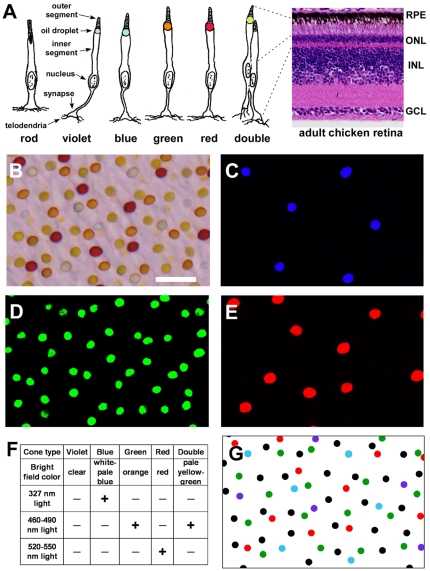
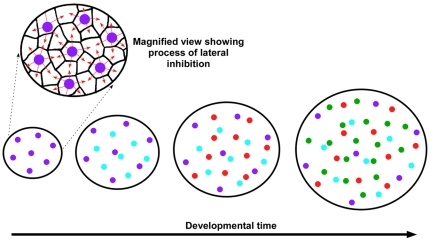
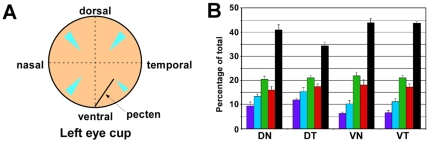
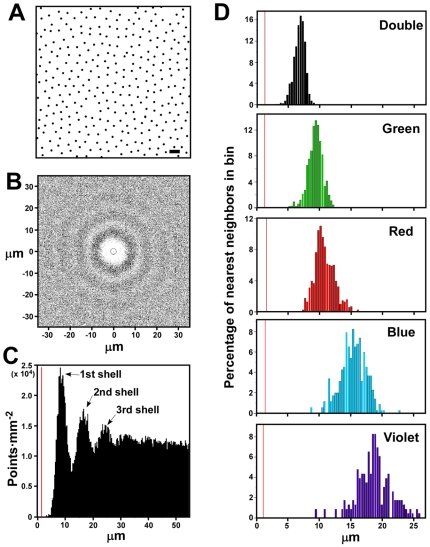
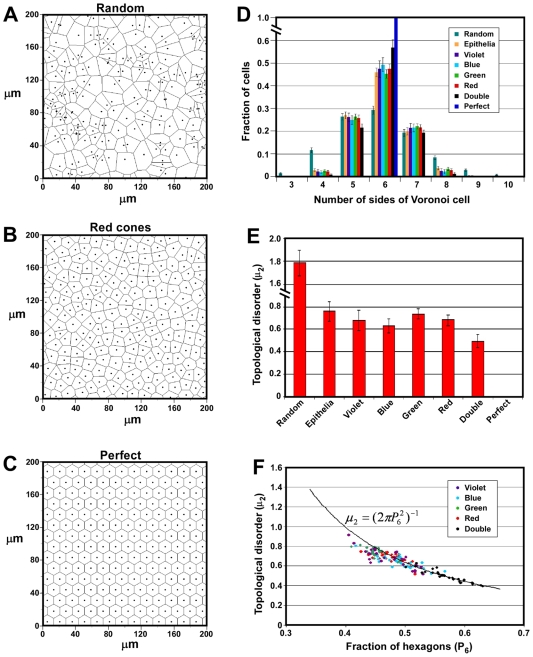
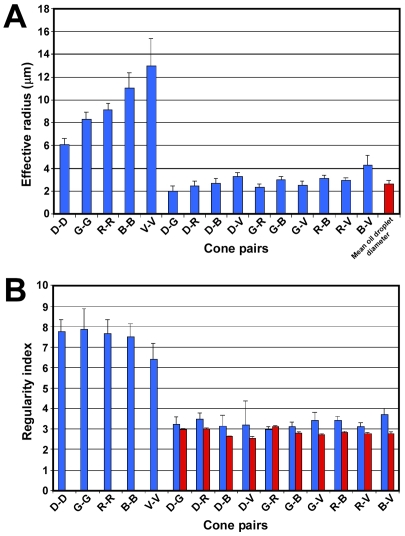
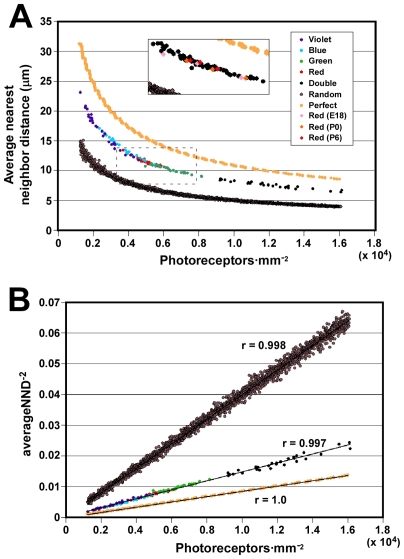
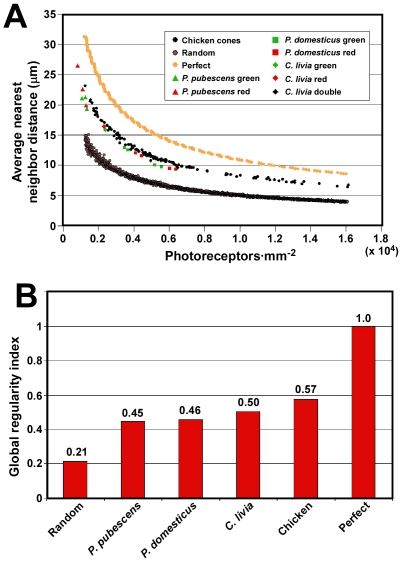
The avian retina possesses one of the most sophisticated cone photoreceptor systems among vertebrates. Birds have five types of cones including four single cones, which support tetrachromatic color vision and a double cone, which is thought to mediate achromatic motion perception. Despite this richness, very little is known about the spatial organization of avian cones and its adaptive significance. Here we show that the five cone types of the chicken independently tile the retina as highly ordered mosaics with a characteristic spacing between cones of the same type. Measures of topological order indicate that double cones are more highly ordered than single cones, possibly reflecting their posited role in motion detection. Although cones show spacing interactions that are cell type-specific, all cone types use the same density-dependent yardstick to measure intercone distance. We propose a simple developmental model that can account for these observations. We also show that a single parameter, the global regularity index, defines the regularity of all five cone mosaics. Lastly, we demonstrate similar cone distributions in three additional avian species, suggesting that these patterning principles are universal among birds. Since regular photoreceptor spacing is critical for uniform sampling of visual space, the cone mosaics of the avian retina represent an elegant example of the emergence of adaptive global patterning secondary to simple local interactions between individual photoreceptors. Our results indicate that the evolutionary pressures that gave rise to the avian retina's various adaptations for enhanced color discrimination also acted to fine-tune its spatial sampling of color and luminance.
禽类的视网膜拥有脊椎动物中最复杂的锥体光感受器系统之一。鸟类有五种类型的锥体,包括四种单锥体,它们支持四色视觉,以及一种双锥体,据认为它介导非色觉运动感知。尽管如此,我们对禽类锥体的空间组织及其适应意义知之甚少。在这里,我们表明,鸡的五种锥体类型独立地排列在视网膜上,形成高度有序的镶嵌图案,同类型的锥体之间具有特征性的间隔。拓扑顺序的度量表明,双锥体比单锥体更有序,这可能反映了它们在运动检测中的假定作用。尽管锥体显示出特定于细胞类型的间隔相互作用,但所有锥体类型都使用相同的密度依赖性标准来测量锥体之间的距离。我们提出了一个简单的发育模型,可以解释这些观察结果。我们还表明,一个单一的参数,即全局规则指数,定义了所有五种锥体镶嵌的规则性。最后,我们在另外三种禽类物种中展示了类似的锥体分布,表明这些图案形成原则在鸟类中是普遍存在的。由于规则的光感受器间隔对于视觉空间的均匀采样至关重要,因此禽类视网膜的锥体镶嵌代表了一种优雅的范例,即简单的个体光感受器之间的局部相互作用导致了适应性的全局模式的出现。我们的研究结果表明,导致禽类视网膜各种增强颜色分辨力的适应压力也对其颜色和亮度的空间采样进行了微调。