Major in Food and Nutrition, College of Human Ecology, Sookmyung Women's University, 52 Hyochangwon-gil, Yongsan-gu, Seoul 140-742, Korea.
Nutr Res Pract. 2008 Fall;2(3):143-51. doi: 10.4162/nrp.2008.2.3.143. Epub 2008 Sep 30.
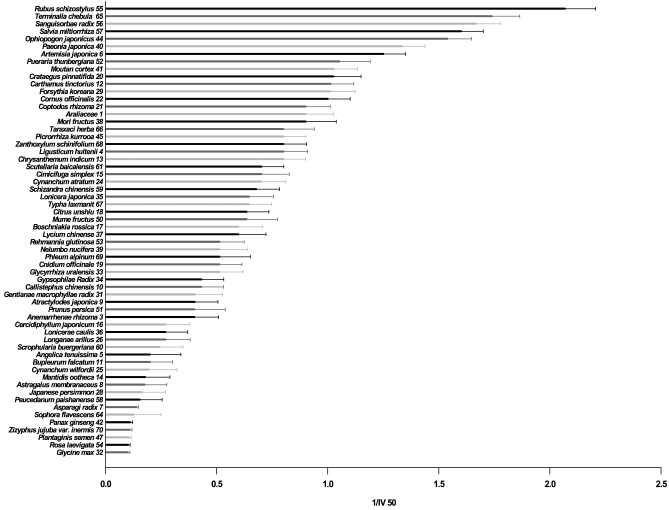
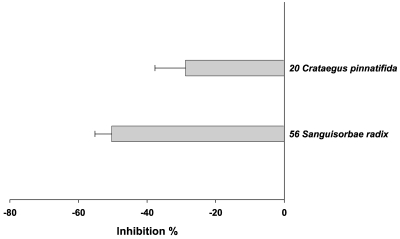
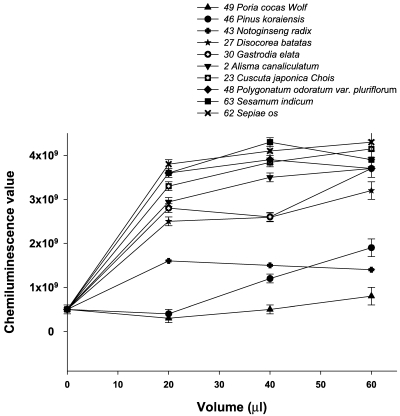
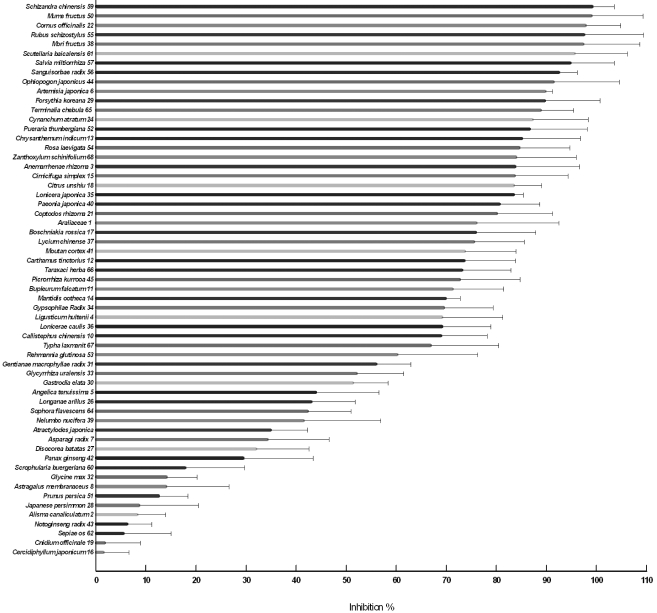
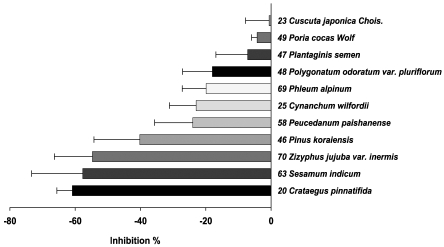
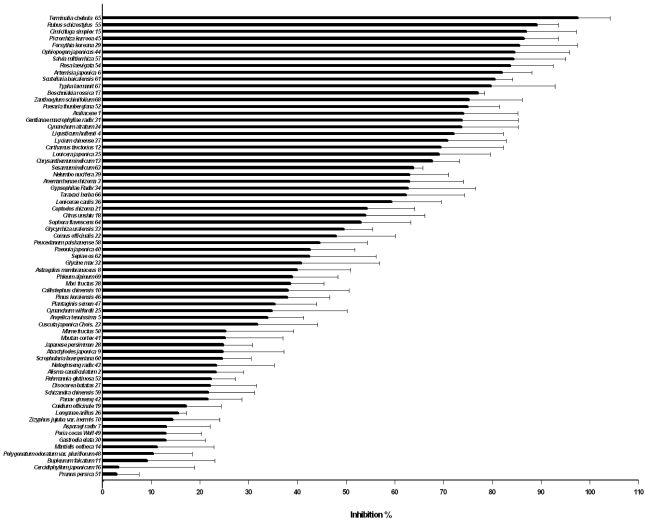
Many herbs have been used as therapeutics in Korean traditional medicine. In view of their clinical indications, anti-oxidant activity may contribute to their pharmacological effects. However, anti-oxidant information on these plants has not been available. In this study, seventy herbs which have been used in Korean traditional medicine were selected and screened for anti-oxidant activity using their water extracts. The anti-oxidant activity was assessed by their ability to inhibit three oxidation reactions; luminol/Fenton reagent, 2, 7-dichlorodihydrofluorescein (DCHF)/Fenton reagent and DCHF/peroxynitrite. In each assay, 70 herbs were divided into two groups; anti-oxidant group which inhibited the respective oxidation reaction and was majority (about 60 herbs), and pro-oxidant group which enhanced the oxidation reaction but was minority (more or less 10 herbs). When the herbs were listed in the order of their anti-oxidant strength, the orders obtained from each assay were found to be quite similar. The upper top rankers (more or less 10 herbs) in each assay showed strong activity compared to the others. The uppermost rankers in each assay were Rubus coreanus Miquel/ Rubus schizostylus, Schisandra chinensis Baillon/ Schizandra chinensis and Terminalia chebula Retzius/ Terminalia chebula. Of the pro-oxidant herbs, about 4-5 herbs were strongly pro-oxidant, which enhanced the control oxidation reactions to 150-300%. But the meaning of this observation is not known since few of them in one assay were also anti-oxidant in other assays. The results obtained in the present study may serve as information for understanding pharmacological effects of these herbs and developing new drugs from them.
许多草药已被用于韩国传统医学的治疗中。鉴于它们的临床适应症,抗氧化活性可能有助于它们的药理作用。然而,这些植物的抗氧化信息尚未可知。在这项研究中,选择了 70 种已在韩国传统医学中使用的草药,并用水提取物筛选其抗氧化活性。抗氧化活性通过其抑制三种氧化反应的能力来评估:发光氨/Fenton 试剂、2,7-二氯二氢荧光素 (DCHF)/Fenton 试剂和 DCHF/过氧亚硝酸盐。在每种测定中,70 种草药分为两组;具有抗氧化活性并占多数(约 60 种)的抗氧化组和增强氧化反应但占少数(或多或少 10 种)的促氧化剂组。当按照抗氧化强度对草药进行排序时,从每种测定中获得的顺序非常相似。每种测定中排名较高的(或多或少 10 种)的草药与其他草药相比具有较强的活性。每种测定中排名最高的草药是茅莓/掌叶覆盆子、华中五味子/南五味子和诃子/诃子。在促氧化剂中,约有 4-5 种草药具有很强的促氧化作用,将对照氧化反应增强至 150-300%。但由于在一种测定中,其中一些草药在其他测定中也是抗氧化的,因此这种观察的意义尚不清楚。本研究获得的结果可作为了解这些草药药理作用和从它们中开发新药的信息。