School of Plant Biology and International Centre for Plant Breeding Education and Research, The University of Western Australia, 35 Stirling Highway, Crawley, WA 6009, Australia.
DNA Res. 2010 Apr;17(2):73-83. doi: 10.1093/dnares/dsq001. Epub 2010 Feb 4.
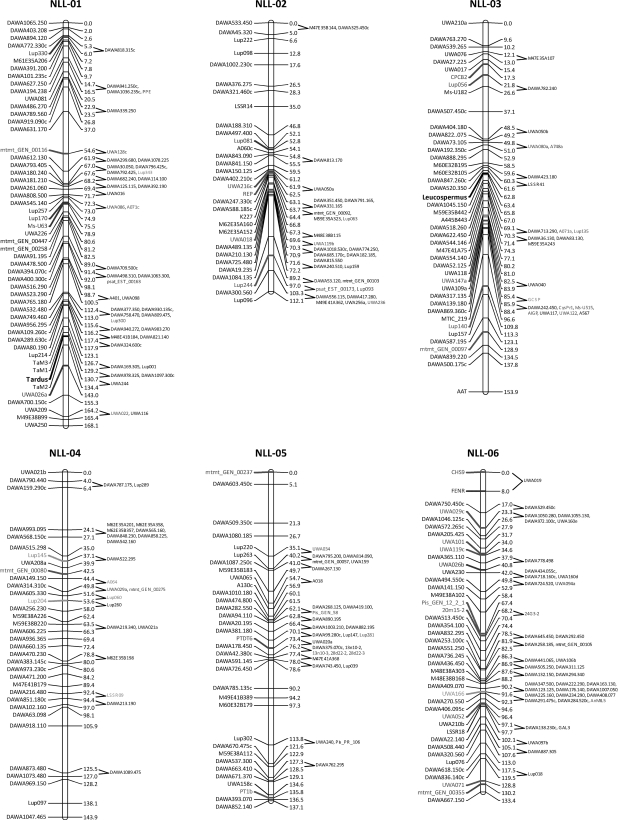
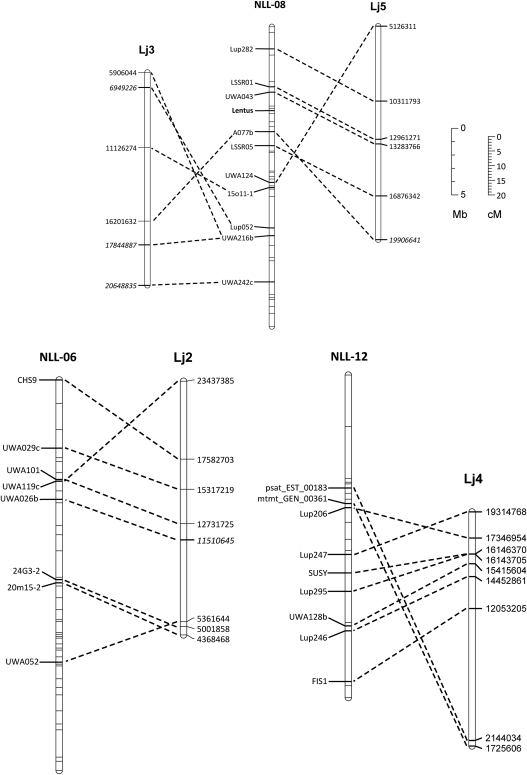
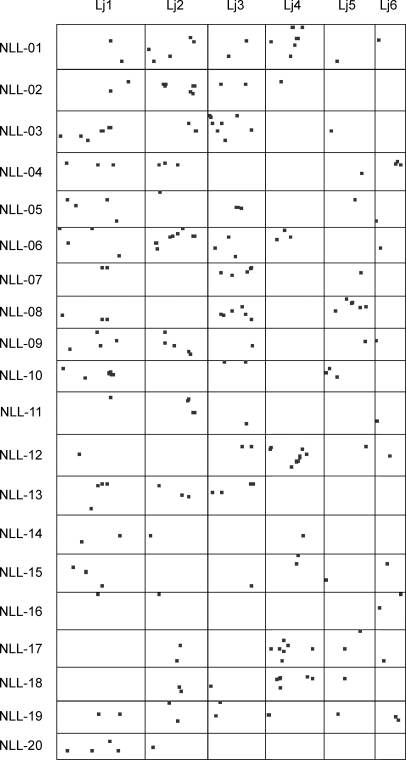
We have developed a dense reference genetic map of Lupinus angustifolius (2n = 40) based on a set of 106 publicly available recombinant inbred lines derived from a cross between domesticated and wild parental lines. The map comprised 1090 loci in 20 linkage groups and three small clusters, drawing together data from several previous mapping publications plus almost 200 new markers, of which 63 were gene-based markers. A total of 171 mainly gene-based, sequence-tagged site loci served as bridging points for comparing the Lu. angustifolius genome with the genome sequence of the model legume, Lotus japonicus via BLASTn homology searching. Comparative analysis indicated that the genomes of Lu. angustifolius and Lo. japonicus are highly diverged structurally but with significant regions of conserved synteny including the region of the Lu. angustifolius genome containing the pod-shatter resistance gene, lentus. We discuss the potential of synteny analysis for identifying candidate genes for domestication traits in Lu. angustifolius and in improving our understanding of Fabaceae genome evolution.
我们开发了一个基于一组 106 个公开可得的重组自交系的密集参考遗传图谱,这些重组自交系是由驯化和野生亲本系杂交产生的。该图谱包含 20 个连锁群和三个小簇的 1090 个位点,汇集了来自几个先前的图谱出版物的数据,以及近 200 个新标记,其中 63 个是基于基因的标记。总共 171 个主要基于基因的序列标记位点作为桥接点,通过 BLASTn 同源搜索,将 Lu. angustifolius 基因组与模式豆科植物 Lotus japonicus 的基因组进行比较。比较分析表明,Lu. angustifolius 和 Lo. japonicus 的基因组在结构上高度分化,但具有显著的保守同线性区域,包括 Lu. angustifolius 基因组中包含豆荚破碎抗性基因 lentus 的区域。我们讨论了同线性分析在鉴定 Lu. angustifolius 驯化性状候选基因以及提高我们对豆科基因组进化理解方面的潜力。