Department of Radiotherapy, University Hospital Maggiore della Carità, Novara, Italy.
Radiat Oncol. 2010 Feb 6;5:10. doi: 10.1186/1748-717X-5-10.
FDG-PET/CT imaging has an emerging role in staging and treatment planning of various tumor locations and a number of literature studies show that also the carcinoma of the anal canal may benefit from this diagnostic approach. We analyzed the potential impact of FDG-PET/CT in stage definition and target volume delineation of patients affected by carcinoma of the anal canal and candidates for curative radiotherapy.
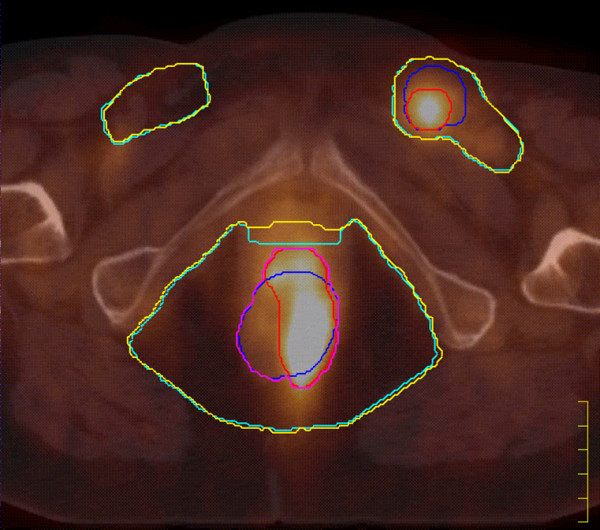
Twenty seven patients with biopsy proven anal carcinoma were enrolled. Pathology was squamous cell carcinoma in 20 cases, cloacogenic carcinoma in 3, adenocarcinoma in 2, and basal cell carcinoma in 2. Simulation was performed by PET/CT imaging with patient in treatment position. Gross Tumor Volume (GTV) and Clinical Target Volume (CTV) were drawn on CT and on PET/CT fused images. PET-GTV and PET-CTV were respectively compared to CT-GTV and CT-CTV by Wilcoxon rank test for paired data.
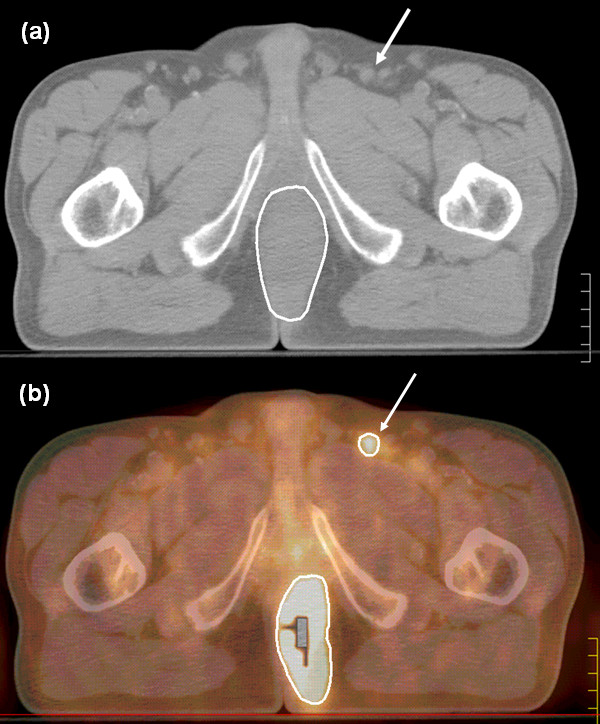
PET/CT fused images led to change the stage in 5/27 cases (18.5%): 3 cases from N0 to N2 and 2 from M0 to M1 leading to change the treatment intent from curative to palliative in a case.Based on PET/CT imaging, GTV and CTV contours changed in 15/27 (55.6%) and in 10/27 cases (37.0%) respectively. PET-GTV and PET-CTV resulted significantly smaller than CT-GTV (p = 1.2 x 10(-4)) and CT-CTV (p = 2.9 x 10(-4)). PET/CT-GTV and PET/CT-CTV, that were used for clinical purposes, were significantly greater than CT-GTV (p = 6 x 10(-5)) and CT-CTV (p = 6 x 10(-5)).
FDG-PET/CT has a potential relevant impact in staging and target volume delineation of the carcinoma of the anal canal. Clinical stage variation occurred in 18.5% of cases with change of treatment intent in 3.7%. The GTV and the CTV changed in shape and in size based on PET/CT imaging.
FDG-PET/CT 成像在各种肿瘤部位的分期和治疗计划中具有新兴作用,许多文献研究表明,肛门管癌也可能受益于这种诊断方法。我们分析了 FDG-PET/CT 在确定分期和划定靶区方面对接受根治性放疗的肛门管癌患者的潜在影响。
共纳入 27 例经活检证实的肛门癌患者。20 例为鳞状细胞癌,3 例为 cloacogenic 癌,2 例为腺癌,2 例为基底细胞癌。通过 PET/CT 成像对患者进行治疗体位模拟。在 CT 和融合的 PET/CT 图像上绘制大体肿瘤体积(GTV)和临床靶区体积(CTV)。采用 Wilcoxon 秩和检验对配对数据进行比较,比较 PET-GTV 和 PET-CTV 与 CT-GTV 和 CT-CTV 的差异。
PET/CT 融合图像导致 5/27 例(18.5%)分期改变:3 例从 N0 变为 N2,2 例从 M0 变为 M1,导致 1 例治疗意图从根治性变为姑息性。基于 PET/CT 成像,GTV 和 CTV 轮廓分别在 15/27(55.6%)和 10/27 例(37.0%)中发生变化。PET-GTV 和 PET-CTV 明显小于 CT-GTV(p=1.2×10(-4))和 CT-CTV(p=2.9×10(-4))。用于临床目的的 PET/CT-GTV 和 PET/CT-CTV 明显大于 CT-GTV(p=6×10(-5))和 CT-CTV(p=6×10(-5))。
FDG-PET/CT 在肛门管癌的分期和靶区划定方面具有潜在的重要影响。18.5%的病例临床分期发生变化,3 例治疗意图发生变化。基于 PET/CT 成像,GTV 和 CTV 的形状和大小发生变化。