Department of Radiotherapy, Comprehensive Cancer Center, Bialystok, Poland.
Department of Oncology, Department of Radiotherapy, Medical University of Bialystok, Comprehensive Cancer Center, 12 Ogrodowa St., 15-027, Bialystok, Poland.
Strahlenther Onkol. 2019 Sep;195(9):780-791. doi: 10.1007/s00066-019-01480-3. Epub 2019 Jun 18.
The aim of the study was to evaluate the usefulness and accuracy of 18-fluorine-labeled fluorodeoxyglucose (PET) and magnetic resonance imaging (MRI) hybrid in gross tumor volume (GTV) delineation during radiotherapy planning in patients with carcinoma of the tongue.
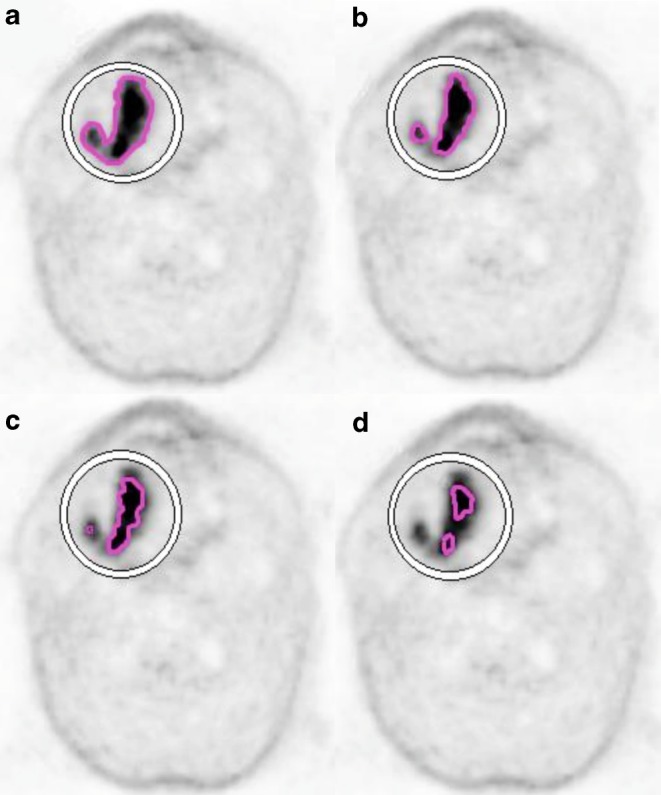
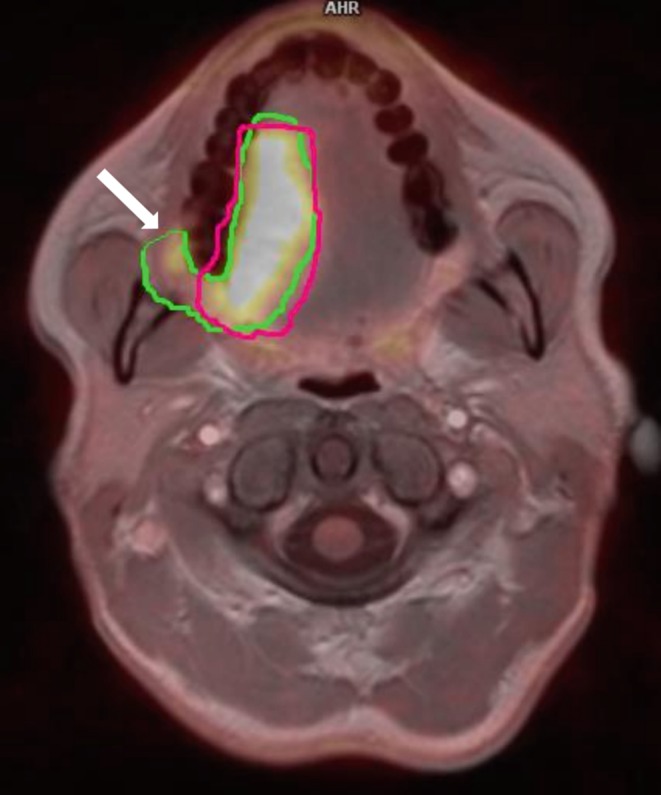
Ten patients with squamous cell carcinoma (SCC) of the tongue underwent computed tomography (CT) and PET/MRI examination. The GTV for primary tumor and lymph nodes (nGTV) were defined on CT (GTV-CT) and compared to GTVs obtained from PET (GTV-PET) and MRI (GTV-MRI) images. Two methods of GTV determination were used: visual interpretation of CT, PET (GTV-PET) and MRI images and quantitative automatic method (Syngovia, Siemens) based on a chosen threshold value (20%, 30%, 40%, 50%) of standardized uptake values (SUV) from PET examination (GTV-PET, GTV-PET, etc.). Statistical analysis of differences in GTV values obtained from CT, PET and MRI studies was performed. GTV-CT was used as a reference.
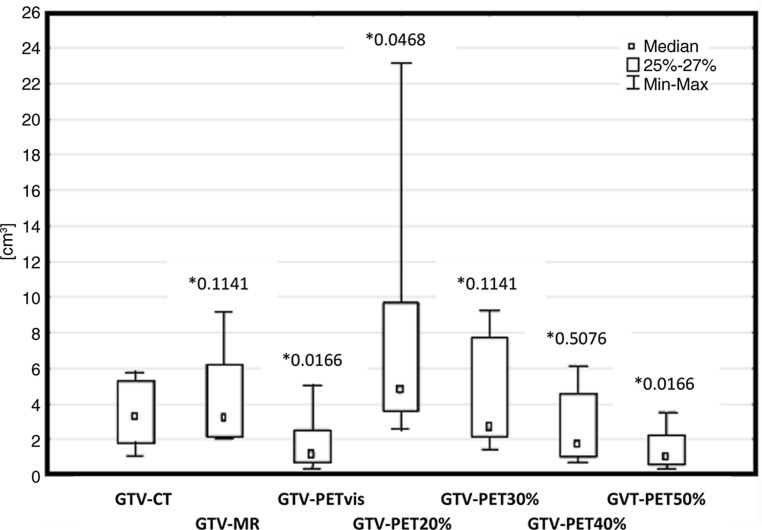
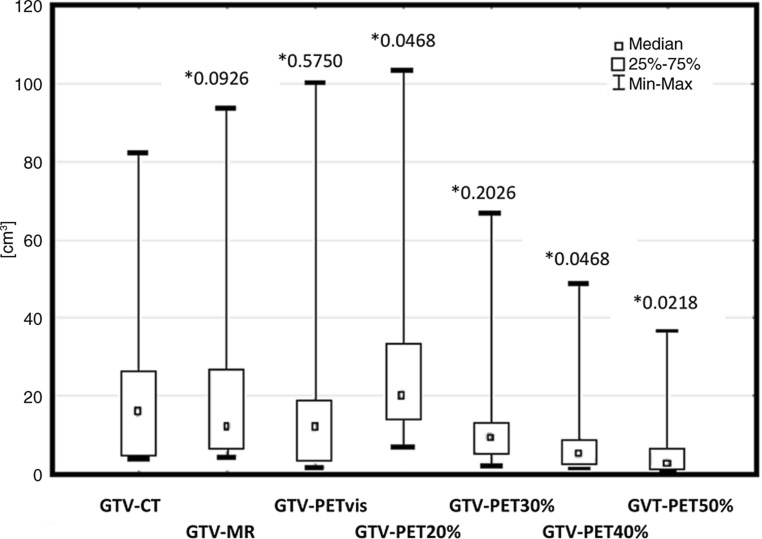
In all, 80% of GTV-MRI and 40% of GTV-PET were larger than GTV-CT. Respectively, 20% of GTV-MRI and 60% of GTV-PET were smaller than GTV-CT. Taking into account all threshold measurements, 70% of volumes were smaller than GTV-CT. GTV-PET were the most closely related volumes to GTV-CT from all threshold methods in 50% of patients. GTV-PET generated the most similar volumes in relation to GTV-CT from all PET measurements. Statistical analysis confirmed those results. Compared to nGTV-CT, 70% of nGTV-MRI and 20% of nGTV-PET were larger. The remaining nGTV-MRI and nGTV-PET measurements were smaller than nGTV-CT. Measurements of all thresholds nGTVs were smaller than nGTV-CTV in 52.5% of cases. nGTV-PET were the most closely related volumes to nGTV-CT in 40% of the cases. Statistical analysis showed that nGTV-PET (p = 0.0468), nGTV-PET (p = 0.0166), and nGTV-PET (p = 0.0166) diverge significantly from nGTV-CT results. nGTV-MRI (p = 0.1141), nGTV-PET (p = 0.2845), and nGTV-PET (p = 0.5076) were significantly related with nGTV-CT.
Combination of PET/MRI provides more information during target tumor mass delineation in radiotherapy planning of patients with SCC of the tongue than other standard imaging methods. The most frequently matching threshold value was 30% of SUV for primary tumor delineation and 30-40% of SUV for nGTV determination.
本研究旨在评估在舌鳞癌患者放射治疗计划中,18 氟标记氟代脱氧葡萄糖(PET)和磁共振成像(MRI)融合在大体肿瘤体积(GTV)勾画中的有用性和准确性。
10 例舌鳞癌患者行 CT 和 PET/MRI 检查。原发肿瘤和淋巴结的 GTV(nGTV)在 CT 上定义(GTV-CT),并与 PET(GTV-PET)和 MRI(GTV-MRI)图像上获得的 GTV 进行比较。使用两种 GTV 确定方法:CT、PET(GTV-PET)和 MRI 图像的视觉解释和基于所选标准摄取值(SUV)阈值(20%、30%、40%、50%)的定量自动方法(Syngovia,Siemens)(GTV-PET、GTV-PET 等)。对 CT、PET 和 MRI 研究中获得的 GTV 值进行统计学分析。以 GTV-CT 作为参考。
在所有患者中,80%的 GTV-MRI 和 40%的 GTV-PET 大于 GTV-CT。相应地,20%的 GTV-MRI 和 60%的 GTV-PET 小于 GTV-CT。考虑到所有阈值测量,70%的体积小于 GTV-CT。在 50%的患者中,50%的患者中,GTV-PET 是所有阈值方法中与 GTV-CT 最相关的体积。GTV-PET 是与所有 PET 测量相关的最相似的 GTV-CT 体积。统计分析证实了这些结果。与 nGTV-CT 相比,70%的 nGTV-MRI 和 20%的 nGTV-PET 较大。其余的 nGTV-MRI 和 nGTV-PET 测量值小于 nGTV-CT。在 52.5%的病例中,所有阈值 nGTV 测量值均小于 nGTV-CTV。在 40%的病例中,nGTV-PET 是与 nGTV-CT 最相关的体积。统计分析显示,nGTV-PET(p=0.0468)、nGTV-PET(p=0.0166)和 nGTV-PET(p=0.0166)与 nGTV-CT 结果显著不同。nGTV-MRI(p=0.1141)、nGTV-PET(p=0.2845)和 nGTV-PET(p=0.5076)与 nGTV-CT 有显著相关性。
在舌鳞癌患者的放射治疗计划中,PET/MRI 的联合提供了比其他标准成像方法更多的肿瘤靶区勾画信息。最常匹配的阈值是原发性肿瘤勾画的 SUV 的 30%,nGTV 确定的 SUV 的 30-40%。