Psychology Department, University of New Orleans, New Orleans, LA 70148, USA.
J Abnorm Psychol. 2010 Feb;119(1):186-96. doi: 10.1037/a0017511.
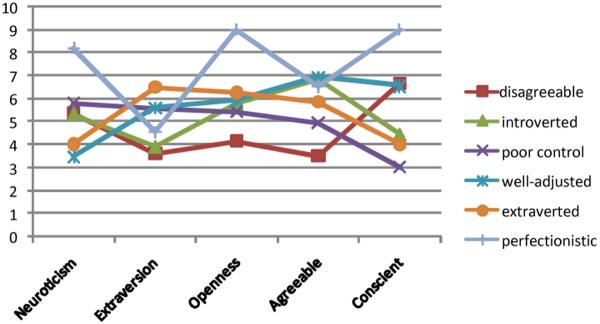
Person-centered personality approaches are an underused means of illuminating clinical heterogeneity of attention-deficit/hyperactivity disorder (ADHD). In the present study, latent profile analysis was conducted with personality traits to identify homogeneous profiles within the ADHD population. Participants were 548 children ages 6-18 years (302 with ADHD). Personality traits were measured via parent report on the California Q-Sort (A. Caspi et al., 1992). Latent profile analysis was conducted on the Big 5 factors. A 6-profile solution best fit the data. Resulting groups were characterized as "disagreeable," "introverted," "poor control," "well adjusted," "extraverted," and "perfectionistic." External validation of this model using ADHD diagnosis, subtypes, and comorbid psychopathology suggested that children with ADHD could be parsed into 4 groups: (a) an introverted group with high rates of the ADHD-inattentive type, (b) a group characterized by poor control, with high rates of ADHD-combined type (ADHD-C) and comorbid disruptive behavior disorders, (c) an extraverted group, with ADHD-C and few associated comorbid disorders, and (c) possibly, a very rare "perfectionistic" group, exhibiting obsessive traits. A person-centered personality approach may be one promising way to capture homogeneous subgroups within the ADHD population.
以人为中心的人格方法是一种未被充分利用的方法,可以阐明注意力缺陷/多动障碍(ADHD)的临床异质性。在本研究中,通过人格特质进行潜在剖面分析,以确定 ADHD 人群中的同质群体。参与者为 548 名 6-18 岁的儿童(302 名患有 ADHD)。人格特质通过父母对加利福尼亚 Q 分类表(A. Caspi 等人,1992 年)的报告进行测量。对大五因素进行潜在剖面分析。六组解决方案最适合数据。结果的群体特征为“不合群”、“内向”、“控制能力差”、“适应良好”、“外向”和“完美主义”。使用 ADHD 诊断、亚型和合并精神病理学对该模型进行外部验证表明,ADHD 儿童可以分为 4 组:(a)注意力不集中型 ADHD 发生率高的内向组,(b)以控制能力差为特征的组,ADHD-混合型(ADHD-C)和合并破坏性行为障碍的发生率高,(c)一个外向组,ADHD-C 和很少有相关合并症,以及(c)可能是一个非常罕见的“完美主义”组,表现出强迫性特征。以人为中心的人格方法可能是一种有前途的方法,可以捕获 ADHD 人群中的同质亚组。