Department of Physiology and Biophysics, Dalhousie University, Halifax, Nova Scotia B3H 1X5, Canada.
J Gen Physiol. 2010 Mar;135(3):229-45. doi: 10.1085/jgp.200910327. Epub 2010 Feb 8.
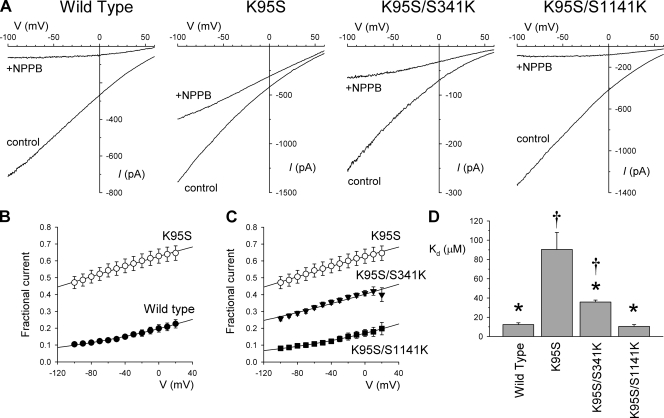
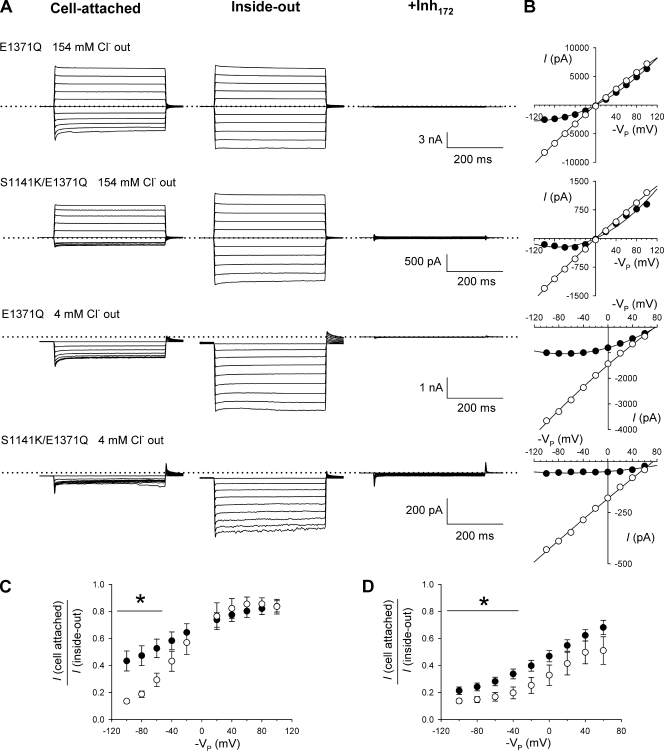
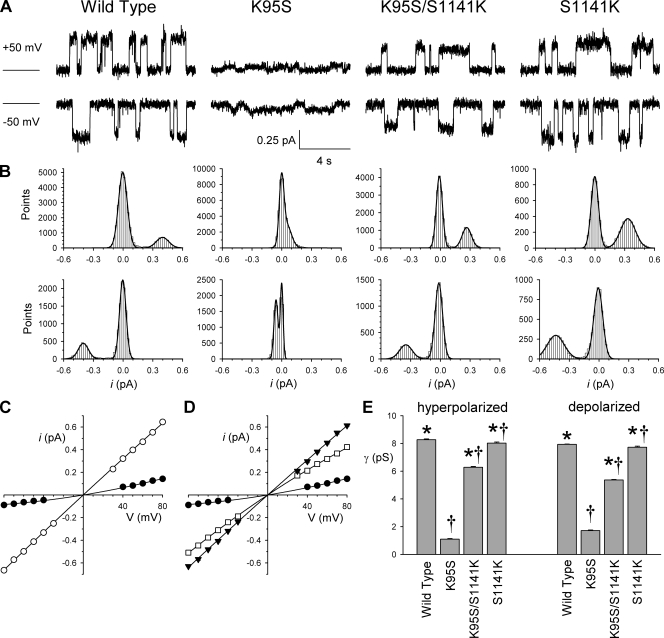
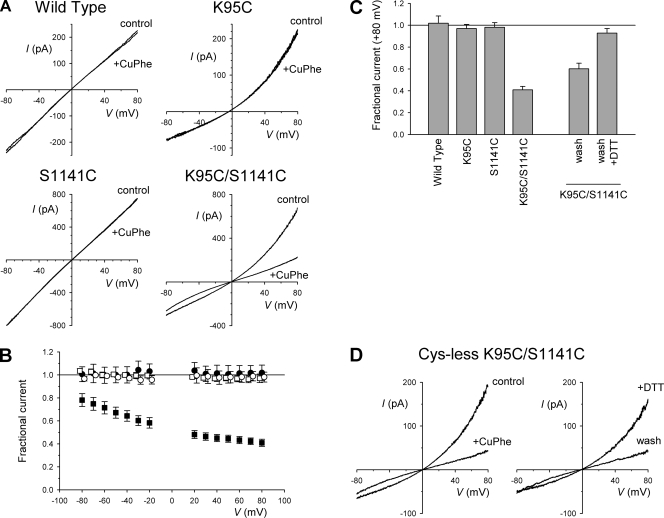
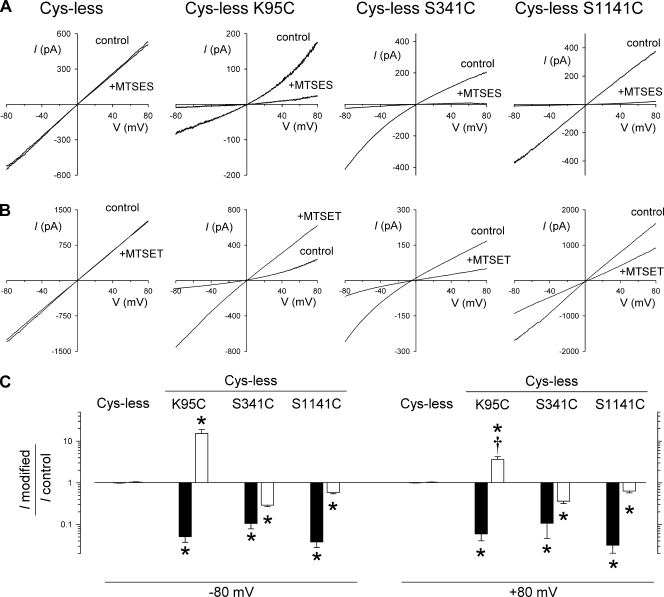
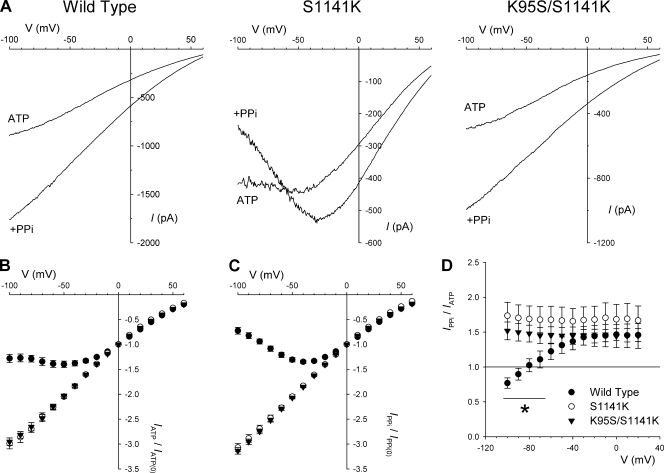
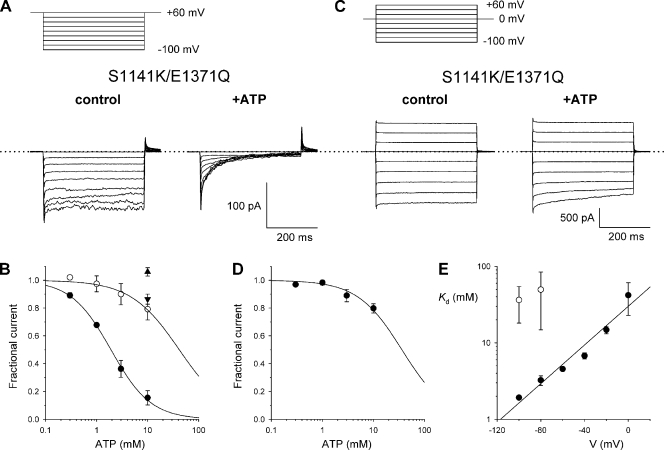
Rapid chloride permeation through the cystic fibrosis transmembrane conductance regulator (CFTR) Cl(-) channel is dependent on the presence of fixed positive charges in the permeation pathway. Here, we use site-directed mutagenesis and patch clamp recording to show that the functional role played by one such positive charge (K95) in the inner vestibule of the pore can be "transplanted" to a residue in a different transmembrane (TM) region (S1141). Thus, the mutant channel K95S/S1141K showed Cl(-) conductance and open-channel blocker interactions similar to those of wild-type CFTR, thereby "rescuing" the effects of the charge-neutralizing K95S mutation. Furthermore, the function of K95C/S1141C, but not K95C or S1141C, was inhibited by the oxidizing agent copper(II)-o-phenanthroline, and this inhibition was reversed by the reducing agent dithiothreitol, suggesting disulfide bond formation between these two introduced cysteine side chains. These results suggest that the amino acid side chains of K95 (in TM1) and S1141 (in TM12) are functionally interchangeable and located closely together in the inner vestibule of the pore. This allowed us to investigate the functional effects of increasing the number of fixed positive charges in this vestibule from one (in wild type) to two (in the S1141K mutant). The S1141K mutant had similar Cl(-) conductance as wild type, but increased susceptibility to channel block by cytoplasmic anions including adenosine triphosphate, pyrophosphate, 5-nitro-2-(3-phenylpropylamino)benzoic acid, and Pt(NO(2))(4)(2-) in inside-out membrane patches. Furthermore, in cell-attached patch recordings, apparent voltage-dependent channel block by cytosolic anions was strengthened by the S1141K mutation. Thus, the Cl(-) channel function of CFTR is maximal with a single fixed positive charge in this part of the inner vestibule of the pore, and increasing the number of such charges to two causes a net decrease in overall Cl(-) transport through a combination of failure to increase Cl(-) conductance and increased susceptibility to channel block by cytosolic substances.
氯离子通过囊性纤维化跨膜电导调节蛋白 (CFTR) Cl(-) 通道的快速渗透依赖于渗透途径中固定正电荷的存在。在这里,我们使用定点突变和膜片钳记录表明,一个这样的正电荷 (K95) 在孔内前庭中的功能作用可以“移植”到不同跨膜 (TM) 区域的一个残基 (S1141)。因此,突变通道 K95S/S1141K 表现出与野生型 CFTR 相似的 Cl(-) 传导率和开放通道阻滞剂相互作用,从而“挽救”了电荷中和 K95S 突变的影响。此外,K95C/S1141C 的功能,但不是 K95C 或 S1141C,被氧化剂铜(II)-邻菲咯啉抑制,这种抑制可被还原剂二硫苏糖醇逆转,表明这两个引入的半胱氨酸侧链之间形成了二硫键。这些结果表明,K95(在 TM1 中)和 S1141(在 TM12 中)的氨基酸侧链在功能上是可互换的,并且在孔的内前庭中紧密地结合在一起。这使我们能够研究在这个前庭中从一个(在野生型中)增加到两个(在 S1141K 突变体中)固定正电荷的数量对通道功能的影响。S1141K 突变体的 Cl(-) 传导率与野生型相似,但对包括三磷酸腺苷、焦磷酸盐、5-硝基-2-(3-苯丙基氨基)苯甲酸和 Pt(NO2)(4)(2-)在内的细胞质阴离子的通道阻断的敏感性增加。此外,在细胞附着的膜片钳记录中,细胞质阴离子的明显电压依赖性通道阻断通过 S1141K 突变得到加强。因此,在孔内前庭的这一部分,CFTR 的 Cl(-) 通道功能在有一个固定正电荷时最大,而将这种电荷的数量增加到两个会导致整体 Cl(-) 转运的净减少,这是由于 Cl(-) 电导增加失败和对细胞质物质的通道阻断敏感性增加的综合作用。