Department of Neuroscience & Cell Biology, The University of Texas Medical Branch, Galveston, Texas 77555-1069, USA.
Mol Pain. 2010 Feb 8;6:10. doi: 10.1186/1744-8069-6-10.
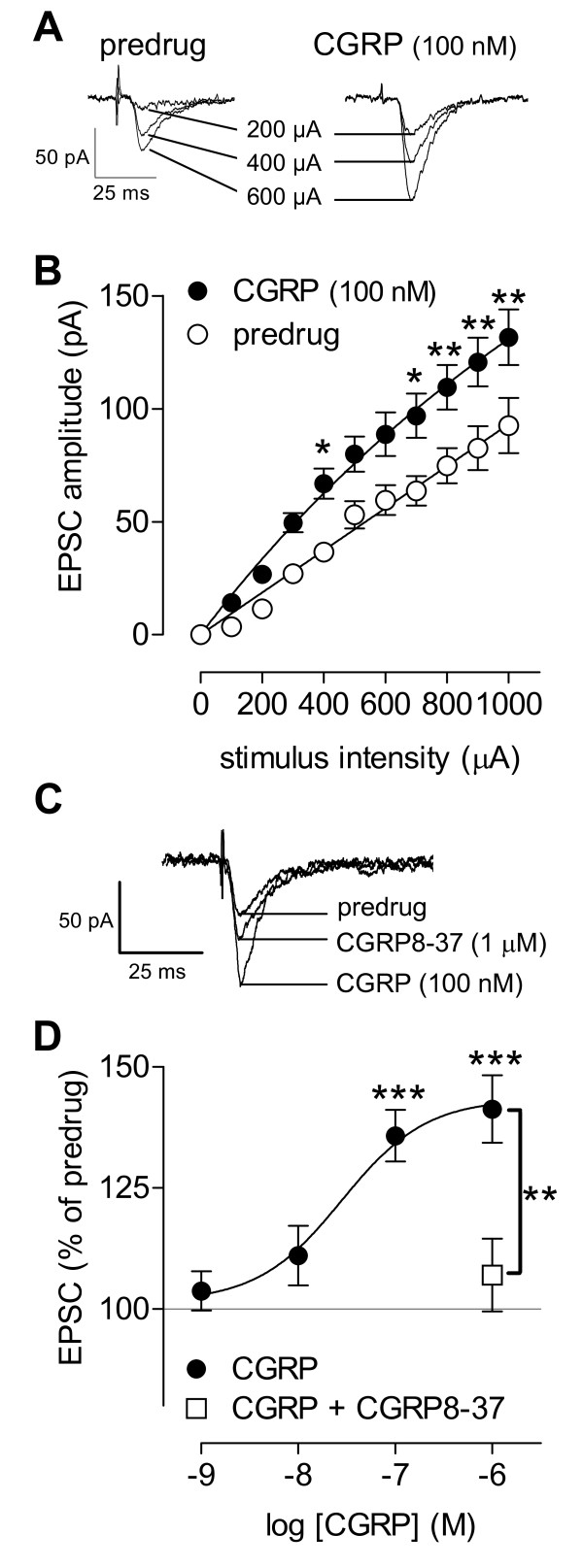
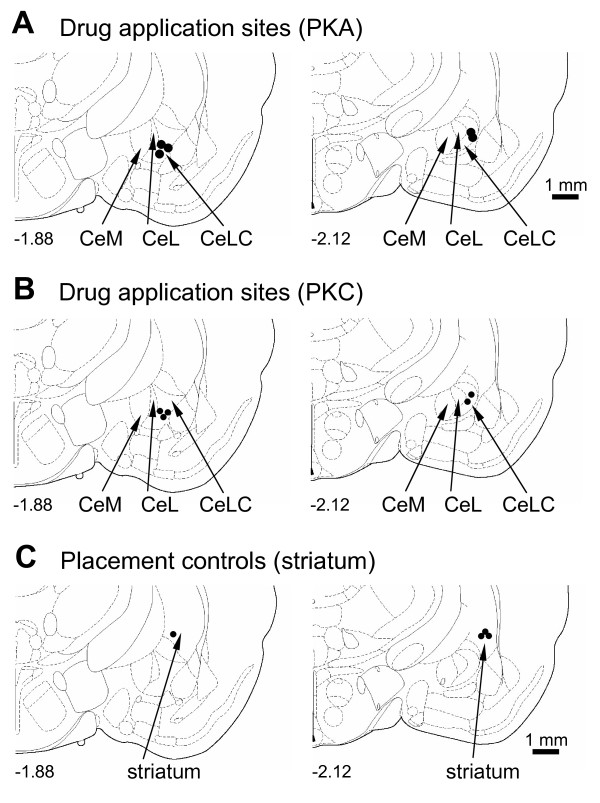
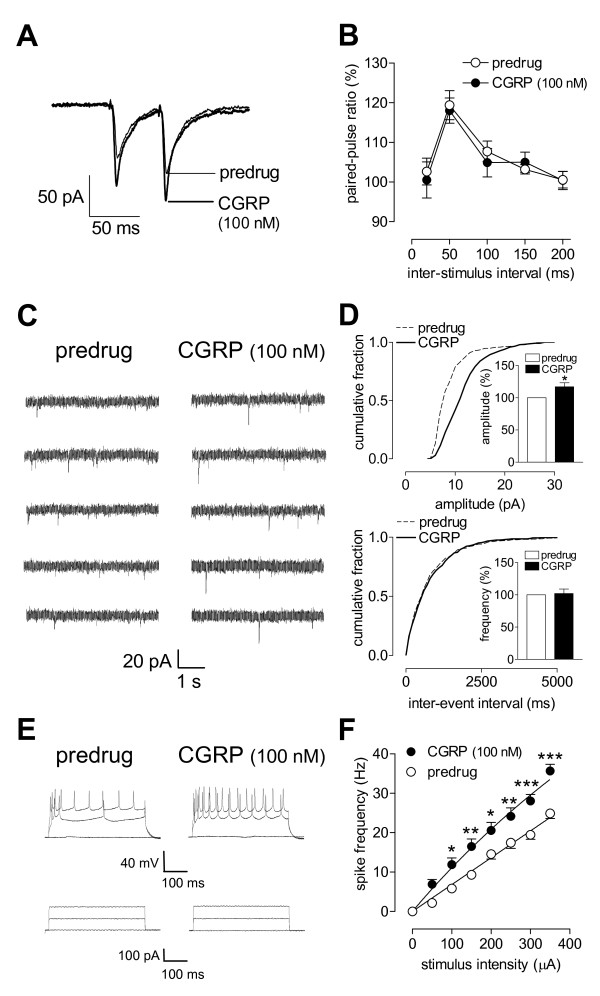
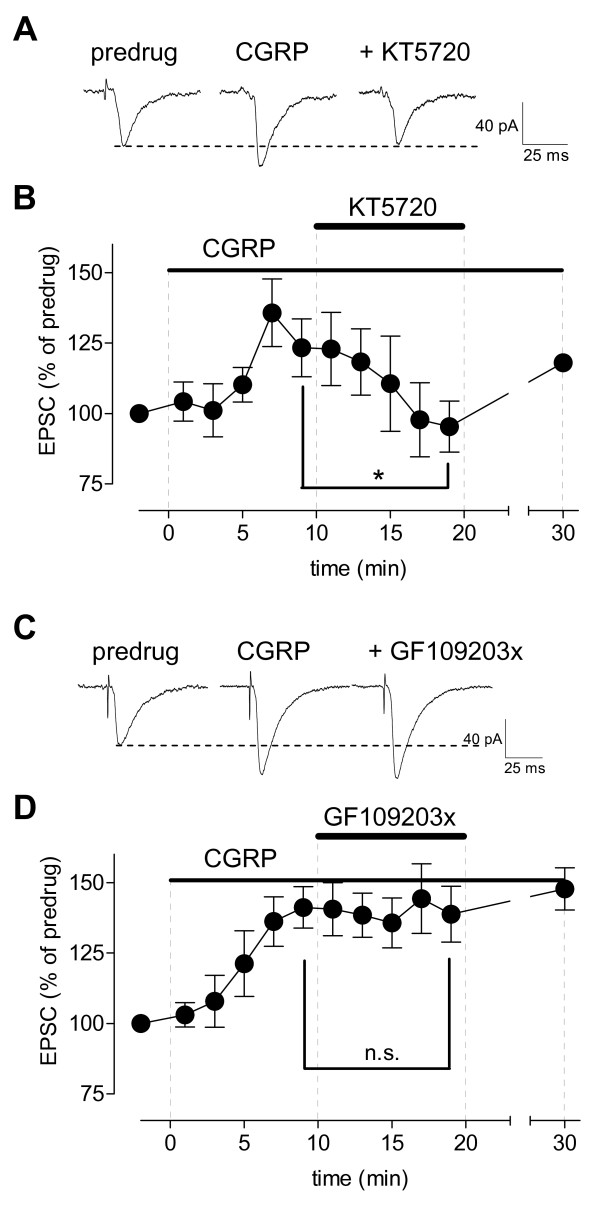
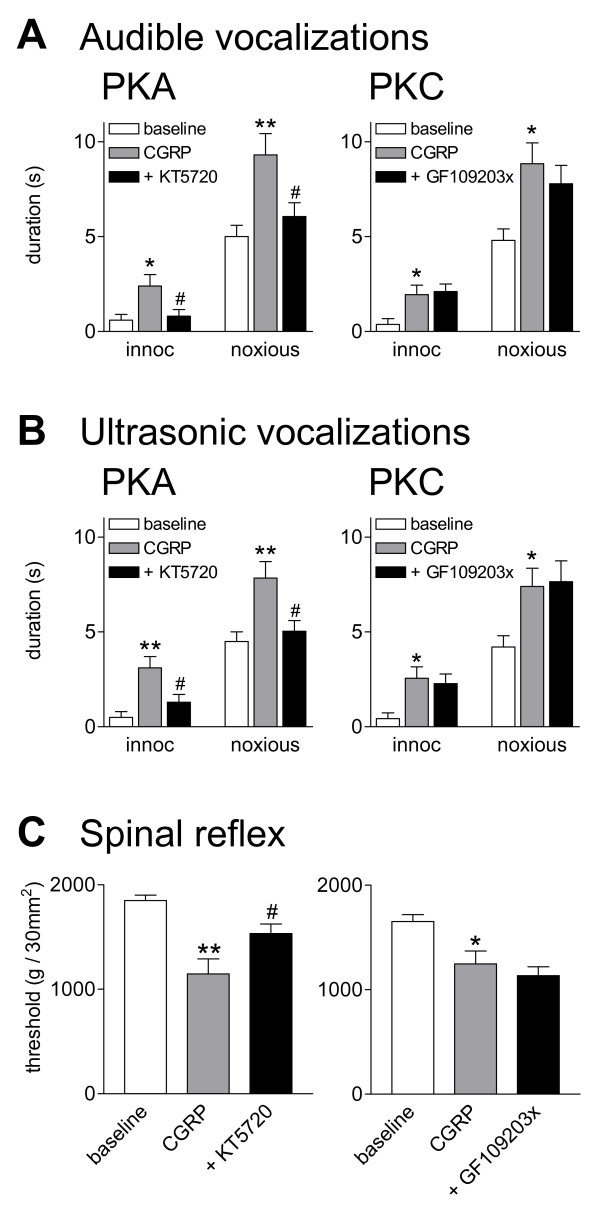
Calcitonin gene-related peptide (CGRP) plays an important role in peripheral and central sensitization. CGRP also is a key molecule in the spino-parabrachial-amygdaloid pain pathway. Blockade of CGRP1 receptors in the spinal cord or in the amygdala has antinociceptive effects in different pain models. Here we studied the electrophysiological mechanisms of behavioral effects of CGRP in the amygdala in normal animals without tissue injury.Whole-cell patch-clamp recordings of neurons in the latero-capsular division of the central nucleus of the amygdala (CeLC) in rat brain slices showed that CGRP (100 nM) increased excitatory postsynaptic currents (EPSCs) at the parabrachio-amygdaloid (PB-CeLC) synapse, the exclusive source of CGRP in the amygdala. Consistent with a postsynaptic mechanism of action, CGRP increased amplitude, but not frequency, of miniature EPSCs and did not affect paired-pulse facilitation. CGRP also increased neuronal excitability. CGRP-induced synaptic facilitation was reversed by an NMDA receptor antagonist (AP5, 50 microM) or a PKA inhibitor (KT5720, 1 microM), but not by a PKC inhibitor (GF109203X, 1 microM). Stereotaxic administration of CGRP (10 microM, concentration in microdialysis probe) into the CeLC by microdialysis in awake rats increased audible and ultrasonic vocalizations and decreased hindlimb withdrawal thresholds. Behavioral effects of CGRP were largely blocked by KT5720 (100 microM) but not by GF109203X (100 microM).The results show that CGRP in the amygdala exacerbates nocifensive and affective behavioral responses in normal animals through PKA- and NMDA receptor-dependent postsynaptic facilitation. Thus, increased CGRP levels in the amygdala might trigger pain in the absence of tissue injury.
降钙素基因相关肽(CGRP)在外周和中枢敏化中发挥重要作用。CGRP 也是脊髓-臂旁核-杏仁核痛觉通路中的关键分子。在不同的疼痛模型中,脊髓或杏仁核中 CGRP1 受体的阻断具有镇痛作用。在这里,我们在没有组织损伤的正常动物中研究了 CGRP 在杏仁核中的电生理机制对行为的影响。在大鼠脑切片中,杏仁核中央核外侧区(CeLC)的神经元全细胞膜片钳记录显示,CGRP(100 nM)增加了臂旁核-杏仁核(PB-CeLC)突触的兴奋性突触后电流(EPSCs),这是杏仁核中 CGRP 的唯一来源。与突触后作用机制一致,CGRP 增加了微小 EPSC 的幅度,但不增加频率,并且不影响成对脉冲易化。CGRP 还增加了神经元兴奋性。CGRP 诱导的突触易化被 NMDA 受体拮抗剂(AP5,50 microM)或 PKA 抑制剂(KT5720,1 microM)逆转,但不被 PKC 抑制剂(GF109203X,1 microM)逆转。在清醒大鼠中,通过微透析将 CGRP(10 microM,微透析探针中的浓度)立体定向注入 CeLC 会增加可听和超声发声,并降低后肢退缩阈值。CGRP 的行为效应主要被 KT5720(100 microM)阻断,但不受 GF109203X(100 microM)的影响。结果表明,杏仁核中的 CGRP 通过 PKA 和 NMDA 受体依赖性突触后易化加重正常动物的伤害性和情感行为反应。因此,杏仁核中 CGRP 水平的升高可能在没有组织损伤的情况下引发疼痛。