Doseeva Victoria, Colpitts Tracey, Gao Grace, Woodcock Juliana, Knezevic Vladimir
20/20 GeneSystems, 9430 Key West Avenue, Rockville, MD, 20850, USA.
Abbott Molecular Inc, 1300 E Touhy Avenue, Des Plaines, IL, 60018, USA.
J Transl Med. 2015 Feb 12;13:55. doi: 10.1186/s12967-015-0419-y.
"PAULA's" test (Protein Assays Utilizing Lung cancer Analytes) is a novel multiplex immunoassay blood test that incorporates both tumor antigens and autoantibodies to determine the risk that lung cancer (LC) is present in individuals from a high-risk population. The test's performance characteristics were evaluated in a study using 380 retrospective clinical serum samples.
PAULA's test is performed on the Luminex xMAP technology platform, and detects a panel of 3 tumor antigens (CEA, CA-125, and CYFRA 21-1) and 1 autoantibody marker (NY-ESO-1). A training set (n = 230) consisting of 115 confirmed diagnoses of non-small cell lung carcinoma (NSCLC) cases and 115 age- and smoking history-matched controls was used to develop the LC predictive model. Data from an independent matched validation set (n = 150) was then used to evaluate the model developed, and determine the ability of the test to distinguish NSCLC cases from controls.
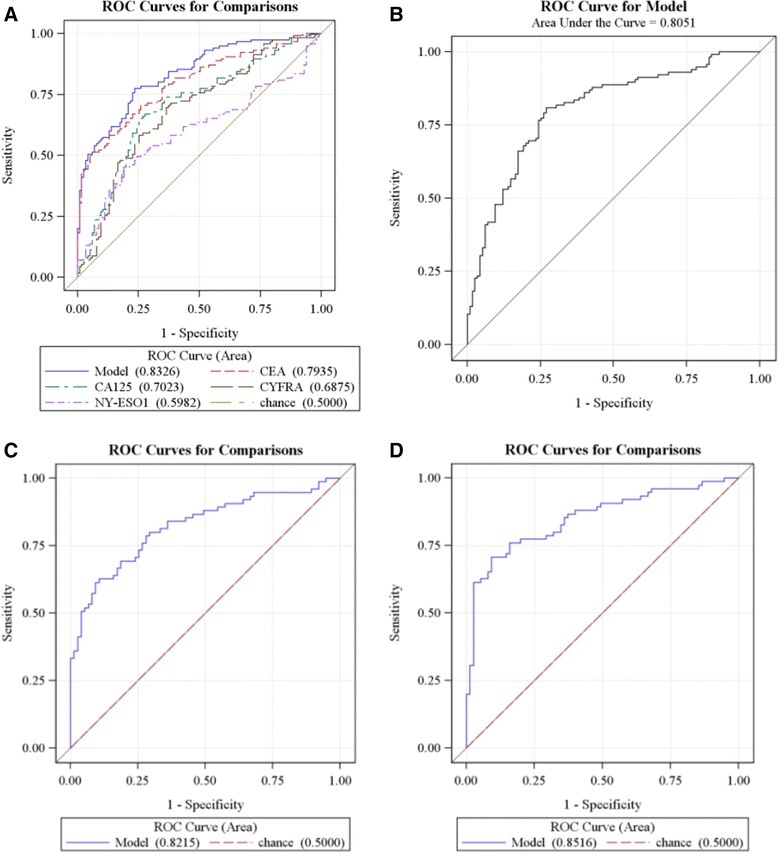
The 4-biomarker panel was able to discriminate NSCLC cases from controls with 74% sensitivity, 80% specificity, and 0.81 AUC in the training set and with 77% sensitivity, 80% specificity, and 0.85 AUC in the independent validation set. The use of NY-ESO-1 autoantibodies substantially increased the overall sensitivity of NSCLC detection as compared to the 3 tumor markers alone. Overall, the multiplexed 4-biomarker panel assay demonstrated comparable performance to a previously employed 8-biomarker non-multiplexed assay.
These studies confirm the value of using a mixed panel of tumor antigens and autoantibodies in the early detection of NSCLC in high-risk individuals. The results demonstrate that the performance of PAULA's test makes it suitable for use as an aid to determine which high-risk patients need to be directed to appropriate noninvasive diagnostic follow-up testing, especially low-dose CT (LDCT).
“宝拉”检测(利用肺癌分析物的蛋白质检测)是一种新型多重免疫分析血液检测,它结合了肿瘤抗原和自身抗体,以确定高危人群个体中存在肺癌(LC)的风险。在一项使用380份回顾性临床血清样本的研究中评估了该检测的性能特征。
“宝拉”检测在Luminex xMAP技术平台上进行,检测一组3种肿瘤抗原(癌胚抗原、糖类抗原125和细胞角蛋白19片段)和1种自身抗体标志物(NY-ESO-1)。使用由115例确诊的非小细胞肺癌(NSCLC)病例和115例年龄及吸烟史匹配的对照组成的训练集(n = 230)来建立LC预测模型。然后使用来自独立匹配验证集(n = 150)的数据来评估所建立的模型,并确定该检测区分NSCLC病例和对照的能力。
在训练集中,4生物标志物组合能够以74%的灵敏度、80%的特异性和0.81的曲线下面积区分NSCLC病例和对照,在独立验证集中以77%的灵敏度、80%的特异性和0.85的曲线下面积区分。与单独的3种肿瘤标志物相比,NY-ESO-1自身抗体的使用显著提高了NSCLC检测的总体灵敏度。总体而言,多重4生物标志物组合检测显示出与先前使用的8生物标志物非多重检测相当的性能。
这些研究证实了在高危个体中使用肿瘤抗原和自身抗体混合组合进行NSCLC早期检测的价值。结果表明,“宝拉”检测的性能使其适合用作辅助手段,以确定哪些高危患者需要接受适当的非侵入性诊断后续检测,尤其是低剂量CT(LDCT)。