Whitacre James M
School of Computer Science, University of Birmingham, Edgbaston, UK.
Theor Biol Med Model. 2010 Feb 18;7:6. doi: 10.1186/1742-4682-7-6.
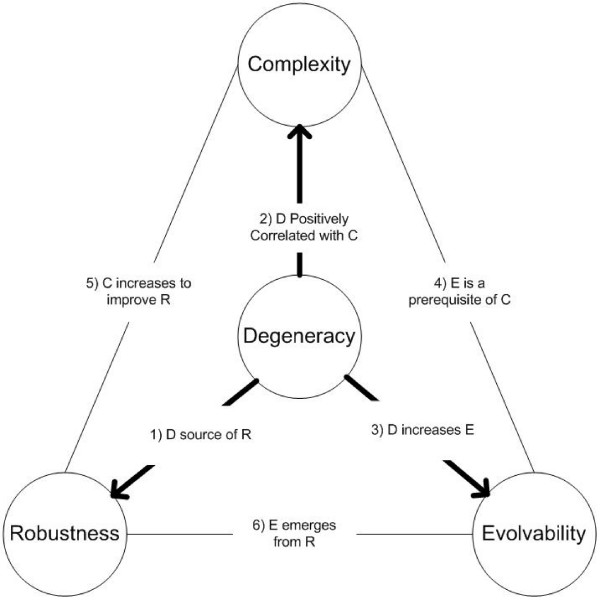
A full accounting of biological robustness remains elusive; both in terms of the mechanisms by which robustness is achieved and the forces that have caused robustness to grow over evolutionary time. Although its importance to topics such as ecosystem services and resilience is well recognized, the broader relationship between robustness and evolution is only starting to be fully appreciated. A renewed interest in this relationship has been prompted by evidence that mutational robustness can play a positive role in the discovery of adaptive innovations (evolvability) and evidence of an intimate relationship between robustness and complexity in biology.This paper offers a new perspective on the mechanics of evolution and the origins of complexity, robustness, and evolvability. Here we explore the hypothesis that degeneracy, a partial overlap in the functioning of multi-functional components, plays a central role in the evolution and robustness of complex forms. In support of this hypothesis, we present evidence that degeneracy is a fundamental source of robustness, it is intimately tied to multi-scaled complexity, and it establishes conditions that are necessary for system evolvability.
对生物稳健性的全面阐释仍然难以捉摸,这体现在实现稳健性的机制以及在进化过程中促使稳健性增强的力量这两个方面。尽管其对生态系统服务和恢复力等主题的重要性已得到充分认可,但稳健性与进化之间更广泛的关系才刚刚开始被全面认识。有证据表明,突变稳健性可在适应性创新(可进化性)的发现中发挥积极作用,且生物学中稳健性与复杂性之间存在密切关系,这引发了对这种关系的新兴趣。本文为进化机制以及复杂性、稳健性和可进化性的起源提供了新视角。在此,我们探讨这样一个假说,即简并性(多功能组件功能的部分重叠)在复杂形式的进化和稳健性中起着核心作用。为支持这一假说,我们提供证据表明,简并性是稳健性的根本来源,它与多尺度复杂性紧密相关,并为系统可进化性奠定了必要条件。