Instituto de Farmacologia e Terapêutica, Faculdade de Medicina, Universidade de Coimbra, Portugal.
Virol J. 2010 Feb 18;7:42. doi: 10.1186/1743-422X-7-42.
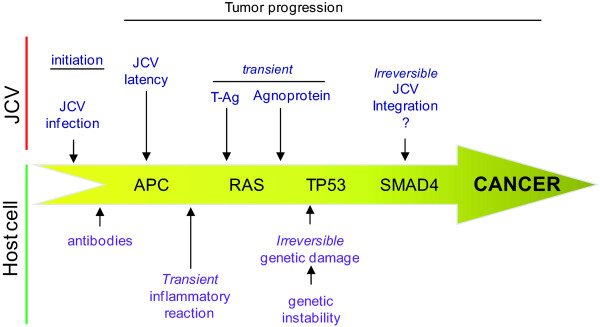
JCV infection occurs early in childhood and last throughout life. JCV has been associated to colorectal cancer and might contribute to the cancer phenotype by several mechanisms. Among JCV proteins, particularly two of them, large T-antigen and agnoprotein, can interfere with cell cycle control and genomic instability mechanisms, but other viral proteins might also contribute to the process. Part of viral DNA sequences are detected in carcinoma lesions, but less frequently in adenomas, and not in the normal surrounding tissue, suggesting they are integrated in the host cell genome and these integrations have been selected; in addition viral integration can cause a gene, or chromosomal damage. The inflammatory infiltration caused by a local chronic viral infection in the intestine can contribute to the selection and expansion of a tumor prone cell in a cytokine rich microenvironment. JCV may not be the cause of colorectal cancer, but it can be a relevant risk factor and able to facilitate progression at one or several stages in tumor progression. JCV transient effects might lead to selective expansion of tumor cells. Since there is not a direct cause and effect relationship, JCV infection may be an alternative to low frequency cancer predisposition genes.
JCV 感染发生在儿童早期,并持续终生。JCV 与结直肠癌有关,可能通过多种机制促进癌症表型。在 JCV 蛋白中,特别是其中两种,即大 T 抗原和 agnoprotein,可干扰细胞周期控制和基因组不稳定性机制,但其他病毒蛋白也可能参与该过程。部分病毒 DNA 序列可在癌病变中检测到,但在腺瘤中较少,在正常周围组织中未检测到,提示它们整合到宿主细胞基因组中,并经过选择;此外,病毒整合可导致基因或染色体损伤。肠道局部慢性病毒感染引起的炎症浸润可能有助于富含细胞因子的微环境中肿瘤倾向细胞的选择和扩增。JCV 可能不是结直肠癌的病因,但它可能是一个相关的危险因素,并能够在肿瘤进展的一个或多个阶段促进进展。JCV 的瞬时效应可能导致肿瘤细胞的选择性扩增。由于没有直接的因果关系,JCV 感染可能是低频癌症易感性基因的替代。