Department of Psychology, The Pennsylvania State University, 415 Moore Building, University Park, PA 16802, USA.
J Fam Psychol. 2010 Feb;24(1):21-30. doi: 10.1037/a0017952.
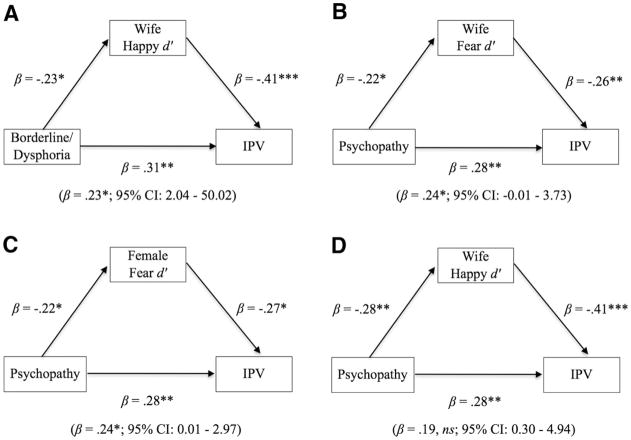
Among a community sample of 88 couples, husbands' emotion recognition skills were examined as a mechanism accounting for the relationships between two dimensions of psychopathology that commonly describe violent husbands (i.e., borderline/dysphoric and psychopathic personality characteristics) and their perpetration of intimate partner violence (IPV). Husbands' diminished sensitivity to their wives' expressions of happiness partially mediated the relationship between their borderline/dysphoric characteristics and their IPV perpetration, supporting Dutton's (1995) theory of IPV. These relationships were specific to expressions displayed by husbands' wives (as opposed to unfamiliar men and women), demonstrating the significance of the intimate relationship. Partial support was found for Blair's (1995) violence inhibition mechanism model, such that husbands' IPV was associated with their diminished sensitivity to expressions of fear and their psychopathy was associated with misidentifying fearful expressions as neutral. However, the strength of husbands' diminished sensitivity to fear as a mediator of the psychopathy-IPV relationship was suboptimal. Moreover, sensitivity to wives' expressions of happiness also mediated the psychopathy-IPV relationship, potentially because of overlap in psychopathology constructs or inadequate examination of the temporal specificity of the two theories tested.
在一个 88 对夫妇的社区样本中,研究了丈夫的情绪识别技能,作为一种机制,解释了两种常见描述暴力丈夫的精神病理学维度(即边缘型/烦躁型和精神病态人格特征)与他们实施亲密伴侣暴力(IPV)之间的关系。丈夫对妻子幸福感表达的敏感性降低部分解释了他们的边缘型/烦躁型特征与他们的 IPV 实施之间的关系,支持了 Dutton(1995)的 IPV 理论。这些关系是特定于丈夫的妻子表现出来的(与不熟悉的男性和女性相对),表明了亲密关系的重要性。Blair(1995)的暴力抑制机制模型得到了部分支持,即丈夫的 IPV 与他们对恐惧表达的敏感性降低有关,他们的精神病态与将恐惧表达错误识别为中性有关。然而,丈夫对恐惧的敏感性降低作为精神病态与 IPV 关系的中介的强度并不理想。此外,对妻子幸福感表达的敏感性也中介了精神病态与 IPV 的关系,这可能是由于精神病理学结构的重叠或对两种测试理论的时间特异性的充分检查。