Research and Development Department, Toxicology Division, National Food Administration, Box 622, SE-751 26 Uppsala, Sweden.
Nutr Metab (Lond). 2010 Feb 22;7:12. doi: 10.1186/1743-7075-7-12.
Drinking coffee has been linked to reduced calcium conservation, but it is less clear whether it leads to sustained bone mineral loss and if individual predisposition for caffeine metabolism might be important in this context. Therefore, the relation between consumption of coffee and bone mineral density (BMD) at the proximal femur in men and women was studied, taking into account, for the first time, genotypes for cytochrome P450 1A2 (CYP1A2) associated with metabolism of caffeine.
Dietary intakes of 359 men and 358 women (aged 72 years), participants of the Prospective Investigation of the Vasculature in Uppsala Seniors (PIVUS), were assessed by a 7-day food diary. Two years later, BMD for total proximal femur, femoral neck and trochanteric regions of the proximal femur were measured by Dual-energy X-ray absorptiometry (DXA). Genotypes of CYP1A2 were determined. Adjusted means of BMD for each category of coffee consumption were calculated.
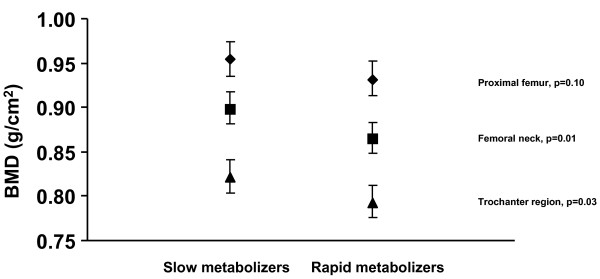
Men consuming 4 cups of coffee or more per day had 4% lower BMD at the proximal femur (p = 0.04) compared with low or non-consumers of coffee. This difference was not observed in women. In high consumers of coffee, those with rapid metabolism of caffeine (C/C genotype) had lower BMD at the femoral neck (p = 0.01) and at the trochanter (p = 0.03) than slow metabolizers (T/T and C/T genotypes). Calcium intake did not modify the relation between coffee and BMD.
High consumption of coffee seems to contribute to a reduction in BMD of the proximal femur in elderly men, but not in women. BMD was lower in high consumers of coffee with rapid metabolism of caffeine, suggesting that rapid metabolizers of caffeine may constitute a risk group for bone loss induced by coffee.
喝咖啡与钙的保留减少有关,但目前尚不清楚它是否会导致持续的骨质流失,以及咖啡因代谢的个体易感性是否在这方面很重要。因此,研究了男性和女性股骨近端骨矿物质密度(BMD)与咖啡消耗之间的关系,同时首次考虑了与咖啡因代谢相关的细胞色素 P450 1A2(CYP1A2)的基因型。
通过 7 天的饮食日记评估了 Prospective Investigation of the Vasculature in Uppsala Seniors(PIVUS)研究中 359 名男性和 358 名女性(年龄 72 岁)的饮食摄入量。两年后,通过双能 X 射线吸收法(DXA)测量总股骨近端、股骨颈和股骨近端转子区域的 BMD。确定 CYP1A2 的基因型。计算了每个咖啡消费类别 BMD 的调整平均值。
每天饮用 4 杯或更多咖啡的男性股骨近端 BMD 比低或不喝咖啡的男性低 4%(p=0.04)。在女性中未观察到这种差异。在高咖啡消费者中,快速代谢咖啡因的人(C/C 基因型)股骨颈(p=0.01)和转子(p=0.03)的 BMD 低于慢速代谢者(T/T 和 C/T 基因型)。钙摄入量并未改变咖啡与 BMD 之间的关系。
高咖啡消耗似乎会导致老年男性股骨近端 BMD 降低,但不会导致女性 BMD 降低。快速代谢咖啡因的高咖啡消费者的 BMD 较低,这表明咖啡因快速代谢者可能构成了咖啡引起的骨质流失的风险群体。