The Center of Diagnosis, Treatment and Research of Hypertension in Xinjiang, Tianchi Road, Urumqi, Xinjiang, China.
BMC Public Health. 2010 Feb 24;10:91. doi: 10.1186/1471-2458-10-91.
The prevalence of population-wide hypertension, obesity and dyslipidemia has not been well studied in the pasture area of Xinjiang. The present epidemiological study was performed to determine the prevalence of hypertension, obesity and dyslipidemia in minority populations from the pasture area of Xinjiang and to discuss the potential risk factors for hypertension.
A population-based, cross-sectional study in the Xinjiang pasture area was performed which included 2251 participants aged over 30 years (90.33% participation rate) of whom 71.26% were Kazaks. Several risk factors were considered: hypertension (defined as systolic or diastolic blood pressure or both of at least 140/90 mmHg measured on one occasion or treatment for hypertension) overweight/obesity (body mass index > or = 25 kg/m2) alcohol intake, smoking/tobacco use and dyslipidemia. Outcomes were prevalence of hypertension, obesity and dyslipidemia and the associated risk factors of hypertension detected by multivariate logistic regression analysis taking into account various metabolic and lifestyle characteristics.
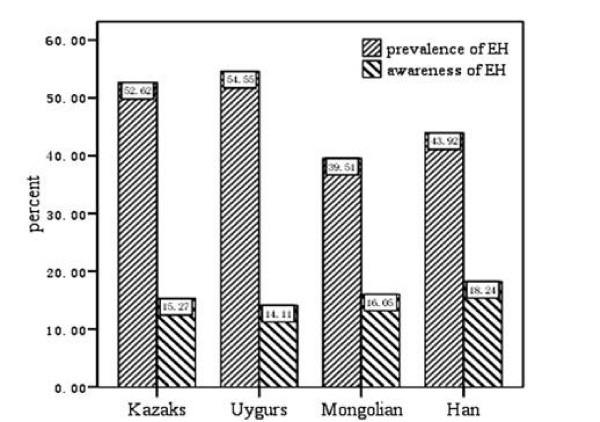
The prevalence of hypertension, overweight/obesity and dyslipidemia in all participants from the pasture area of Xinjiang was 51.9%, 47.9% and 49.2% respectively. Independently, the prevalence and awareness of hypertension was 52.6% and 15.3% among Kazaks (n = 1604), 54.6% and 14.1% among Uygurs (n = 418), 39.5% and 16.1% among Mongolians (n = 81) and 43.9% and 18.2% among non-Xinjiang-born Han immigrants (n = 148). The prevalence of overweight/obesity in Kazaks, Uygurs, Mongolians and Han immigrants was 46.7%, 48.9%, 62.5% and 50.3%, respectively. The prevalence of dyslipidemia in the four ethnic groups mentioned was 53.5%, 34.8%, 49.3% and 47.3%, respectively. The mean blood pressure in all participants was 136/86 mmHg (pre-hypertensive), the mean BMI was 24.7 kg/m2. Based on multiple logistic regression analysis, the significant risk factors for hypertension were age [1.07(1.06-1.09), P < 0.0001], overweight/obesity [overweight: 1.61(1.22-2.13), p = 0.0007; obesity: 1.95 (1.33-2.87), p = 0.0007], hypercholesterolemia [1.30(1.15-1.47), p < 0.0001] and an alcohol intake of over 30 g/day [2.22(1.43-3.45), p = 0.0004].
The considerably high prevalence of hypertension, overweight/obesity and dyslipidemia among the minority population aged over 30 from the pasture area of Xinjiang calls for effective preventive measures. Age, increased body mass index, hypercholesterolemia and > or =30 g/d alcohol intake can be counted as risk factors for hypertension, but further genetic or environmental clarification would be desirable to explain the unusually high prevalence of the conditions mentioned above.
在新疆牧区,人群高血压、肥胖和血脂异常的流行情况尚未得到很好的研究。本研究旨在确定新疆牧区少数民族人群高血压、肥胖和血脂异常的流行情况,并探讨高血压的潜在危险因素。
采用整群抽样方法,对新疆牧区 2251 名年龄在 30 岁以上的人群(参与率为 90.33%)进行了一项基于人群的横断面研究,其中哈萨克族占 71.26%。考虑了几种危险因素:高血压(定义为一次测量收缩压或舒张压或两者均至少为 140/90mmHg,或正在接受高血压治疗)、超重/肥胖(体重指数≥25kg/m2)、饮酒、吸烟/使用烟草和血脂异常。采用多变量 logistic 回归分析,考虑各种代谢和生活方式特征,分析高血压、肥胖和血脂异常的流行情况以及高血压的相关危险因素。
新疆牧区所有参与者的高血压、超重/肥胖和血脂异常的患病率分别为 51.9%、47.9%和 49.2%。分别来看,哈萨克族(n=1604)高血压的患病率和知晓率为 52.6%和 15.3%,维吾尔族(n=418)为 54.6%和 14.1%,蒙古族(n=81)为 39.5%和 16.1%,非新疆籍汉族移民(n=148)为 43.9%和 18.2%。哈萨克族、维吾尔族、蒙古族和汉族移民的超重/肥胖患病率分别为 46.7%、48.9%、62.5%和 50.3%。上述四个民族的血脂异常患病率分别为 53.5%、34.8%、49.3%和 47.3%。所有参与者的平均血压为 136/86mmHg(高血压前期),平均 BMI 为 24.7kg/m2。基于多变量 logistic 回归分析,高血压的显著危险因素为年龄[1.07(1.06-1.09),P<0.0001]、超重/肥胖[超重:1.61(1.22-2.13),p=0.0007;肥胖:1.95(1.33-2.87),p=0.0007]、高胆固醇血症[1.30(1.15-1.47),p<0.0001]和每日饮酒量超过 30g[2.22(1.43-3.45),p=0.0004]。
新疆牧区 30 岁以上少数民族人群高血压、超重/肥胖和血脂异常的患病率相当高,需要采取有效的预防措施。年龄、体重指数增加、高胆固醇血症和≥30g/d的饮酒量可视为高血压的危险因素,但为了更好地解释上述情况的高发率,还需要进一步的遗传或环境阐明。