Department of Psychology, Catholic University of America, Washington, DC 20064, USA.
J Abnorm Child Psychol. 2010 Jul;38(5):695-706. doi: 10.1007/s10802-010-9395-0.
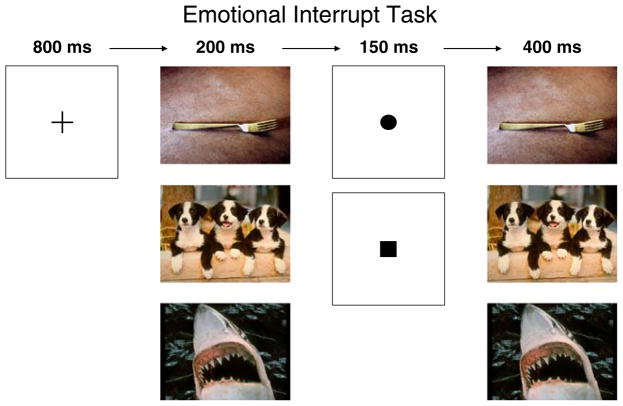
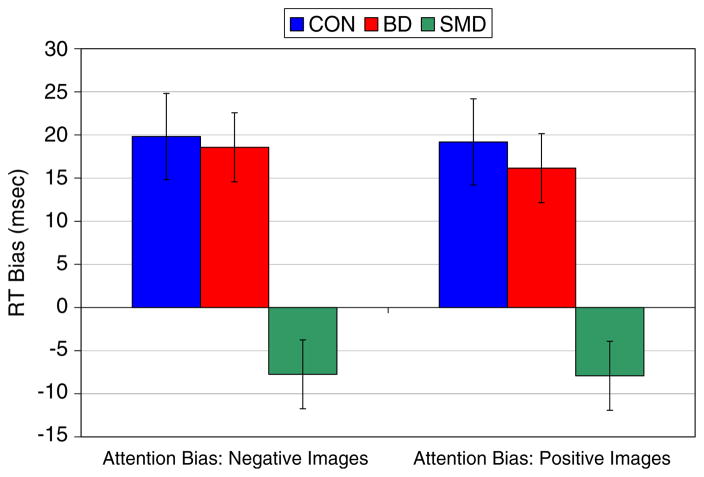
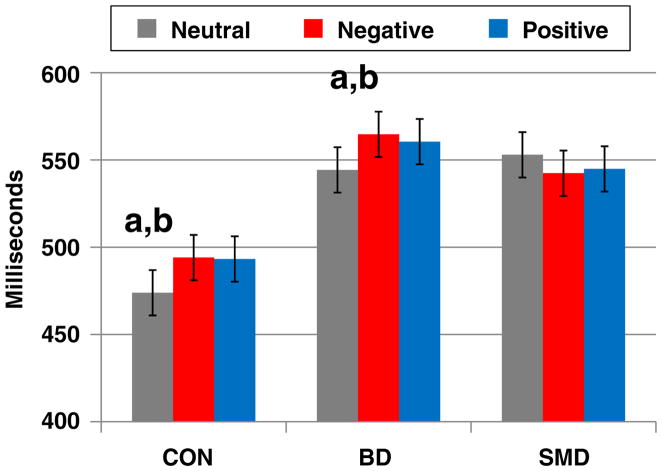
Studying attention in the context of emotional stimuli may aid in differentiating pediatric bipolar disorder (BD) from severe mood dysregulation (SMD). SMD is characterized by chronic irritability, arousal, and hyper-reactivity; SMD youth frequently receive a BD diagnosis although they do not meet DSM-IV criteria for BD because they lack manic episodes. We compared 57 BD (14.4 +/- 2.9 years old, 56% male), 41 SMD (12.6 +/- 2.6 years old, 66% male), and 33 control subjects (13.7 +/- 2.5 years old, 52% male) using the Emotional Interrupt task, which examines how attention is impacted by positive, negative, or neutral distracters. We compared reaction time (RT) and accuracy and calculated attention interference scores by subtracting performance on neutral trials from emotional trials. Between-group analyses indicated that SMD subjects had significantly reduced attention interference from emotional distracters relative to BD and control subjects. Thus, attention in SMD youth was not modulated by emotional stimuli. This blunted response in SMD youth may contribute to their affective and behavioral dysregulation.
研究情绪刺激下的注意力有助于区分儿童双相情感障碍(BD)和严重情绪失调(SMD)。SMD 的特征为慢性易怒、觉醒和高反应性;尽管 SMD 青少年不符合 DSM-IV 双相障碍标准,因为他们缺乏躁狂发作,但他们经常被诊断为双相障碍。我们使用情绪中断任务比较了 57 名 BD(14.4 +/- 2.9 岁,56%为男性)、41 名 SMD(12.6 +/- 2.6 岁,66%为男性)和 33 名对照组(13.7 +/- 2.5 岁,52%为男性),该任务检查了注意力如何受到正性、负性或中性干扰物的影响。我们比较了反应时间(RT)和准确性,并通过从中性试验中减去情绪试验的结果来计算注意力干扰分数。组间分析表明,与 BD 和对照组相比,SMD 受试者的情绪干扰注意力明显减少。因此,SMD 青少年的注意力不受情绪刺激的调节。SMD 青少年的这种反应迟钝可能导致他们的情感和行为失调。