National Institute of Mental Health (NIMH), National Institutes of Health (NIH), Department of Health and Human Services, USA.
J Am Acad Child Adolesc Psychiatry. 2011 Nov;50(11):1173-1185.e2. doi: 10.1016/j.jaac.2011.07.011. Epub 2011 Sep 9.
Outcome and family history data differentiate children with severe mood dysregulation (SMD), a syndrome characterized by chronic irritability, from children with "classic" episodic bipolar disorder (BD). Nevertheless, the presence of cognitive inflexibility in SMD and BD highlights the need to delineate neurophysiologic similarities and differences between the two patient groups. Functional magnetic resonance imaging was used to examine neural correlates of cognitive flexibility deficits in patients with SMD and BD versus healthy volunteers (HV).
During functional magnetic resonance imaging, subjects completed a response reversal task that assessed cognitive flexibility (n = 22 with SMD, 26 with BD, 34 HV). Task effects were examined in four regions of interest: caudate, cingulate gyrus, inferior frontal gyrus (IFG), and ventromedial prefrontal cortex.
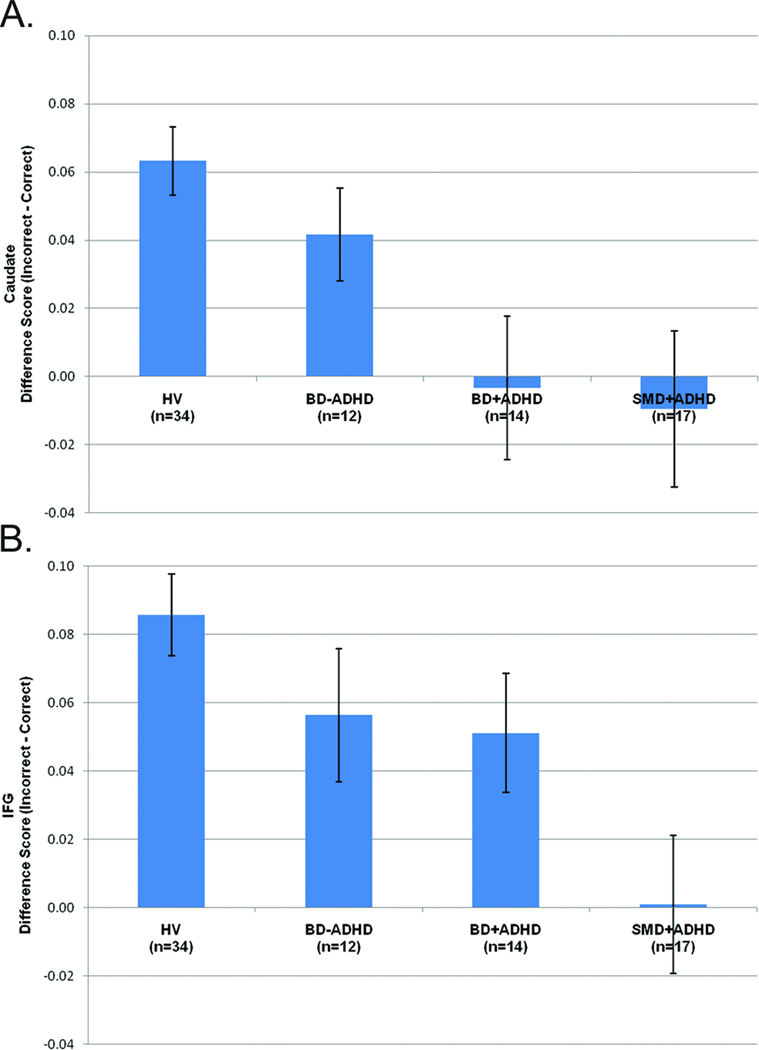
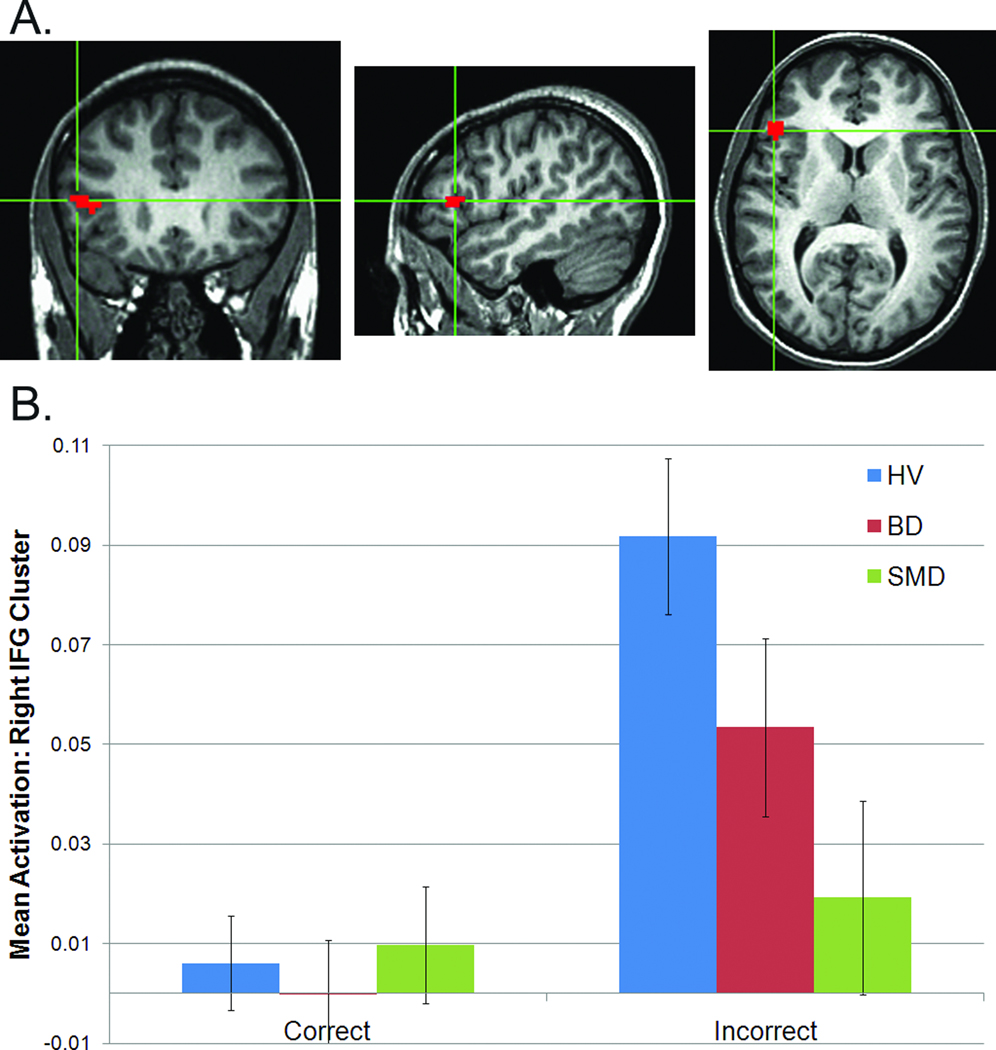
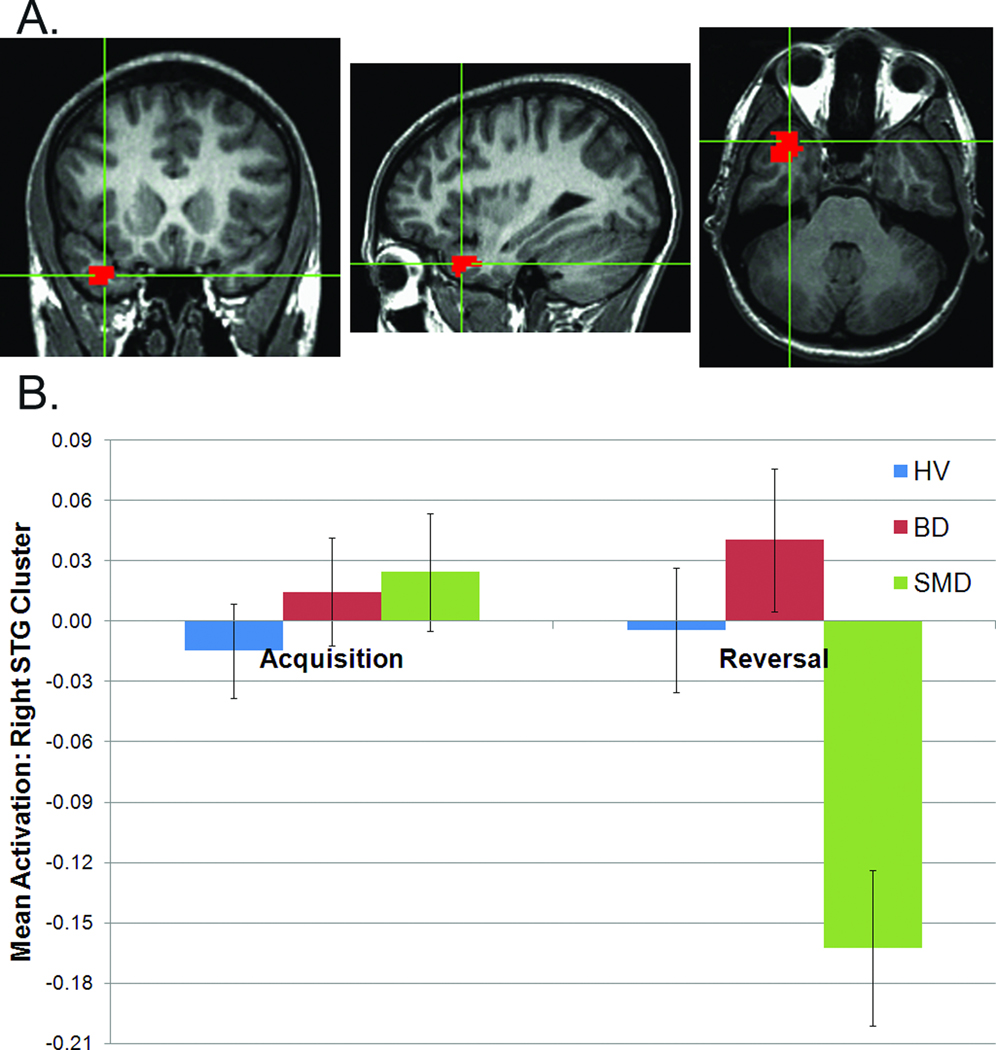
Diagnosis-by-accuracy interactions emerged in the caudate and IFG. In these regions, the difference in activation was calculated between incorrect and correct trials. In the caudate, this value was smaller in subjects with SMD and with BD than in HV. In the IFG, however, this value was smaller in subjects with SMD than in those with BD and in HV. Post hoc analyses indicated that comorbid attention-deficit/hyperactivity disorder in patients may influence the caudate findings. Exploratory whole-brain analysis confirmed the caudate and IFG findings. In addition, other regions differentiating SMD from BD were identified (e.g., superior parietal lobule/precuneus and inferior temporal gyrus).
In response to errors, similar perturbations occur in the caudate for youth with SMD and BD compared with HV youth. IFG deficits, in contrast, manifest in youth with SMD, but not with BD.
结局和家族史数据可区分具有严重情绪失调(SMD)的儿童与以慢性易激惹为特征的“典型”发作性双相情感障碍(BD)儿童。然而,SMD 和 BD 中认知灵活性的存在突出表明需要描绘这两组患者之间的神经生理相似性和差异性。使用功能磁共振成像检查 SMD 和 BD 患者与健康对照者(HV)认知灵活性缺陷的神经相关性。
在功能磁共振成像期间,受试者完成了一项反应反转任务,该任务评估了认知灵活性(SMD 组 22 名,BD 组 26 名,HV 组 34 名)。在四个感兴趣区域(尾状核、扣带回、下额前回和腹内侧前额皮质)中检查了任务效果。
在尾状核和 IFG 中出现了诊断-准确性交互作用。在这些区域,在错误和正确试验之间计算了激活的差异。在尾状核中,SMD 和 BD 患者的激活值小于 HV。然而,在 IFG 中,SMD 患者的激活值小于 BD 患者和 HV。事后分析表明,患者的共患注意缺陷/多动障碍可能影响尾状核的发现。探索性全脑分析证实了尾状核和 IFG 的发现。此外,还确定了可区分 SMD 与 BD 的其他区域(例如,顶叶上回/楔前叶和颞下回)。
与 HV 青少年相比,SMD 和 BD 青少年在出现错误时尾状核中出现类似的扰动。相反,IFG 缺陷在 SMD 青少年中出现,但在 BD 青少年中未出现。