Kriegeskorte Nikolaus
Medical Research Council Cognition and Brain Sciences Unit Cambridge, UK.
Front Neurosci. 2009 Dec 15;3(3):363-73. doi: 10.3389/neuro.01.035.2009. eCollection 2009.
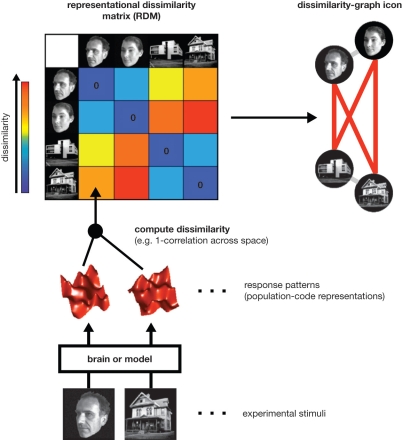
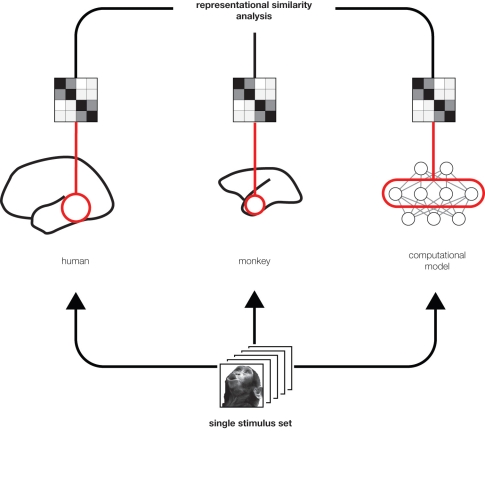
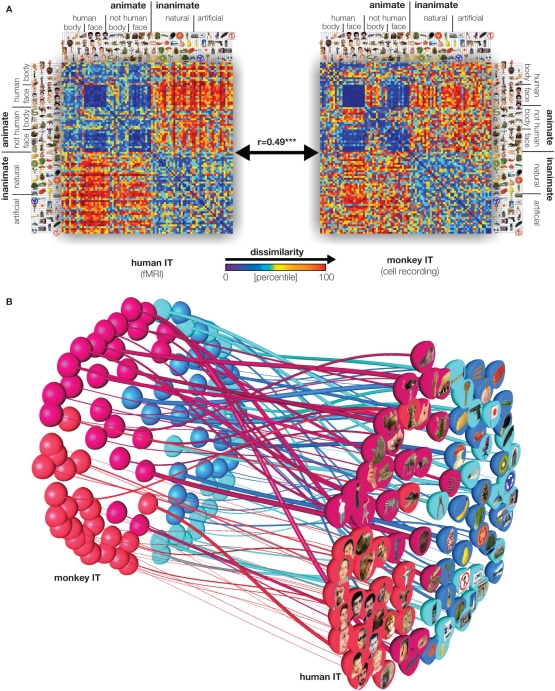
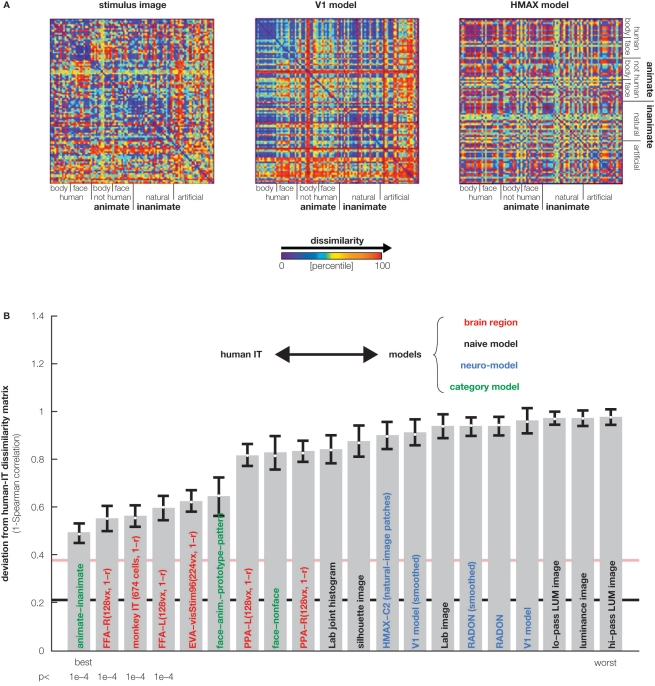
Perceptual and cognitive content is thought to be represented in the brain by patterns of activity across populations of neurons. In order to test whether a computational model can explain a given population code and whether corresponding codes in man and monkey convey the same information, we need to quantitatively relate population-code representations. Here I give a brief introduction to representational similarity analysis, a particular approach to this problem. A population code is characterized by a representational dissimilarity matrix (RDM), which contains a dissimilarity for each pair of activity patterns elicited by a given stimulus set. The RDM encapsulates which distinctions the representation emphasizes and which it deemphasizes. By analyzing correlations between RDMs we can test models and compare different species. Moreover, we can study how representations are transformed across stages of processing and how they relate to behavioral measures of object similarity. We use an example from object vision to illustrate the method's potential to bridge major divides that have hampered progress in systems neuroscience.
知觉和认知内容被认为是由神经元群体的活动模式在大脑中进行表征的。为了测试一个计算模型是否能够解释给定的群体编码,以及人类和猴子的相应编码是否传达相同的信息,我们需要对群体编码表征进行定量关联。在此,我简要介绍一种解决此问题的特定方法——表征相似性分析。群体编码由一个表征差异矩阵(RDM)来表征,该矩阵包含了由给定刺激集引发的每对活动模式之间的差异。RDM概括了表征所强调的区分和所淡化的区分。通过分析RDM之间的相关性,我们可以测试模型并比较不同物种。此外,我们可以研究表征在处理阶段是如何转换的,以及它们如何与物体相似性的行为测量相关联。我们以物体视觉为例来说明该方法在弥合阻碍系统神经科学进展的主要分歧方面的潜力。