Department of International Health, Johns Hopkins Bloomberg School of Public Health, Baltimore, Maryland, USA.
J Infect Dis. 2010 Apr 15;201(8):1208-24. doi: 10.1086/651505.
A quadrivalent meningococcal conjugate vaccine (MCV4) was licensed in the United States in 2005; no serogroup B vaccine is available. Neisseria meningitidis changes its capsular phenotype through capsular switching, which has implications for vaccines that do not protect against all serogroups.
Meningococcal isolates from 10 Active Bacterial Core surveillance sites from 2000 through 2005 were analyzed to identify changes occurring after MCV4 licensure. Isolates were characterized by multilocus sequence typing (MLST) and outer membrane protein gene sequencing. Isolates expressing capsular polysaccharide different from that associated with the MLST lineage were considered to demonstrate capsular switching.
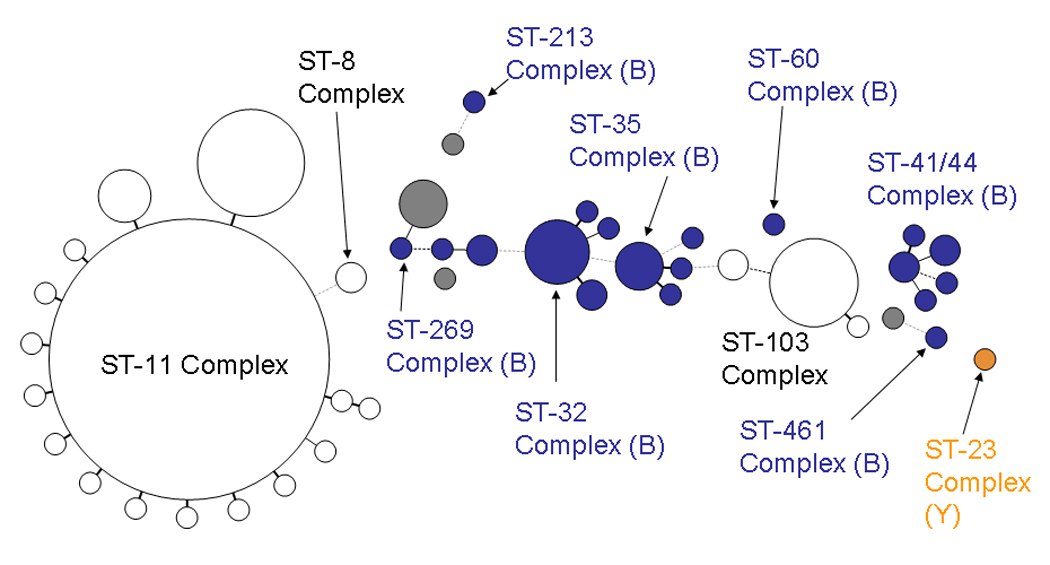
Among 1160 isolates, the most common genetic lineages were the sequence type (ST)-23, ST-32, ST-11, and ST-41/44 clonal complexes. Of serogroup B and Y isolates, 8 (1.5%) and 3 (0.9%), respectively, demonstrated capsular switching, compared with 36 (12.9%) for serogroup C (P < .001); most serogroup C switches were from virulent serogroup B and/or serogroup Y lineages.
A limited number of genetic lineages caused the majority of invasive meningococcal infections. A substantial proportion of isolates had evidence of capsular switching. The high prevalence of capsular switching requires surveillance to detect changes in the meningococcal population structure that may affect the effectiveness of meningococcal vaccines.
四价脑膜炎球菌结合疫苗(MCV4)于 2005 年在美国获得许可;目前尚无 B 型脑膜炎球菌疫苗。脑膜炎奈瑟菌通过荚膜转换改变其荚膜表型,这对不能预防所有血清群的疫苗有影响。
分析了 2000 年至 2005 年期间来自 10 个主动细菌性核心监测点的脑膜炎奈瑟菌分离株,以确定 MCV4 许可后发生的变化。通过多位点序列分型(MLST)和外膜蛋白基因测序对分离株进行了特征描述。与 MLST 谱系相关的荚膜多糖不同的分离株被认为表现出荚膜转换。
在 1160 株分离株中,最常见的遗传谱系是序列型(ST)-23、ST-32、ST-11 和 ST-41/44 克隆复合体。B 群和 Y 群的分离株中,分别有 8 株(1.5%)和 3 株(0.9%)表现出荚膜转换,而 C 群的转换株有 36 株(12.9%)(P<0.001);大多数 C 群的转换株来自毒力较强的 B 群和/或 Y 群谱系。
少数遗传谱系引起了大多数侵袭性脑膜炎奈瑟菌感染。大量分离株有荚膜转换的证据。荚膜转换的高发生率需要进行监测,以发现脑膜炎奈瑟菌种群结构的变化,这些变化可能影响脑膜炎球菌疫苗的效果。