Baker IDI Heart and Diabetes Institute, Melbourne, Victoria, Australia, and the Department of Medicine, Monash University, Melbourne, Victoria, Australia.
Diabetes. 2010 Jun;59(6):1512-20. doi: 10.2337/db09-1456. Epub 2010 Mar 9.
Compelling epidemiological and clinical evidence has identified a specific cardiomyopathy in diabetes, characterized by early diastolic dysfunction and adverse structural remodeling. Activation of the insulin-like growth factor 1 (IGF-1) receptor (IGF-1R) promotes physiological cardiac growth and enhances contractile function. The aim of the present study was to examine whether cardiac-specific overexpression of IGF-1R prevents diabetes-induced myocardial remodeling and dysfunction associated with a murine model of diabetes.
Type 1 diabetes was induced in 7-week-old male IGF-1R transgenic mice using streptozotocin and followed for 8 weeks. Diastolic and systolic function was assessed using Doppler and M-mode echocardiography, respectively, in addition to cardiac catheterization. Cardiac fibrosis and cardiomyocyte width, heart weight index, gene expression, Akt activity, and IGF-1R protein content were also assessed.
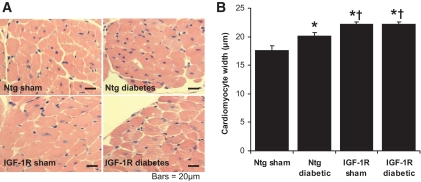
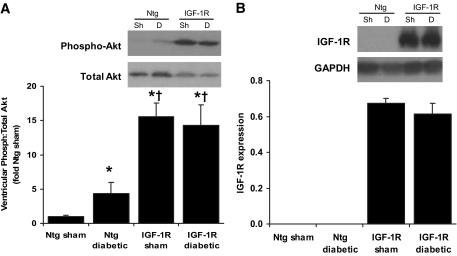
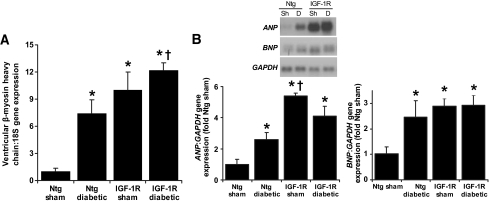
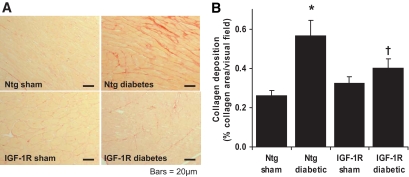
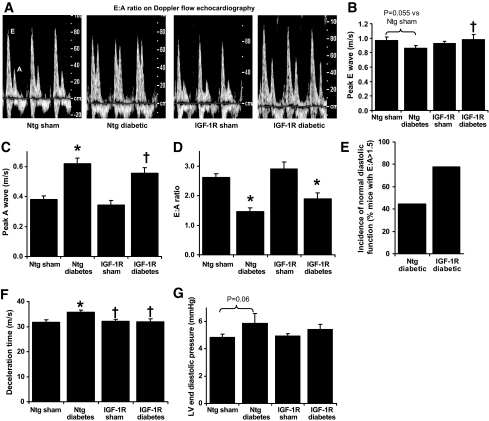
Nontransgenic (Ntg) diabetic mice had reduced initial (E)-to-second (A) blood flow velocity ratio (E:A ratio) and prolonged deceleration times on Doppler echocardiography compared with nondiabetic counterparts, indicative markers of diastolic dysfunction. Diabetes also increased cardiomyocyte width, collagen deposition, and prohypertrophic and profibrotic gene expression compared with Ntg nondiabetic littermates. Overexpression of the IGF-1R transgene markedly reduced collagen deposition, accompanied by a reduction in the incidence of diastolic dysfunction. Akt phosphorylation was elevated approximately 15-fold in IGF-1R nondiabetic mice compared with Ntg, and this was maintained in a setting of diabetes.
The current study suggests that cardiac overexpression of IGF-1R prevented diabetes-induced cardiac fibrosis and diastolic dysfunction. Targeting IGF-1R-Akt signaling may represent a therapeutic target for the treatment of diabetic cardiac disease.
大量强有力的流行病学和临床证据表明,糖尿病存在一种特殊的心肌病,其特征为早期舒张功能障碍和不良的结构重构。胰岛素样生长因子 1(IGF-1)受体(IGF-1R)的激活可促进生理性心脏生长并增强收缩功能。本研究旨在探讨心脏特异性过表达 IGF-1R 是否可以预防糖尿病诱导的心肌重构和功能障碍,以及这种现象与糖尿病小鼠模型的相关性。
使用链脲佐菌素诱导 7 周龄雄性 IGF-1R 转基因小鼠产生 1 型糖尿病,并对其进行为期 8 周的随访。使用多普勒和 M 型超声心动图分别评估舒张和收缩功能,此外还进行了心脏导管术检查。还评估了心脏纤维化和心肌细胞宽度、心脏重量指数、基因表达、Akt 活性和 IGF-1R 蛋白含量。
与非转基因(Ntg)糖尿病小鼠相比,非糖尿病对照组的初始(E)到第二次(A)血流速度比(E:A 比)降低,多普勒超声心动图上的减速时间延长,这些均为舒张功能障碍的标志物。糖尿病还导致心肌细胞宽度、胶原沉积以及促肥厚和促纤维化基因表达增加,与 Ntg 非糖尿病同窝仔鼠相比。IGF-1R 转基因的过度表达可显著减少胶原沉积,同时降低舒张功能障碍的发生率。与 Ntg 相比,IGF-1R 非糖尿病小鼠的 Akt 磷酸化升高了约 15 倍,而在糖尿病状态下仍保持这一水平。
本研究表明,心脏过表达 IGF-1R 可预防糖尿病引起的心脏纤维化和舒张功能障碍。靶向 IGF-1R-Akt 信号可能成为治疗糖尿病性心脏疾病的一种治疗靶点。