Niwa Toshimitsu
Department of Advanced Medicine for Uremia, Nagoya University School of Medicine, 65 Tsurumai-cho, Showa-ku, Nagoya 466-8550, Japan.
Nagoya J Med Sci. 2010 Feb;72(1-2):1-11.
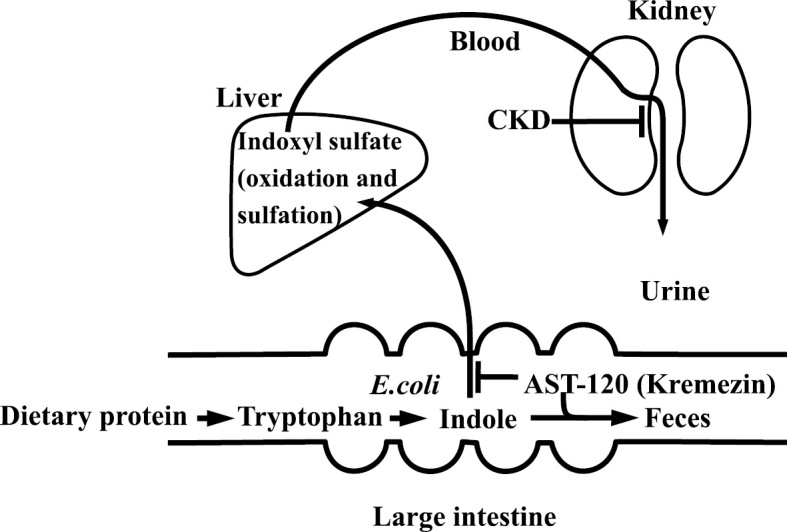
Indoxyl sulfate, a uremic toxin, is accumulated in the serum of chronic kidney disease (CKD) patients. A part of the dietary protein-derived tryptophan is metabolized into indole by tryptophanase in intestinal bacteria. Indole is absorbed into the blood from the intestine, and is metabolized to indoxyl sulfate in the liver. Indoxyl sulfate is normally excreted into urine. In CKD, however, an inadequate renal clearance of indoxyl sulfate leads to its elevated serum levels. The oral adsorbent AST-120 reduces the serum levels of indoxyl sulfate by adsorbing indole in the intestines and stimulating its excretion into feces. I have proposed a protein metabolite theory by which endogenous protein metabolites such as indoxyl sulfate play a significant role in the progression of CKD. A progressive decline in the glomerular filtration rate leads to increased serum levels of endogenous protein metabolites such as indoxyl sulfate, and to the adverse effects of their overload on the remnant nephrons. Indoxyl sulfate stimulates progressive both tubulointerstitial fibrosis and glomerular sclerosis by increasing the expression of transforming growth factor-beta1, a tissue inhibitor of metalloproteinase-1 and proalpha1 (I) collagen, leading to a further loss of nephrons. AST-120 delays the progression of CKD by removing serum indoxyl sulfate. Moreover, indoxyl sulfate induces oxidative stress in tubular cells, mesangial cells, vascular smooth muscle cells, endothelial cells and osteoblasts as well as stimulating aortic calcification in hypertensive rats, it is also involved in the progression of CKD, cardiovascular disease (CVD) and osteodystrophy. Thus, the removal of indoxyl sulfate by AST-120 ameliorates the progression of not only CKD, but also of CVD and osteodystrophy.
硫酸吲哚酚是一种尿毒症毒素,在慢性肾脏病(CKD)患者的血清中蓄积。膳食蛋白质来源的一部分色氨酸被肠道细菌中的色氨酸酶代谢为吲哚。吲哚从肠道吸收入血,并在肝脏中代谢为硫酸吲哚酚。硫酸吲哚酚通常经尿液排出。然而,在CKD患者中,硫酸吲哚酚的肾脏清除不足导致其血清水平升高。口服吸附剂AST - 120通过在肠道吸附吲哚并刺激其排泄至粪便中,从而降低硫酸吲哚酚的血清水平。我提出了一种蛋白质代谢产物理论,即硫酸吲哚酚等内源性蛋白质代谢产物在CKD进展中起重要作用。肾小球滤过率的逐渐下降导致硫酸吲哚酚等内源性蛋白质代谢产物的血清水平升高,以及它们的过载对残余肾单位产生不良影响。硫酸吲哚酚通过增加转化生长因子 - β1、金属蛋白酶组织抑制剂 - 1和原α1(I)型胶原的表达,刺激肾小管间质纤维化和肾小球硬化的进展,导致肾单位进一步丧失。AST - 120通过清除血清硫酸吲哚酚来延缓CKD的进展。此外,硫酸吲哚酚在肾小管细胞、系膜细胞、血管平滑肌细胞、内皮细胞和成骨细胞中诱导氧化应激,同时刺激高血压大鼠的主动脉钙化,它还参与CKD、心血管疾病(CVD)和骨营养不良的进展。因此,AST - 120清除硫酸吲哚酚不仅改善了CKD的进展,也改善了CVD和骨营养不良的进展。