Norfolk and Norwich University Hospital, Norwich NR2 7UY.
BMJ. 2010 Mar 16;340:c1199. doi: 10.1136/bmj.c1199.
To compare the clinical outcomes of staples versus sutures in wound closure after orthopaedic surgery.
Meta-analysis.
Medline, CINAHL, AMED, Embase, Scopus, and the Cochrane Library databases were searched, in addition to the grey literature, in all languages from 1950 to September 2009. Additional studies were identified from cited references. Selection criteria Two authors independently assessed papers for eligibility. Included studies were randomised and non-randomised controlled trials that compared the use of staples with suture material for wound closure after orthopaedic surgery procedures. All studies were included, and publications were not excluded because of poor methodological quality. Review methods Two authors independently reviewed studies for methodological quality and extracted data from each paper. Final data for analysis were collated through consensus. The primary outcome measure was the assessment of superficial wound infection after wound closure with staples compared with sutures. Relative risk and mean difference with 95% confidence intervals were calculated and pooled with a random effects model. Heterogeneity was assessed with I(2) and chi(2) statistical test.
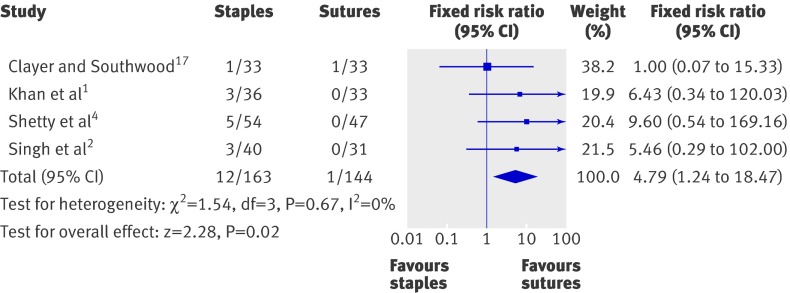
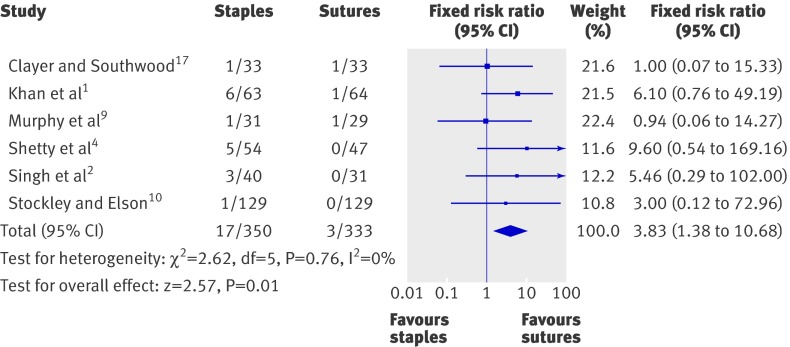
Six papers, which included 683 wounds, were identified; 332 patients underwent suture closure and 351 staple closure. The risk of developing a superficial wound infection after orthopaedic procedures was over three times greater after staple closure than suture closure (relative risk 3.83, 95% confidence interval 1.38 to 10.68; P=0.01). On subgroup analysis of hip surgery alone, the risk of developing a wound infection was four times greater after staple closure than suture closure (4.79, 1.24 to 18.47; P=0.02). There was no significant difference between sutures and staples in the development of inflammation, discharge, dehiscence, necrosis, and allergic reaction. The included studies had several major methodological limitations, including the recruitment of small, underpowered cohorts, poorly randomising patients, and not blinding assessors to the allocated methods of wound closure. Only one study had acceptable methodological quality.
After orthopaedic surgery, there is a significantly higher risk of developing a wound infection when the wound is closed with staples rather than sutures. This risk is specifically greater in patients who undergo hip surgery. The use of staples for closing hip or knee surgery wounds after orthopaedic procedures cannot be recommended, though the evidence comes from studies with substantial methodological limitations. Though we advise orthopaedic surgeons to reconsider their use of staples for wound closure, definitive randomised trials are still needed to assess this research question.

比较骨科手术后缝线与订书钉缝合伤口的临床效果。
荟萃分析。
检索了 Medline、CINAHL、AMED、Embase、Scopus 和 Cochrane 图书馆数据库,此外还检索了所有语言的灰色文献,时间跨度为 1950 年至 2009 年 9 月。从引用参考文献中还确定了其他研究。选择标准:两名作者独立评估文献的合格性。纳入的研究为随机和非随机对照试验,比较了骨科手术后用订书钉与缝线缝合伤口的效果。所有研究都被纳入,并且不因为方法学质量差而排除研究。
两名作者独立对研究进行方法学质量评估,并从每篇论文中提取数据。通过共识汇集最终用于分析的数据。主要结局指标为评估使用订书钉与缝线缝合伤口后伤口浅层感染的情况。用随机效应模型计算和汇总相对风险和均数差值及其 95%可信区间。用 I(2)和卡方检验评估异质性。
共发现 6 篇论文,涉及 683 个伤口,332 例患者接受缝线缝合,351 例患者接受订书钉缝合。与缝线相比,使用订书钉后骨科手术后伤口浅层感染的风险高出 3 倍以上(相对风险 3.83,95%可信区间 1.38 至 10.68;P=0.01)。在髋关节手术亚组分析中,与缝线相比,使用订书钉后伤口感染的风险高出 4 倍(4.79,1.24 至 18.47;P=0.02)。缝线与订书钉在炎症、分泌物、裂开、坏死和过敏反应的发生方面无显著差异。纳入的研究有几个主要的方法学局限性,包括招募的小样本、分组能力不足、未对患者进行随机分组,以及评估人员对伤口缝合方法未进行盲法评估。仅有 1 项研究具有可接受的方法学质量。
骨科手术后,使用订书钉缝合伤口比使用缝线缝合伤口发生伤口感染的风险显著增加。在接受髋关节手术的患者中,这种风险更大。不能推荐在骨科手术后使用订书钉缝合髋关节或膝关节手术伤口,尽管这些证据来自存在严重方法学局限性的研究。尽管我们建议骨科医生重新考虑使用订书钉缝合伤口,但仍需要进行确定随机试验来评估这个研究问题。