Unidad Mixta de Investigación en Genómica y Salud, Centro Superior de Investigación en Salud Pública (CSISP) y Universidad de Valencia (Instituto Cavanilles de Biodiversidad y Biología Evolutiva), 46020 Valencia, Spain.
BMC Microbiol. 2010 Mar 22;10:85. doi: 10.1186/1471-2180-10-85.
The increasing availability of gene sequences of prokaryotic species in samples extracted from all kind of locations allows addressing the study of the influence of environmental patterns in prokaryotic biodiversity. We present a comprehensive study to address the potential existence of environmental preferences of prokaryotic taxa and the commonness of the specialist and generalist strategies. We also assessed the most significant environmental factors shaping the environmental distribution of taxa.
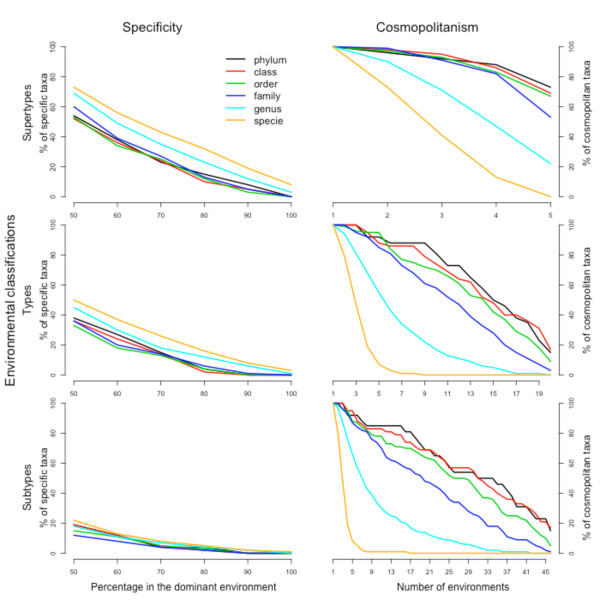
We used 16S rDNA sequences from 3,502 sampling experiments in natural and artificial sources. These sequences were taxonomically assigned, and the corresponding samples were also classified into a hierarchical classification of environments. We used several statistical methods to analyze the environmental distribution of taxa. Our results indicate that environmental specificity is not very common at the higher taxonomic levels (phylum to family), but emerges at lower taxonomic levels (genus and species). The most selective environmental characteristics are those of animal tissues and thermal locations. Salinity is another very important factor for constraining prokaryotic diversity. On the other hand, soil and freshwater habitats are the less restrictive environments, harboring the largest number of prokaryotic taxa. All information on taxa, samples and environments is provided at the envDB online database, http://metagenomics.uv.es/envDB.
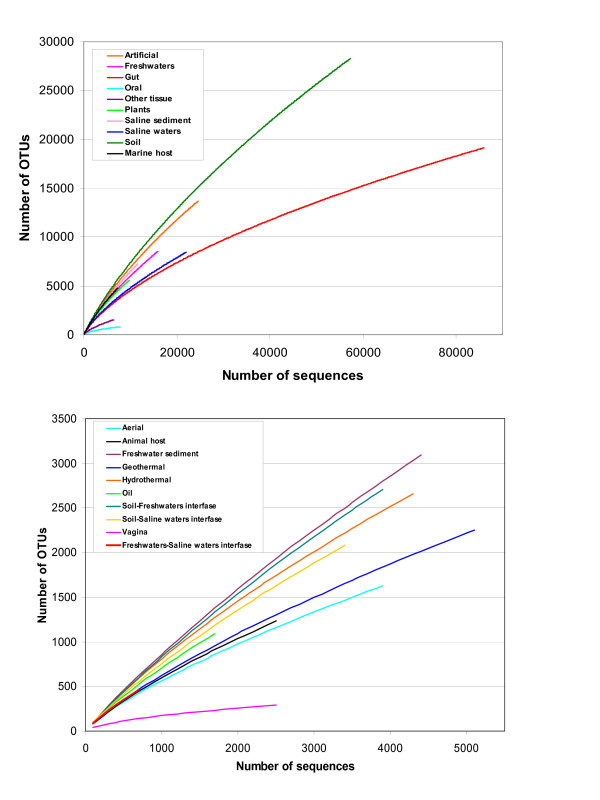
This is, as far as we know, the most comprehensive assessment of the distribution and diversity of prokaryotic taxa and their associations with different environments. Our data indicate that we are still far from characterizing prokaryotic diversity in any environment, except, perhaps, for human tissues such as the oral cavity and the vagina.
越来越多的从各种来源提取的样本中获得的原核物种的基因序列,使得人们能够研究环境模式对原核生物多样性的影响。我们进行了一项全面的研究,以探讨原核分类群是否存在环境偏好以及专门化和一般性策略的普遍性。我们还评估了塑造分类群环境分布的最重要环境因素。
我们使用了来自自然和人工来源的 3502 个采样实验的 16S rDNA 序列。这些序列被分类学分配,相应的样本也被分类为环境的分层分类。我们使用了几种统计方法来分析分类群的环境分布。我们的研究结果表明,在较高的分类水平(门到科)上,环境特异性并不常见,但在较低的分类水平(属和种)上则出现。最具选择性的环境特征是动物组织和热区。盐度是限制原核生物多样性的另一个非常重要的因素。另一方面,土壤和淡水生境是限制较小的环境,容纳了最多的原核生物分类群。有关分类群、样本和环境的所有信息都在在线数据库 envDB 中提供,网址为 http://metagenomics.uv.es/envDB。
据我们所知,这是对原核分类群的分布和多样性及其与不同环境的关联进行的最全面的评估。我们的数据表明,除了人类组织(如口腔和阴道)等环境外,我们仍远未能够描述任何环境中的原核生物多样性。