Aiewsakun Pakorn, Katzourakis Aris
Department of Zoology, University of Oxford, Oxford, United KingdomUniversity of Illinois at Chicago.
Department of Zoology, University of Oxford, Oxford, United KingdomUniversity of Illinois at Chicago
J Virol. 2016 Jul 27;90(16):7184-95. doi: 10.1128/JVI.00593-16. Print 2016 Aug 15.
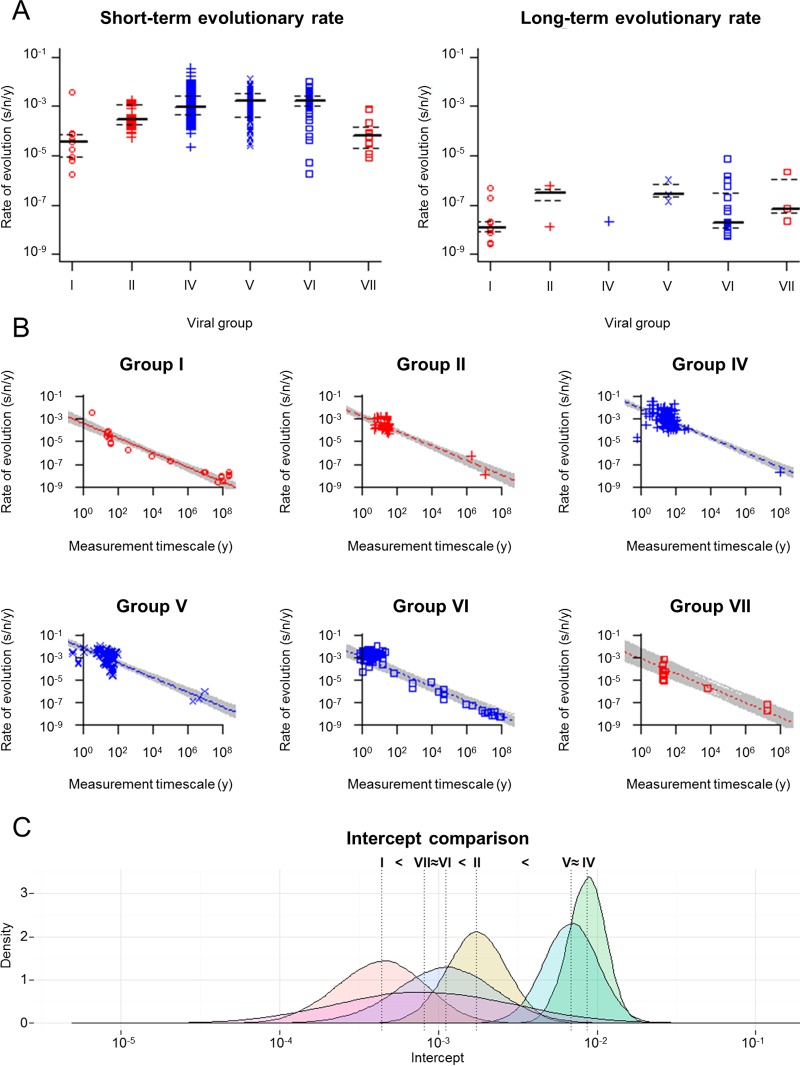
Among the most fundamental questions in viral evolutionary biology are how fast viruses evolve and how evolutionary rates differ among viruses and fluctuate through time. Traditionally, viruses are loosely classed into two groups: slow-evolving DNA viruses and fast-evolving RNA viruses. As viral evolutionary rate estimates become more available, it appears that the rates are negatively correlated with the measurement timescales and that the boundary between the rates of DNA and RNA viruses might not be as clear as previously thought. In this study, we collected 396 viral evolutionary rate estimates across almost all viral genome types and replication strategies, and we examined their rate dynamics. We showed that the time-dependent rate phenomenon exists across multiple levels of viral taxonomy, from the Baltimore classification viral groups to genera. We also showed that, by taking the rate decay dynamics into account, a clear division between the rates of DNA and RNA viruses as well as reverse-transcribing viruses could be recovered. Surprisingly, despite large differences in their biology, our analyses suggested that the rate decay speed is independent of viral types and thus might be useful for better estimation of the evolutionary time scale of any virus. To illustrate this, we used our model to reestimate the evolutionary timescales of extant lentiviruses, which were previously suggested to be very young by standard phylogenetic analyses. Our analyses suggested that these viruses are millions of years old, in agreement with paleovirological evidence, and therefore, for the first time, reconciled molecular analyses of ancient and extant viruses.
This work provides direct evidence that viral evolutionary rate estimates decay with their measurement timescales and that the rate decay speeds do not differ significantly among viruses despite the vast differences in their molecular features. After adjustment for the rate decay dynamics, the division between the rates of double-stranded DNA (dsDNA), single-stranded RNA (ssRNA), and ssDNA/reverse-transcribing viruses could be seen more clearly than before. Our results provide a guideline for further improvement of the molecular clock. As a demonstration of this, we used our model to reestimate the timescales of modern lentiviruses, which were previously thought to be very young, and concluded that they are millions of years old. This result matches the estimate from paleovirological analyses, thus bridging the gap between ancient and extant viral evolutionary studies.
病毒进化生物学中最基本的问题包括病毒进化的速度有多快,以及不同病毒的进化速率如何不同且随时间波动。传统上,病毒大致分为两类:进化缓慢的DNA病毒和进化快速的RNA病毒。随着病毒进化速率估计数据越来越多,似乎这些速率与测量时间尺度呈负相关,而且DNA病毒和RNA病毒的速率界限可能不像以前认为的那么清晰。在本研究中,我们收集了几乎所有病毒基因组类型和复制策略的396个病毒进化速率估计值,并研究了它们的速率动态。我们表明,从巴尔的摩分类病毒组到属,时间依赖性速率现象存在于病毒分类学的多个层面。我们还表明,考虑到速率衰减动态,可以恢复DNA病毒、RNA病毒以及逆转录病毒速率之间的清晰划分。令人惊讶的是,尽管它们的生物学特性有很大差异,但我们的分析表明速率衰减速度与病毒类型无关,因此可能有助于更好地估计任何病毒的进化时间尺度。为了说明这一点,我们使用我们的模型重新估计了现存慢病毒的进化时间尺度,标准系统发育分析此前认为这些病毒非常年轻。我们的分析表明这些病毒有数百万年的历史,这与古病毒学证据一致,因此首次调和了古代和现存病毒的分子分析。
这项工作提供了直接证据,表明病毒进化速率估计值随其测量时间尺度而衰减,并且尽管病毒的分子特征存在巨大差异,但速率衰减速度在病毒之间并没有显著差异。在调整速率衰减动态之后,双链DNA(dsDNA)、单链RNA(ssRNA)和单链DNA/逆转录病毒的速率划分比以前更清晰可见。我们的结果为进一步改进分子钟提供了指导方针。作为对此的一个证明,我们使用我们的模型重新估计了现代慢病毒的时间尺度,此前认为它们非常年轻,并得出它们有数百万年历史的结论。这一结果与古病毒学分析的估计相匹配,从而弥合了古代和现存病毒进化研究之间的差距。