Department of Trauma Surgery, VU University Medical Center, PO Box 7057, 1007 MB, Amsterdam, The Netherlands.
Clin Orthop Relat Res. 2010 Oct;468(10):2789-96. doi: 10.1007/s11999-010-1309-5. Epub 2010 Mar 23.
Biofilm-associated infections in trauma surgery are difficult to treat with conventional therapies. Therefore, it is important to develop new treatment modalities. Maggots in captured bags, which are permeable for larval excretions/secretions, aid in healing severe, infected wounds, suspect for biofilm formation. Therefore we presumed maggot excretions/secretions would reduce biofilm formation.
QUESTIONS/PURPOSES: We studied biofilm formation of Staphylococcus aureus, Staphylococcus epidermidis, Klebsiella oxytoca, Enterococcus faecalis, and Enterobacter cloacae on polyethylene, titanium, and stainless steel. We compared the quantities of biofilm formation between the bacterial species on the various biomaterials and the quantity of biofilm formation after various incubation times. Maggot excretions/secretions were added to existing biofilms to examine their effect.
Comb-like models of the biomaterials, made to fit in a 96-well microtiter plate, were incubated with bacterial suspension. The formed biofilms were stained in crystal violet, which was eluted in ethanol. The optical density (at 595 nm) of the eluate was determined to quantify biofilm formation. Maggot excretions/secretions were pipetted in different concentrations to (nonstained) 7-day-old biofilms, incubated 24 hours, and finally measured.
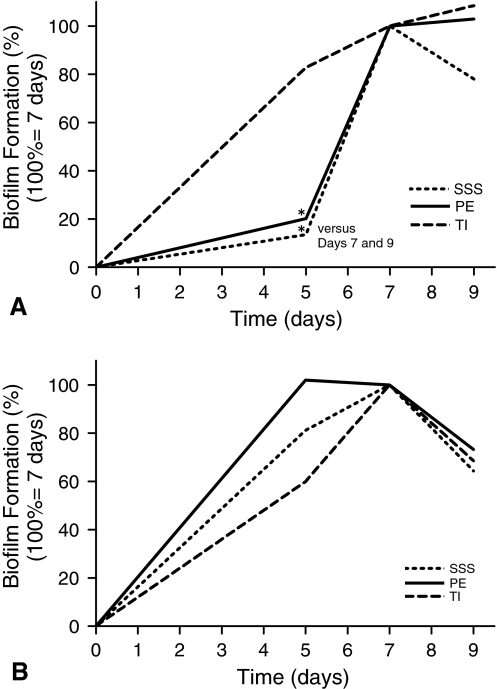
The strongest biofilms were formed by S. aureus and S. epidermidis on polyethylene and the weakest on titanium. The highest quantity of biofilm formation was reached within 7 days for both bacteria. The presence of excretions/secretions reduced biofilm formation on all biomaterials. A maximum of 92% of biofilm reduction was measured.
Our observations suggest maggot excretions/secretions decrease biofilm formation and could provide a new treatment for biofilm formation on infected biomaterials.
创伤外科中生物膜相关感染很难用传统疗法治疗。因此,开发新的治疗方法很重要。被幼虫分泌物渗透的捕获袋中的蛆有助于治愈严重感染的伤口,这些伤口可能存在生物膜形成。因此,我们推测蛆的分泌物会减少生物膜的形成。
问题/目的:我们研究了金黄色葡萄球菌、表皮葡萄球菌、产酸克雷伯菌、粪肠球菌和阴沟肠杆菌在聚乙烯、钛和不锈钢上的生物膜形成。我们比较了不同生物材料上不同细菌种类的生物膜形成量和不同孵育时间后的生物膜形成量。我们将蛆的分泌物添加到现有的生物膜中,以观察其效果。
将生物材料的梳状模型制成适合 96 孔微量滴定板的形状,然后用细菌悬浮液孵育。用结晶紫染色形成的生物膜,然后用乙醇洗脱。洗脱液的吸光度(在 595nm 处)用于定量生物膜的形成。将不同浓度的分泌物用移液管吸出到(未染色的)7 天龄生物膜中,孵育 24 小时,最后进行测量。
金黄色葡萄球菌和表皮葡萄球菌在聚乙烯上形成的生物膜最强,在钛上最弱。两种细菌的生物膜形成量在 7 天内达到最高。分泌物的存在减少了所有生物材料上的生物膜形成。生物膜减少了 92%。
我们的观察表明,蛆的分泌物减少了生物膜的形成,并为感染生物材料上的生物膜形成提供了新的治疗方法。