Department of Psychology, University of Alabama at Birmingham, Birmingham, AL 35294-1200, USA.
J Child Psychol Psychiatry. 2010 Aug;51(8):953-61. doi: 10.1111/j.1469-7610.2010.02222.x. Epub 2010 Mar 10.
Violence exposure within each setting of community, school, or home has been linked with internalizing and externalizing problems. Although many children experience violence in multiple contexts, the effects of such cross-contextual exposure have not been studied. This study addresses this gap by examining independent and interactive effects of witnessing violence and victimization in the community, home, and school on subsequent internalizing and externalizing problems in early adolescence.
A community sample of 603 boys and girls (78% African American, 20% Caucasian) participated in a longitudinal study of youth violence. During two assessments 16 months apart, adolescents reported on witnessing violence and victimization in the community, school, and home, and their internalizing and externalizing problems.
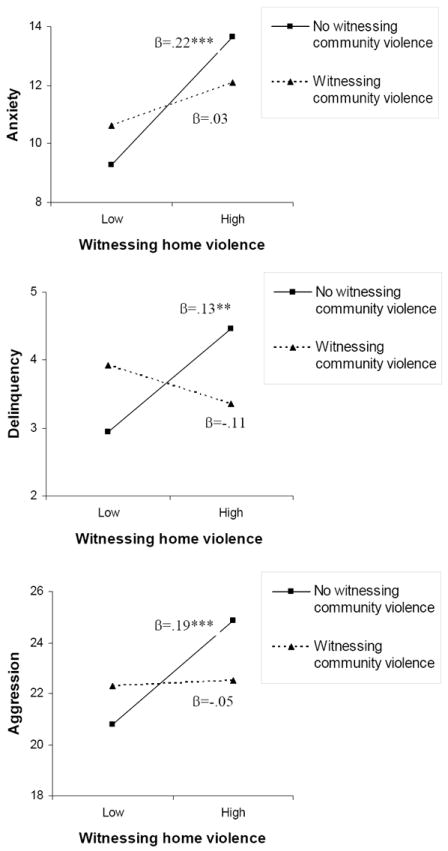
Multiple regressions tested the independent and interactive effects of witnessing violence or victimization across contexts on subsequent adjustment, after controlling for initial levels of internalizing and externalizing problems and demographic covariates. Witnessing violence at school predicted anxiety and depression; witnessing at home was related to anxiety and aggression; and witnessing community violence predicted delinquency. Victimization at home was related to subsequent anxiety, depression, and aggression; victimization at school predicted anxiety; and victimization in the community was not independently related to any outcomes. Finally, witnessing violence at home was associated with more anxiety, delinquency, and aggression only if adolescents reported no exposure to community violence.
Violence exposure at home and school had the strongest independent effects on internalizing and externalizing outcomes. Witnessing community violence attenuated the effects of witnessing home violence on anxiety and externalizing problems, perhaps due to desensitization or different norms or expectations regarding violence. However, no comparable attenuation effects were observed for victimization across contexts.
社区、学校或家庭环境中的暴力暴露与内化和外化问题有关。尽管许多儿童在多个环境中经历过暴力,但这种跨环境暴露的影响尚未得到研究。本研究通过检查在社区、家庭和学校目睹暴力和受害在青少年早期对随后的内化和外化问题的独立和交互影响,解决了这一差距。
一项针对青年暴力的纵向社区样本,共有 603 名男孩和女孩(78%为非裔美国人,20%为白种人)参与了该研究。在相隔 16 个月的两次评估中,青少年报告了在社区、学校和家庭中目睹的暴力和受害情况,以及他们的内化和外化问题。
多元回归检验了跨环境目睹暴力或受害对随后调整的独立和交互影响,控制了初始内化和外化问题水平以及人口统计学协变量。在学校目睹暴力与焦虑和抑郁有关;在家中目睹暴力与焦虑和攻击有关;社区目睹暴力与犯罪有关。在家中受害与随后的焦虑、抑郁和攻击有关;在学校受害与焦虑有关;在社区受害与任何结果无关。最后,只有当青少年没有报告社区暴力暴露时,在家中目睹暴力才与更多的焦虑、犯罪和攻击有关。
家庭和学校的暴力暴露对内化和外化结果有最强的独立影响。目睹社区暴力减弱了在家中目睹暴力对焦虑和外化问题的影响,这可能是由于脱敏或对暴力有不同的规范或期望。然而,在跨环境的受害方面,没有观察到类似的衰减效应。