Newman-Norlund Roger D, Ondobaka Sasha, van Schie Hein T, van Elswijk Gijs, Bekkering Harold
Department of Exercise Science, University of South Carolina Columbia, SC, USA.
Front Behav Neurosci. 2010 Mar 3;4:5. doi: 10.3389/neuro.08.005.2010. eCollection 2010.
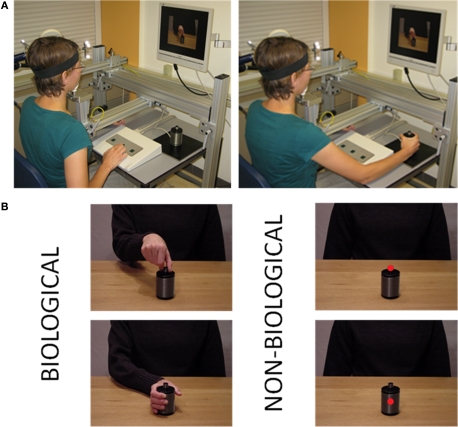
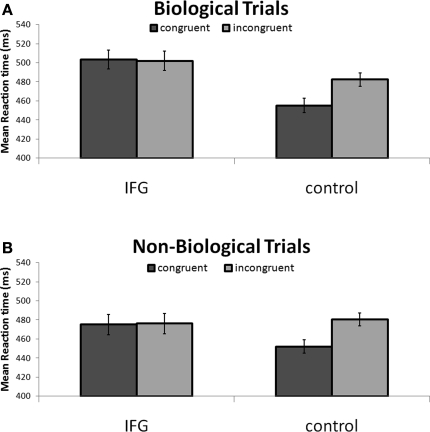
Humans are faster to perform a given action following observation of that same action. Converging evidence suggests that the human mirror neuron system (MNS) plays an important role in this phenomenon. However, the specificity of the neural mechanisms governing this effect remain controversial. Specialist theories of imitation suggest that biological cues are maximally capable of eliciting imitative facilitation. Generalist models, on the other hand, posit a broader role for the MNS in linking visual stimuli with appropriate responses. In the present study, we investigated the validity of these two theoretical approaches by disrupting the left and right inferior frontal gyrus (IFG) during the preparation of congruent (imitative) and incongruent (complementary) actions cued by either biological (hand) or non-biological (static dot) stimuli. Delivery of TMS over IFG abolished imitative response facilitation. Critically, this effect was identical whether actions were cued by biological or non-biological stimuli. This finding argues against theories of imitation in which biological stimuli are treated preferentially and stresses the notion of the IFG as a vital center of general perception-action coupling in the human brain.
在观察到相同动作后,人类执行给定动作的速度会更快。越来越多的证据表明,人类镜像神经元系统(MNS)在这一现象中起着重要作用。然而,支配这种效应的神经机制的特异性仍存在争议。模仿的专门理论认为,生物线索最能引发模仿促进作用。另一方面,通用模型则假定MNS在将视觉刺激与适当反应联系起来方面具有更广泛的作用。在本研究中,我们通过在由生物(手部)或非生物(静态点)刺激提示的一致(模仿)和不一致(互补)动作准备过程中干扰左右额下回(IFG),研究了这两种理论方法的有效性。在IFG上施加经颅磁刺激(TMS)消除了模仿反应促进作用。至关重要的是,无论动作是由生物刺激还是非生物刺激提示的,这种效应都是相同的。这一发现反对了优先处理生物刺激的模仿理论,并强调了IFG作为人类大脑中一般感知 - 动作耦合的重要中心的概念。