The Procter & Gamble Company, Cincinnati, OH 45241-9974, USA.
Br J Dermatol. 2010 Mar;162(3):647-54. doi: 10.1111/j.1365-2133.2009.09436.x.
Tretinoin is considered the benchmark prescription topical therapy for improving fine facial wrinkles, but skin tolerance issues can affect patient compliance. In contrast, cosmetic antiwrinkle products are well tolerated but are generally presumed to be less efficacious than tretinoin.
To compare the efficacy of a cosmetic moisturizer regimen vs. a prescription regimen with 0.02% tretinoin for improving the appearance of facial wrinkles.
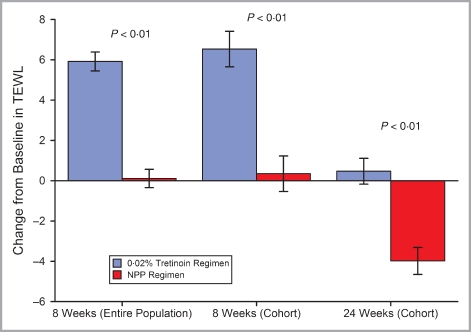
An 8-week, randomized, parallel-group study was conducted in 196 women with moderate to moderately severe periorbital wrinkles. Following 2 weeks washout, subjects on the cosmetic regimen (n = 99) used a sun protection factor (SPF) 30 moisturizing lotion containing 5% niacinamide, peptides and antioxidants, a moisturizing cream containing niacinamide and peptides, and a targeted wrinkle product containing niacinamide, peptides and 0.3% retinyl propionate. Subjects on the prescription regimen (n = 97) used 0.02% tretinoin plus moisturizing SPF 30 sunscreen. Subject cohorts (n = 25) continued treatment for an additional 16 weeks. Changes in facial wrinkling were assessed by both expert grading and image analysis of digital images of subjects' faces and by self-assessment questionnaire. Product tolerance was assessed via clinical erythema and dryness grading, subject self-assessment, and determinations of skin barrier integrity (transepidermal water loss) and stratum corneum protein changes.
The cosmetic regimen significantly improved wrinkle appearance after 8 weeks relative to tretinoin, with comparable benefits after 24 weeks. The cosmetic regimen was significantly better tolerated than tretinoin through 8 weeks by all measures.
An appropriately designed cosmetic regimen can improve facial wrinkle appearance comparably with the benchmark prescription treatment, with improved tolerability.
维 A 酸被认为是改善细小面部皱纹的基准处方局部治疗药物,但皮肤耐受性问题会影响患者的依从性。相比之下,美容抗皱产品的耐受性较好,但通常被认为不如维 A 酸有效。
比较美容保湿方案与含有 0.02%维 A 酸的处方方案改善面部皱纹外观的疗效。
一项为期 8 周、随机、平行组研究纳入了 196 名眶周皱纹中度至重度的女性。经过 2 周洗脱期后,使用美容方案的受试者(n = 99)使用含有 5%烟酰胺、肽和抗氧化剂的防晒因子(SPF)30 保湿乳液、含有烟酰胺和肽的保湿霜以及含有烟酰胺、肽和 0.3%视黄醇丙酸酯的靶向皱纹产品。使用 0.02%维 A 酸加保湿 SPF 30 防晒霜的处方方案受试者(n = 97)。两组受试者中有 25 名继续接受额外 16 周的治疗。通过专家分级以及受试者面部数字图像的图像分析和自我评估问卷评估面部皱纹的变化。通过临床红斑和干燥分级、受试者自我评估以及评估皮肤屏障完整性(经皮水分丢失)和角质层蛋白变化来评估产品耐受性。
美容方案在 8 周时与维 A 酸相比显著改善了皱纹外观,在 24 周时效果相当。通过所有评估指标,美容方案在 8 周时的耐受性明显优于维 A 酸。
设计合理的美容方案可改善面部皱纹外观,与基准处方治疗相当,且具有更好的耐受性。