URMITE, UMR IRD 198/CNRS 6236, Mediterranean University, Medical Faculty, Marseille, France.
PLoS Negl Trop Dis. 2010 Apr 6;4(4):e654. doi: 10.1371/journal.pntd.0000654.
Q fever is a worldwide zoonotic disease caused by Coxiella burnetii. Epidemiologically, animals are considered reservoirs and humans incidental hosts.
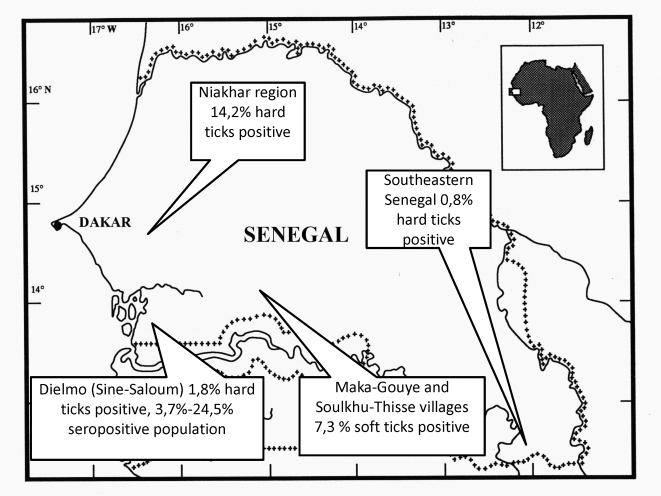
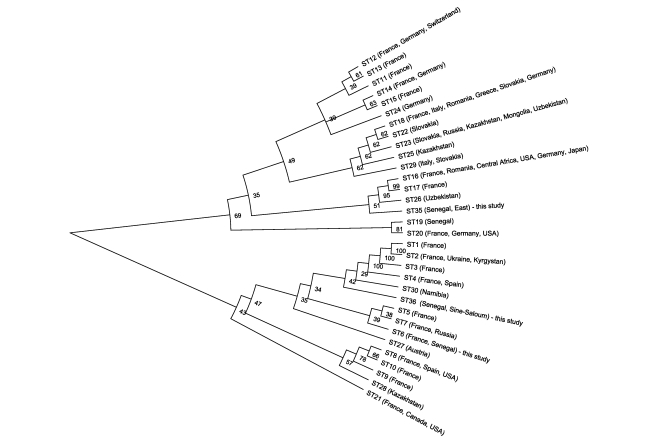
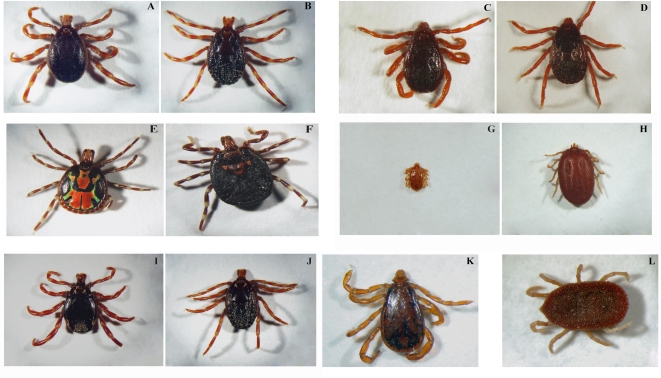
METHODOLOGY/PRINCIPAL FINDINGS: We investigated Q fever in rural Senegal. Human samples (e.g., sera, saliva, breast milk, feces) were screened in the generally healthy population of two villages of the Sine-Saloum region. Ticks were collected in four regions. Seroprevalence was studied by immunofluorescence, and all other samples were tested by two qPCR systems for detection of C. burnetii. Positive samples were genotyped (multispacer typing) by amplification and sequencing of three spacers. Strains were isolated by cell culture. We found that the seroprevalence may be as high as 24.5% (59 of 238 studied) in Dielmo village. We identified spontaneous excretion of C. burnetii by humans through faeces and milk. Hard and soft ticks (8 species) were infected in 0-37.6%. We identified three genotypes of C. burnetii. The previously identified genotype 6 was the most common in ticks in all studied regions and the only one found in human samples. Three strains of genotype 6 of C. burnetii were also recovered from soft tick Ornithodoros sonrai. Two other genotypes found in ticks, 35 and 36, were identified for the first time.
CONCLUSIONS/SIGNIFICANCE: Q fever should be considered a significant public health threat in Senegal. Humans, similar to other mammals, may continuously excrete C. burnetii.
Q 热是一种由贝氏柯克斯体引起的全球性人畜共患病。从流行病学角度来看,动物被认为是储存宿主,而人类则是偶然宿主。
方法/主要发现:我们在塞内加尔农村地区调查了 Q 热。在锡内-索罗地区的两个村庄的一般健康人群中,筛选了人类样本(如血清、唾液、母乳、粪便)。在四个地区收集了蜱。通过免疫荧光法研究了血清流行率,并用两种 qPCR 系统检测所有其他样本中是否存在 C. burnetii。阳性样本通过扩增和测序三个间隔区进行基因分型(多位点分型)。通过细胞培养分离菌株。我们发现,在迪尔莫村,血清流行率可能高达 24.5%(238 名研究对象中有 59 名)。我们发现人类会通过粪便和母乳自发排出 C. burnetii。硬蜱和软蜱(8 种)的感染率为 0-37.6%。我们鉴定出了三种 C. burnetii 基因型。之前鉴定出的基因型 6 在所有研究地区的蜱中最为常见,也是在人类样本中唯一发现的一种。还从软蜱 Ornithodoros sonrai 中分离出了 6 种基因型的 3 株 C. burnetii 菌株。在蜱中还首次发现了另外两种基因型 35 和 36。
结论/意义:Q 热应被视为塞内加尔的重大公共卫生威胁。与其他哺乳动物类似,人类可能会持续排出 C. burnetii。